Algeria
 Egypt
 Libya
 Morocco
 Sudan
 Tunisia
 Benin
 Burkina Faso
 Cabo Verde
 Côte d'Ivoire
 Guinea
 Guinea-Bissau
 Liberia
 Mali
 Mauritania
 Niger
 Nigeria
 Senegal
 Sierra Leone
 The Gambia
 Togo
 Cameroon
 Central African Republic
 Chad
 DR Congo
 Equatorial Guinea
 Gabon
 Republic of the Congo
 São Tomé and Príncipe
 Burundi
 Comoros
 Djibouti
 Eritrea
 Ethiopia
 Kenya
 Madagascar
 Malawi
 Mauritius
 Mozambique
 Rwanda
 Seychelles
 Somalia
 South Sudan
 Tanzania
 Uganda
 Angola
 Botswana
 Eswatini
 Lesotho
 Namibia
 South Africa
 Zambia
 Zimbabwe
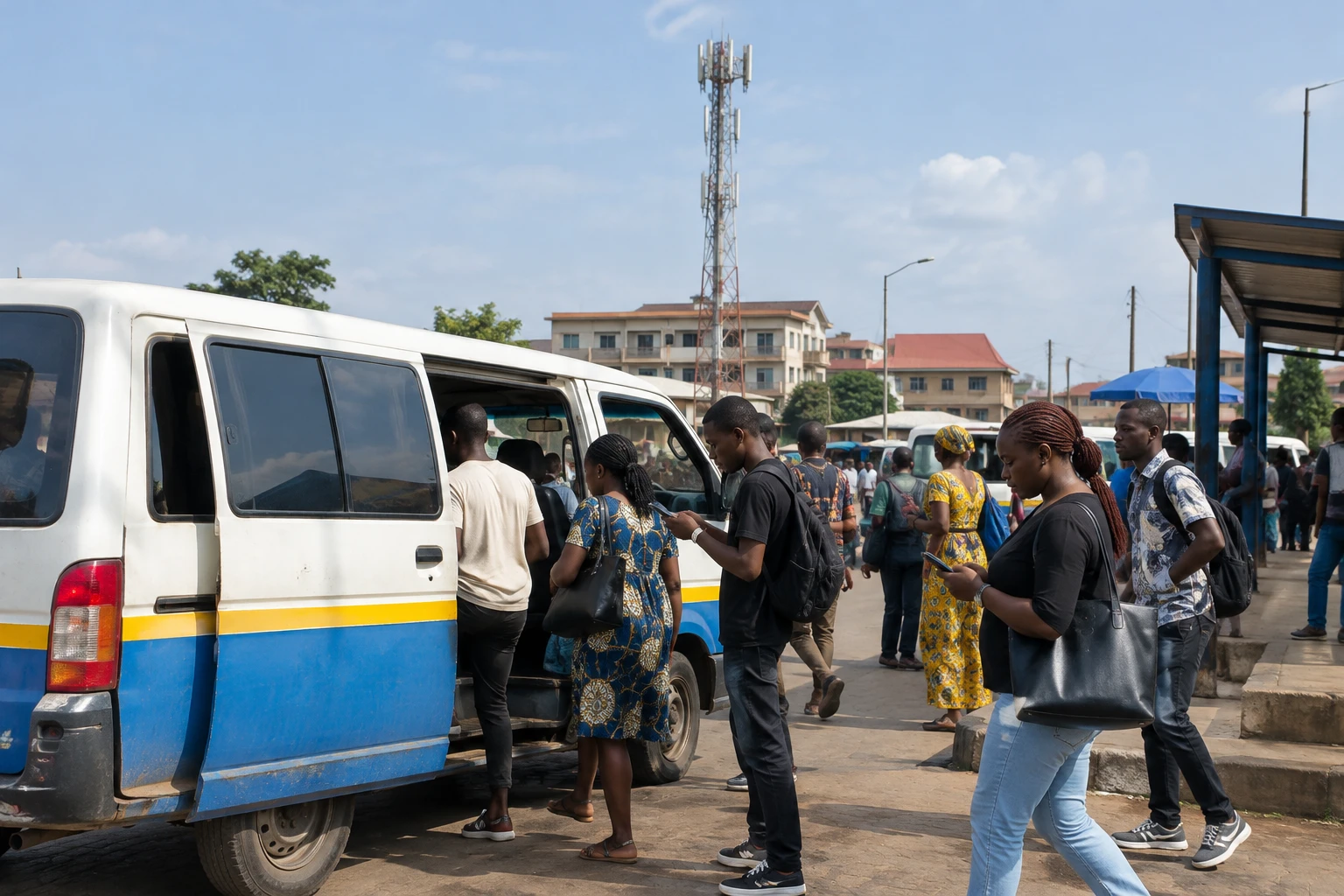
An installed mobile site does not necessarily mean a new connection is available. In Ghana, the challenge of extending mobile coverage lies as much in building sites as in powering and protecting them, and ensuring they are brought into service.
The government wants to add equipment and strengthen existing infrastructure. But fibre cuts and project delays are a reminder that announced coverage alone does not guarantee reliable service for residents.
Extending the network beyond major cities
Ghana plans to build 800 new telecoms sites and upgrade 2,000 nationwide. Communications, Digital Technology and Innovation Minister Samuel Nartey George announced the programme on 16 October 2026 during a visit to the Volta Region. The project is aimed in particular at areas where network access remains inadequate.
The ambition is part of a broader digital transformation drive. The country is developing its infrastructure and pursuing rural telephony projects, while the National Communications Authority (NCA), the sector regulator, oversees operators and services. For remote communities, the stakes are tangible: being able to make calls, access the internet or use digital services without relying on patchy coverage.
Usage data should nevertheless be treated with caution. Available estimates do not all give the same proportion of people who are offline. The International Telecommunication Union estimates that about 72% of Ghana’s population used the internet in 2024, meaning nearly 28% did not. This figure alone does not measure connection quality or cost.
Infrastructure exposed to outages
Fibre-optic cables connect mobile sites to the rest of the network. When a cable is damaged, several sites can lose some of their services, even if their radio equipment is still working. Roadworks and some mining activities are cited among the causes of these breaks.
On 7 September 2026, Samuel Nartey George reported that 8,578 fibre cuts had been recorded since the start of the year, according to the Ghana News Agency, the national news agency. Later in September, MyJoyOnline also reported simultaneous cuts on several fibre routes serving the north of the country and part of the Oti Region. These incidents show that network resilience also depends on co-ordination between telecoms companies, road authorities and other parties working on the ground.
Equipment at remote sites is also vulnerable. In November 2025, a regional official with the Ghana Investment Fund for Electronic Communications (GIFEC), a public body tasked with supporting access to electronic communications, reported battery thefts and damage to solar panels in the Upper East Region. The incidents, reported by Asaase Radio, illustrate the operational risk to facilities that supply communities sometimes reliant on a limited number of sites.
The cost of energy and maintenance
A site must remain powered to provide continuous service. Yet some rural communities do not have a reliable electricity connection. Operators and infrastructure managers must then rely on batteries, solar panels or generators. Diesel adds fuel, transport and maintenance costs, particularly where roads are difficult to access.
Across Africa, the GSMA, an industry association for the mobile sector, estimates that generating electricity for a site with a diesel generator generally costs three to four times as much as drawing power from the grid. Solar or hybrid systems can therefore reduce some costs and limit reliance on fuel. They must, however, be protected against theft and maintained to remain operational.
Bad weather and power cuts can also undermine services. In September, the minister cited power failures and flooding among the factors disrupting networks. For residents, the consequences can go beyond calls: an unstable connection also makes it harder to access mobile payments, government services and commercial activities that use the internet.
The number of sites is not enough
The Rural Telephony Project (RTP) highlights the potential gap between works declared complete and actual operation. Of the 2,016 sites planned, more than 1,600 were reported as built by mid-October 2026. Only about 1,400 were carrying traffic at the time, according to statements by the minister reported by MyJoyOnline and WoezorTV.
Samuel Nartey George gave the contractor 30 days to complete the remaining work, threatening penalties in the event of delays. Monitoring will therefore need to distinguish between sites that have been built, those that have a power supply and those that are actually providing service. This final step determines whether a community is truly connected.
Setting up new sites can also take time because of access to land, permits and consultations with the communities concerned. Technical teams must then be able to reach the facilities to repair faults. These constraints affect operators’ costs and the speed of repairs, particularly outside major urban centres such as Accra.
A Ghanaian concern, a West African challenge
For Ghana, a member of the Economic Community of West African States (ECOWAS), network expansion is tied both to digital inclusion and infrastructure reliability. Link failures in the north are also a reminder that continuity of communications depends on networks able to withstand incidents and on rapid repairs.
The programme’s success will therefore be measured less by the number of announced sites than by their availability, signal quality and service consistency in remote areas. The next steps to watch are the commissioning of RTP sites, compliance with the deadline given to the contractor, and the protection of cables and equipment. For users, the promise of wider coverage will only be meaningful when the connection works reliably over time.