
 Algeria
 Egypt
 Libya
 Morocco
 Sudan
 Tunisia
 Benin
 Burkina Faso
 Cabo Verde
 Ghana
 Guinea
 Guinea-Bissau
 Liberia
 Mali
 Mauritania
 Niger
 Nigeria
 Senegal
 Sierra Leone
 The Gambia
 Togo
 Cameroon
 Central African Republic
 Chad
 DR Congo
 Equatorial Guinea
 Gabon
 Republic of the Congo
 São Tomé and Príncipe
 Burundi
 Comoros
 Djibouti
 Eritrea
 Ethiopia
 Kenya
 Madagascar
 Malawi
 Mauritius
 Mozambique
 Rwanda
 Seychelles
 Somalia
 South Sudan
 Tanzania
 Uganda
 Angola
 Botswana
 Eswatini
 Lesotho
 Namibia
 South Africa
 Zambia
 Zimbabwe
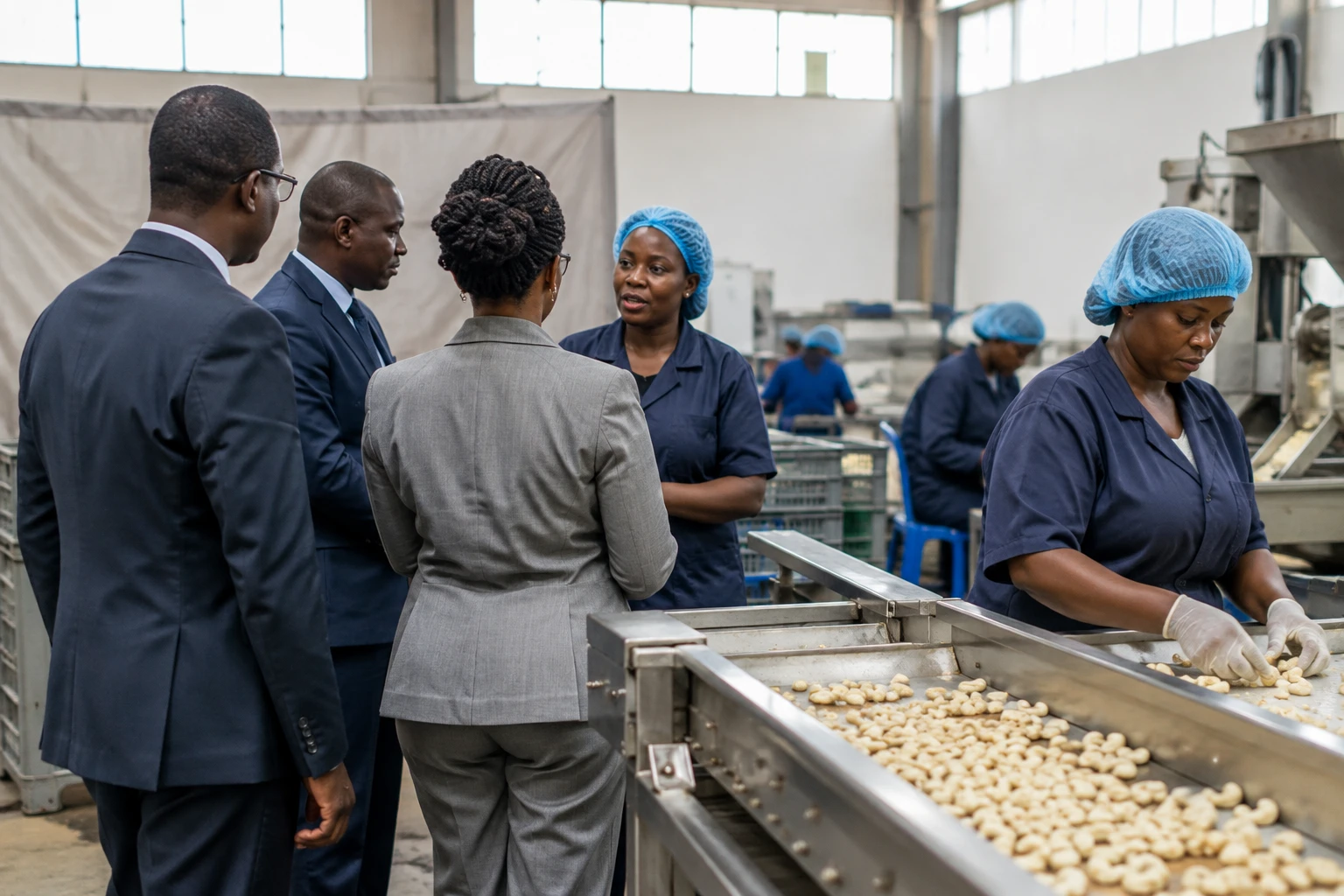
In Ghana, processing more cashew nuts could create industrial activity in producing regions and retain a greater share of value locally. But announcing new plants is not enough: existing facilities are still operating well below capacity, notably because of a lack of finance and regular supplies.
A West African industry with strong regional flows
Ghana is one of West Africa’s cashew-producing countries. The crop is particularly prevalent in the Bono, Bono East and Ahafo regions. The industry links rural farms with traders, ports and processing markets, particularly in Asia. Some of the nuts shipped through Ghana also come from neighbouring countries: export volumes therefore do not correspond solely to the national harvest.
This regional dimension matters in an area where Côte d’Ivoire, Burkina Faso and Mali are also producers. Ecowas, the West African economic integration organisation, seeks to facilitate trade between its members. For Ghanaian processors, these flows can broaden sourcing options, but they also fuel competition between exports of raw nuts and local processing.
Available data chiefly show a gap between facilities and their use. A Nitidae study, cited by the International Cashew Council, estimates that about 15,000 tonnes of raw nuts were processed in Ghana in 2025, out of an estimated national production of 262,000 tonnes. Installed capacity is thought to be close to 65,000 tonnes a year. In other words, less than a quarter of that capacity may have been used. Data on the gap between production and processing in Ghana shed light on the scale of the challenge.
Three projects, with differing timelines
In Techiman, in the Bono East Region, Nadkansco Processing Limited is due to commission a plant financed by the Ghana Export-Import Bank, or GEXIM, the state-owned bank that finances exports and investment. According to GEXIM, the facility is designed to process up to 100 tonnes of raw nuts a day. At 300 operating days, that would represent a theoretical capacity of 30,000 tonnes a year. The bank has also cited around 450 direct jobs and 1,500 jobs in total, including expected indirect effects. These figures are forecasts, not a record of jobs already created. GEXIM sets out the timeline and planned capacity in Techiman.
The inauguration is scheduled for 16 November 2026, by President John Dramani Mahama. As of the publication date, it is therefore still to come. The project’s total cost has not been made public. The plant could substantially increase the volumes processed in the country, but its actual contribution will depend on its launch, operating rate and ability to secure the nuts it needs.
Two other partnerships are in the pipeline. In February 2026, the Ministry of Agriculture signed a memorandum of understanding with B5 Plus Limited, a company best known for its steel industry activities. The project envisages the company financing, building, equipping and operating a large processing plant. The agreement also refers to sourcing arrangements with producers, including grading nuts and making prompt payments. Capacity and the commissioning timetable have not been specified. The African Cashew Alliance outlines the terms of the agreement with B5 Plus.
In April, the ministry concluded three memorandums of understanding with the SENTUO Group. One concerns a plant in Sampa, in the Bono Region, intended to process cashew nuts and apples, the fleshy fruit that surrounds the nut. The government says preliminary works have begun. Capacity, investment amount and opening date are not known. The information was published by Ghana’s Government Information Services Department, which also says the group plans other agricultural projects. The statement on the agreements between the ministry and SENTUO distinguishes announced projects from capacities yet to be confirmed.
The decisive link: keeping plants running
The projects reflect a broader policy direction: developing the processing of perennial crops, including cashew, shea and rubber, rather than exporting them mainly in raw form. At Ghana’s Tree Crops Investment Summit in February 2026, John Dramani Mahama cited a target of processing 50 to 60 per cent of these crops locally. He did not set a target specifically for cashew. The announced objective therefore remains general and does not, by itself, constitute a verifiable sectoral obligation.
For farmers, more local buyers could widen market opportunities and support demand during harvests. But the benefit is not automatic. It will depend on the prices offered, the regularity of purchases and payment times. Producers’ incomes will rise sustainably only if contracts and sourcing arrangements guarantee them predictable terms.
Industrial operators, meanwhile, must contend with the cost of credit, working-capital needs, access to equipment and the reliability of electricity. They also face competition from traders who buy raw nuts for export. Without suitable finance and stable supplies, a new plant risks joining facilities that are already underused. In September 2026, the Ghana Cashew Processors Association called for long-term financing, more reliable electricity and a better co-ordinated national policy. A sector meeting in Accra organised by the Ghana Cashew Board also addressed the industry’s competitiveness. Discussions among Ghanaian stakeholders on processing constraints confirm that the challenge goes beyond building new plants.
A test for regional industrialisation
Local processing can create industrial jobs, transport activity and opportunities for equipment suppliers. It can also increase the value of Ghanaian exports. These effects will depend, however, on the share actually processed in the country and on companies’ ability to operate throughout the year. The jobs announced in Techiman will in particular need to be measured against actual recruitment and working conditions once the plant is operational.
Across West Africa, the challenge is also to better co-ordinate production, cross-border trade and processing. Ghana is an Ecowas member, but raw materials and buyers do not stop at national borders. The next steps to watch are therefore concrete: the planned opening of the Techiman plant on 16 November 2026, publication of the capacities and timelines for the B5 Plus and SENTUO projects, and then the actual utilisation rate of the facilities. It is this measure, more than the number of announcements, that will determine whether agricultural production becomes a sustainable local industry.



