Algeria
 Egypt
 Libya
 Morocco
 Sudan
 Tunisia
 Benin
 Burkina Faso
 Cabo Verde
 Ghana
 Guinea
 Guinea-Bissau
 Liberia
 Mali
 Mauritania
 Niger
 Nigeria
 Senegal
 Sierra Leone
 The Gambia
 Togo
 Cameroon
 Central African Republic
 Chad
 DR Congo
 Equatorial Guinea
 Gabon
 Republic of the Congo
 São Tomé and Príncipe
 Burundi
 Comoros
 Djibouti
 Eritrea
 Ethiopia
 Kenya
 Madagascar
 Malawi
 Mauritius
 Mozambique
 Rwanda
 Seychelles
 Somalia
 South Sudan
 Tanzania
 Uganda
 Angola
 Botswana
 Eswatini
 Lesotho
 Namibia
 South Africa
 Zambia
 Zimbabwe
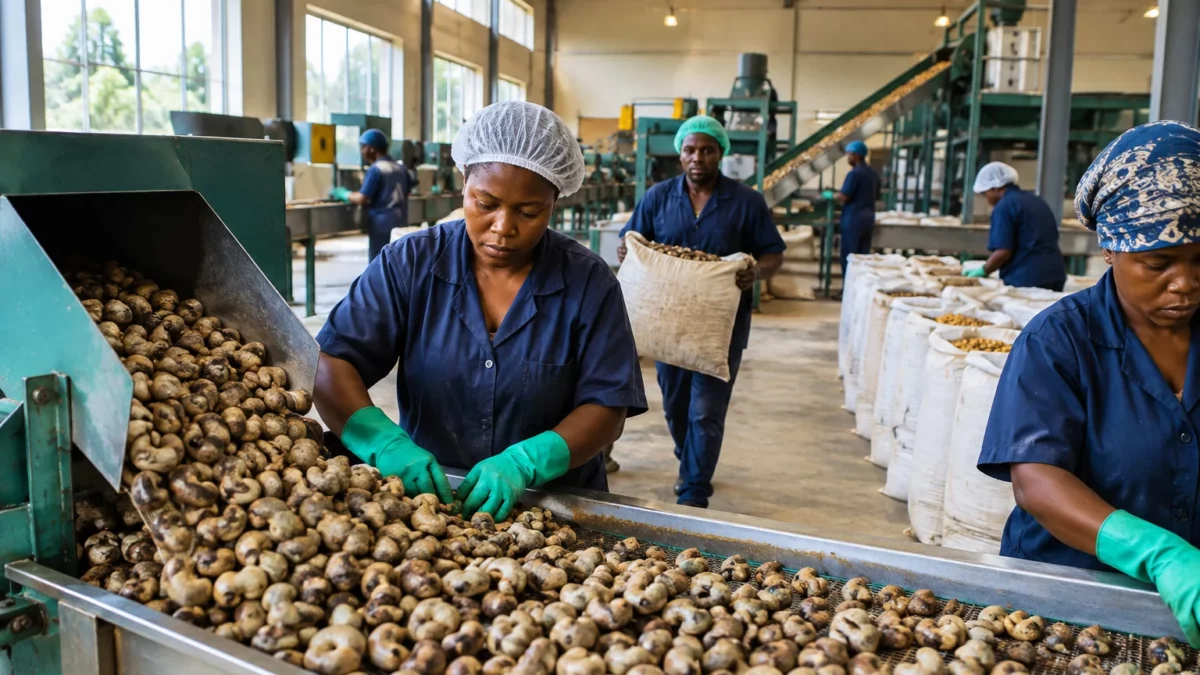
Producing more cashew nuts does not guarantee that their value stays in the country. In Ghana, factories have far more processing capacity than the volumes they handle. The government therefore wants to secure their supplies while seeking to protect producers’ incomes.
A plan to supply Ghanaian factories
In Techiman, in the Bono East Region, President John Dramani Mahama announced two measures still under consideration on 16 November 2026. The first would reserve the first three months of each season for local processors. Exports of raw nuts would be allowed only afterwards, for the remaining volumes.
The head of state also raised the possibility of a tax on exports of unprocessed nuts. According to the Ghanaian Government Information Service, the proceeds would go into a fund to help industrial processors buy their raw material. The measure has not yet been presented as a policy that has taken effect. Its terms, timetable and impact on prices remain to be clarified. The announcement was reported by the Egyptian media outlet Ahram Online, which cited remarks made at the inauguration of the Nadkansco Processing Limited factory.
The announcement comes as Ghana seeks to expand the processing of its agricultural produce at home. Cashew nuts, grown in several regions of the country, are largely sold raw. Processors, meanwhile, need a regular supply to keep their equipment running and recoup their investments.
An industry still far from its potential
Available figures illustrate the gap between production, capacity and actual activity. A study by Nitidae, cited by the African Cashew Alliance, estimates Ghanaian production in 2025 at about 262 000 tonnes. Local plants are estimated to have processed nearly 15 000 tonnes. Their installed capacity is said to be about 65 000 tonnes a year. These figures indicate that the problem is not just the number of factories: existing plants also lack the nuts and resources needed to operate at full capacity.
Ghanaian processors cite several obstacles. Financing equipment and working capital is expensive. Electricity costs also weigh on factories. In September 2026, the Ghana Cashew Processors Association called for longer-term financing, better access to credit and a more reliable electricity supply. The recommendations, published after an industry meeting, underline that reserving nuts for factories is not enough if they cannot afford to buy or process them.
The issue also affects producers. Restricting exports may increase the supply available to processors, but the effect on farm-gate prices will depend on purchasing rules and competition among buyers. If processors have little cash, they may not take up the available volumes. Conversely, better-organised local demand could create more regular outlets. The consequences will therefore depend on implementation, not just on the announcement.
The Ivorian model is useful, but not automatic
The Ghanaian government says it is drawing inspiration from Côte d’Ivoire, the world’s leading cashew producer. At the start of the season, Abidjan reserves a period for local processors to buy nuts before allowing exporters to source them. The country also taxes exports of raw nuts, while locally processed kernels receive different treatment.
Côte d’Ivoire’s industrial results are notable. The Groupement des industriels du cajou de Côte d’Ivoire puts the volume of nuts processed locally in 2025 at 659 579 tonnes, or about 43 % of national production. The Ivorian government cites a rate close to 43 %. These figures show the scale of the industry’s expansion, but do not prove that the same measures would produce the same results in Ghana. Côte d’Ivoire has a different industry framework, infrastructure and scale of production.
The two proposed tax schemes are not identical either. The Ivorian levy is public revenue linked to exports of raw nuts. In Accra, the announced proposal combines a tax with a fund intended to finance processors’ purchases. The fund’s governance, eligibility criteria and the share of revenue actually returned to the industry will need to be known before its impact can be assessed. Ivorian figures are available from the Groupement des industriels du cajou de Côte d’Ivoire and the Ivorian authorities.
A West African value-chain issue
The debate extends beyond Ghana’s borders. Ghana and Côte d’Ivoire are members of ECOWAS, the Economic Community of West African States, which aims, among other things, to facilitate regional trade. A national policy that temporarily restricts external sales could alter trade flows and prices in neighbouring countries. Nuts move around a region where production, collection and processing chains are closely linked.
For the Ghanaian authorities, the challenge is to capture more added value without undermining farmers or making regional exports unpredictable. For businesses, it is about securing sufficient volumes and affordable financing. For producers, the central question will remain the price actually paid and the reliability of outlets. Consumers and workers in producing regions are also affected by the jobs and income that sustainable local processing can generate.
The next step, then, is less the principle of restricting exports than the specific rules: the precise length of the reserved window, purchasing arrangements, export controls and the operation of the announced fund. As Ghana clarifies these choices, their compatibility with regional trade and their ability to keep factories running will be decisive. Côte d’Ivoire’s path offers a point of comparison, not a ready-made formula.