Algeria
 Egypt
 Libya
 Morocco
 Sudan
 Tunisia
 Benin
 Burkina Faso
 Cabo Verde
 Côte d'Ivoire
 Guinea
 Guinea-Bissau
 Liberia
 Mali
 Mauritania
 Niger
 Nigeria
 Senegal
 Sierra Leone
 The Gambia
 Togo
 Cameroon
 Central African Republic
 Chad
 DR Congo
 Equatorial Guinea
 Gabon
 Republic of the Congo
 São Tomé and Príncipe
 Burundi
 Comoros
 Djibouti
 Eritrea
 Ethiopia
 Kenya
 Madagascar
 Malawi
 Mauritius
 Mozambique
 Rwanda
 Seychelles
 Somalia
 South Sudan
 Tanzania
 Uganda
 Angola
 Botswana
 Eswatini
 Lesotho
 Namibia
 South Africa
 Zambia
 Zimbabwe
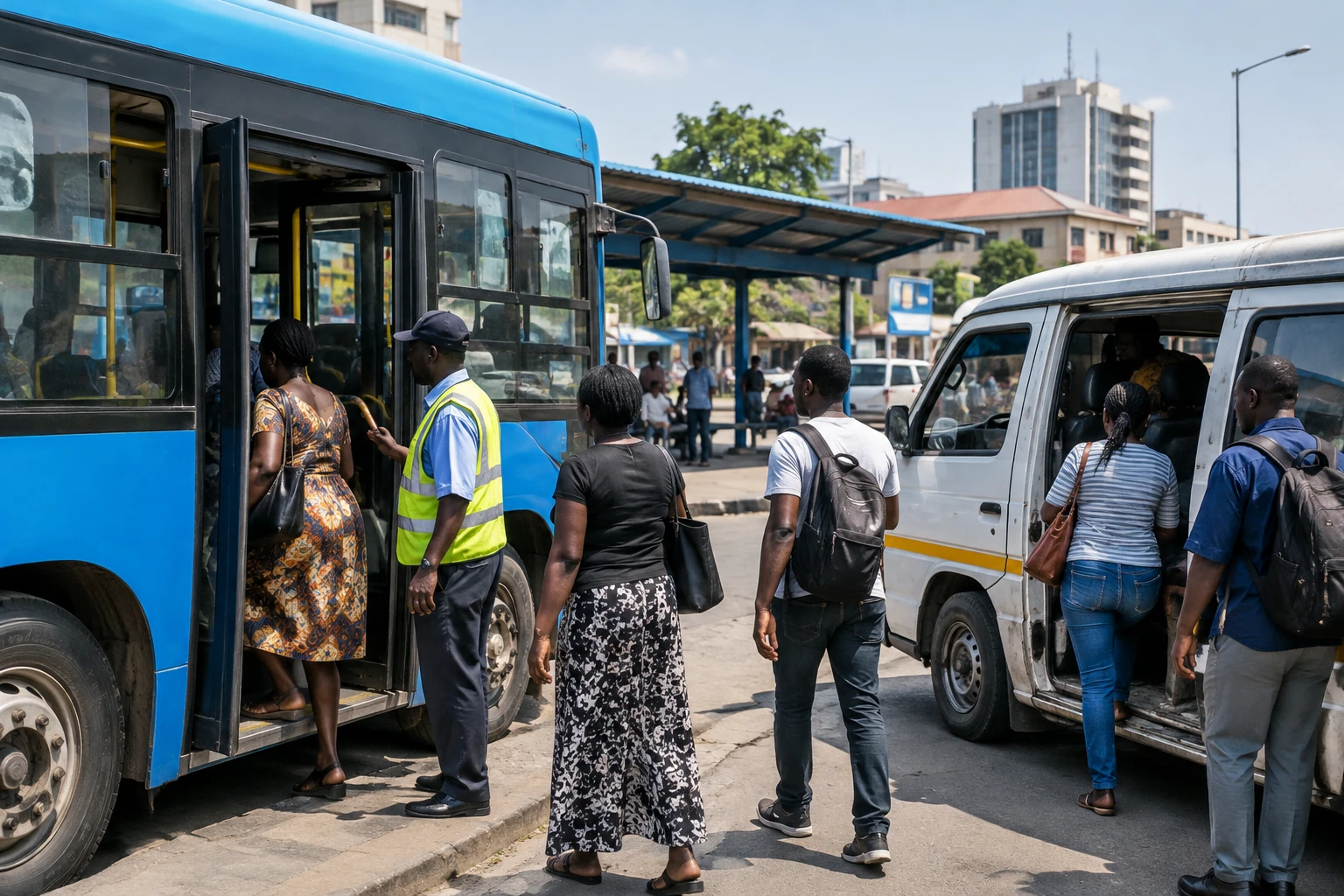
In Accra, adding buses is not enough to make journeys predictable. They must also be kept in working order, assigned to the routes where they are needed and integrated with other forms of transport. The official timetable for renewing Metro Mass Transit shows that this upgrade is taking place in stages.
A phased renewal, with 300 buses not yet in service
The Ghanaian government has announced a programme of 300 buses to renew the fleets of Metro Mass Transit Limited (MMT), the state-owned intercity company STC and private operators. But announcements of deliveries and vehicles actually entering service are not the same thing.
On 22 May 2026, Vice-President Naana Jane Opoku-Agyemang inaugurated 100 new 29-seat Isuzu buses for MMT. The operator and the Ministry of Transport confirmed this first batch. The Ghana News Agency also reported that they had entered service, including in the Volta and Oti regions.
Government documents available in November present a more nuanced picture than one in which all 300 vehicles have already been received. The 2027 draft budget states that the first 100 buses have been received and deployed, that a second batch of 100 is being cleared through customs and that the final 100 are expected in the first quarter of 2027. The arrival of 200 additional buses had therefore not been confirmed as a completed fact at that date.
A public company facing a shortage of available vehicles
This distinction matters to passengers. In February 2026, MMT management said that only 136 of the 461 buses on its books were operational. This figure, reported by Ghanaian daily Graphic Online, highlights a problem that cannot be solved simply by buying vehicles: part of the existing fleet remains out of service.
The new buses must therefore meet two needs. The first is to increase the number of vehicles on the roads. The second is to ensure lasting availability through maintenance, spare parts and depot organisation. Without these conditions, the fleet’s theoretical capacity can quickly diverge from the service actually provided.
MMT operates urban and intercity routes. In Accra and Greater Accra, its buses compete and complement tro-tros, widely used private minibuses, taxis and ride-hailing services. These modes cater to diverse daily demand, but provision remains fragmented and journeys depend heavily on road congestion.
Different effects for different routes and passengers
For people travelling between home, work, a market or a school, the central questions are practical: does the bus run, how often and at what fare? An additional vehicle can improve service along a corridor, but its effect depends on where it is assigned and how regular the service is.
The first buses were not reserved for the capital. The Ghana News Agency reported their deployment in Volta and Oti, where passengers hoped for the restoration of discontinued routes and more reliable journeys. This distribution is a reminder that public transport also concerns connections between cities and regions, not just Accra’s traffic jams.
In the capital, private operators often provide a greater range of routes and departures. But their presence does not replace joint planning. When buses, tro-tros, taxis and ride-hailing vehicles compete for space without sufficient coordination, congestion penalises passengers and drivers alike. Traffic problems can also reduce the number of trips a bus makes in a day.
A stronger public fleet could provide additional capacity on busy routes and regular links between residential areas and centres of activity. However, it cannot by itself guarantee shorter journey times or improved safety. These outcomes will also depend on routes, timetables, stops, road conditions and coordination with other services.
Maintenance is the programme’s next test
The renewal raises a management challenge as much as an equipment one. The number of vehicles actually operational, the routes served, service frequency and continuity will need to be monitored. These indicators will help distinguish a one-off delivery from an improvement that benefits passengers over the long term.
The 2027 draft budget also refers to expanding the bus rapid transit network, integrating electronic ticketing and modernising terminals in several cities. These projects could make journeys easier to navigate, provided they are linked to existing services rather than developed separately. For operators, they will also require investment and sustained institutional coordination.
The issue extends beyond Accra. Ghana is a member of ECOWAS, the Economic Community of West African States, where exchanges between cities, regions and neighbouring countries also rely on dependable road connections. Better domestic transport can support the journeys of workers and traders, but its impact will depend on service continuity and the authorities’ ability to maintain the infrastructure.
The next stage to watch is therefore clear: customs clearance and deployment of the second batch, followed by the delivery of the remaining buses, scheduled for the first quarter of 2027. For Ghanaians, success will not be measured by the number of vehicles announced, but by how many actually run, on which routes and how regularly.