
 Egypt
 Libya
 Morocco
 Sudan
 Tunisia
 Benin
 Burkina Faso
 Cabo Verde
 Côte d'Ivoire
 Ghana
 Guinea
 Guinea-Bissau
 Liberia
 Mali
 Mauritania
 Niger
 Nigeria
 Senegal
 Sierra Leone
 The Gambia
 Togo
 Cameroon
 Central African Republic
 Chad
 DR Congo
 Equatorial Guinea
 Gabon
 Republic of the Congo
 São Tomé and Príncipe
 Burundi
 Comoros
 Djibouti
 Eritrea
 Ethiopia
 Kenya
 Madagascar
 Malawi
 Mauritius
 Mozambique
 Rwanda
 Seychelles
 Somalia
 South Sudan
 Tanzania
 Uganda
 Angola
 Botswana
 Eswatini
 Lesotho
 Namibia
 South Africa
 Zambia
 Zimbabwe
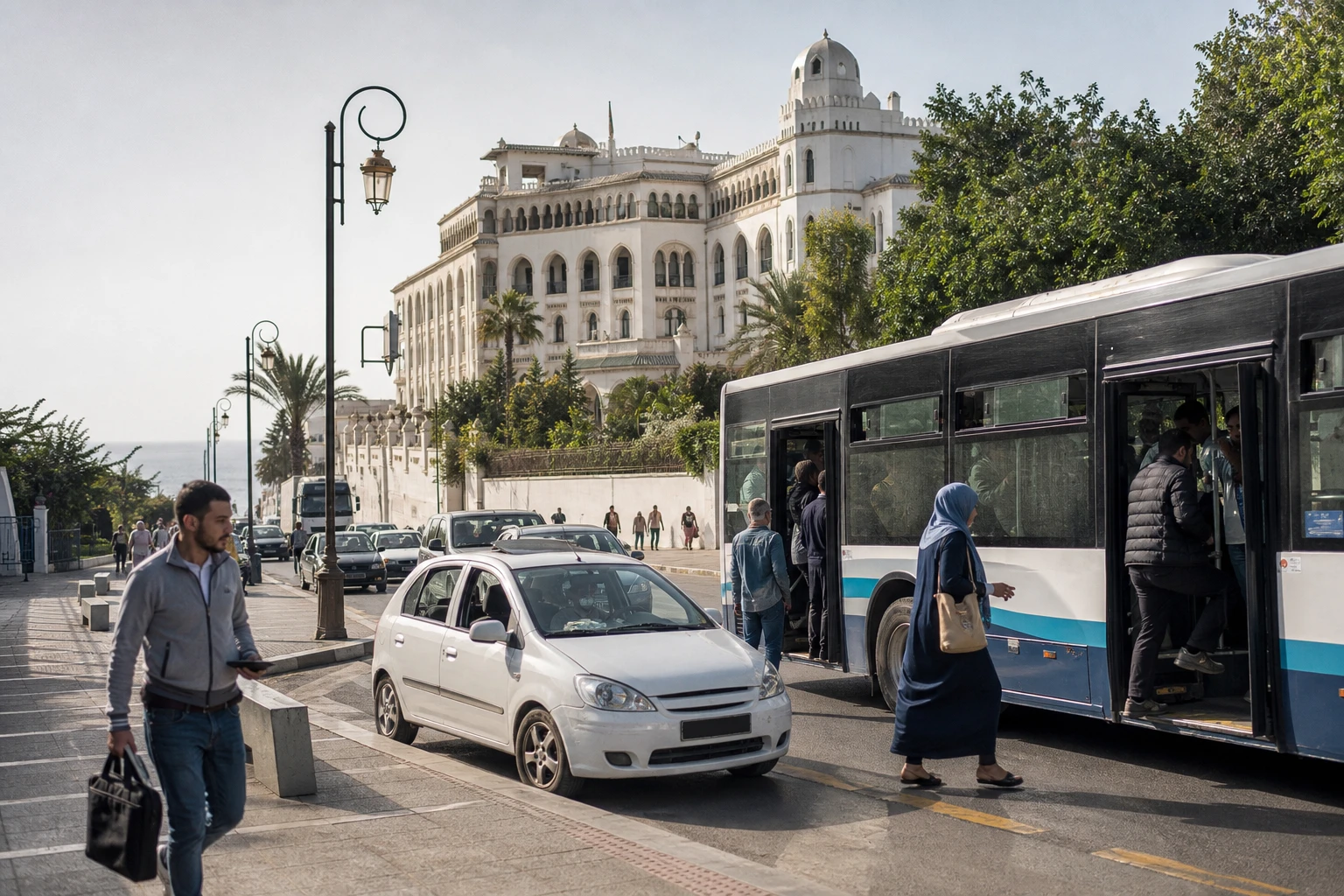
In Algiers, some places do more than accommodate travellers. They preserve traces of an entire city. The El Djazaïr hotel, set on the heights of El Mouradia, belongs to this rare category: its architecture, gardens and salons tell the story of several centuries of change in Algeria.
Its current name recalls the country’s identity. Its former name, Saint-George, points to another period in its history. Between these two names, the building has changed function, ownership and appearance. Yet it has retained a singular presence in Algiers’ landscape.
A palace turned into an iconic Algiers address
Accounts of the building do not always agree on its original construction date. Some associate it with a palace established in the late 18th century. Other sources link it to an older residence dating from the Ottoman period. This uncertainty calls for caution, but one point is established: the site predates the creation of the hotel in the late 19th century by a considerable margin.
Before becoming a hotel, the palace served, among other things, as a boarding school and educational establishment. This period helped preserve its spaces and gardens, as the city of Algiers underwent profound changes under French colonial rule.
In 1889, the site was converted into a hotel. Its architecture draws on Moorish and Mediterranean influences. The decor combines courtyards, woodwork, ceramic tiles and gardens. This choice was not incidental. In Algiers, prestigious architecture was becoming a meeting ground, but also a source of tension, between local forms, European models and colonial staging.
The establishment quickly attracted an international clientele. Writers such as Rudyard Kipling, André Gide and Henri de Montherlant are associated with it. The presence of artistic and political figures helped establish the hotel in the cultural imagination of the Algerian capital.
The garden played a central role in this reputation. It offers a breath of fresh air above the city and a view of Algiers’ hills. Even today, its vegetation sets the hotel apart from large urban establishments designed as purely functional spaces.
A witness to the Second World War
The hotel’s history took on an international dimension during the Second World War. After the Allied landings in North Africa on 8 November 1942, Algiers became a strategic centre for the Anglo-American and French forces engaged in the Mediterranean campaign.
General Dwight Eisenhower then used the hotel as his headquarters. Its salons hosted military and diplomatic meetings related to the conduct of operations. This period permanently inscribed the establishment in the history of the war, beyond the tourist narrative alone.
The presence of Allied leaders in Algiers unfolded against a complex political backdrop. The city became a decision-making centre for rival French authorities, including representatives of Vichy, the Free French forces and Allied officials. Tensions came to a head in particular over Admiral François Darlan, assassinated in Algiers on 24 December 1942 by Fernand Bonnier de La Chapelle.
However, the memories associated with places must be distinguished from precisely documented facts. Popular accounts link the hotel to numerous meetings involving Winston Churchill, Eisenhower, Charles de Gaulle and other figures in the conflict. Some visits are attested, while others belong more to the hotel’s own lore and oral tradition.
This distinction does not diminish the site’s importance. On the contrary, it helps explain how a building becomes a place of memory. The hotel preserves material traces, as well as stories passed down through successive generations.
From colonial hotel to Algerian heritage
After Algeria’s independence in 1962, the establishment took on a new meaning. It was no longer just an address frequented by European travellers. It became part of a capital that had emerged as a major political centre for the anti-colonial world and liberation struggles.
In the 1960s and 1970s, Algiers welcomed revolutionary movements, African leaders and representatives of newly independent countries. Saint-George became one of the places where diplomats, artists, journalists and political figures crossed paths. This period accompanied independent Algeria’s ambition to establish itself as an actor in the Third World and the Non-Aligned Movement.
The building entered a new phase with the intervention of architect Fernand Pouillon. He worked in Algeria for several decades and helped build hotels, housing and public facilities. At the Algiers hotel, his approach was to modernise its use without erasing its older features.
Work carried out in the early 1980s, notably ahead of the twentieth anniversary of independence, gave the establishment part of its current appearance. Pouillon added spaces and adapted the hotel to contemporary requirements. He nevertheless preserved the importance of materials, interior courtyards, proportions and decor inspired by Algerian art.
This approach speaks to a central question for the historic cities of North Africa: how can an old building be transformed without reducing it to a static backdrop? In Algiers, the answer lies in active conservation. The heritage remains in use, lived in and economically viable.
The ceramics, woodwork and decorative details contribute to this continuity. The hammam, refurbished within the hotel’s wellness area, illustrates the effort to bring contemporary comfort into dialogue with architectural heritage. The past is therefore not presented as a museum exhibit. It becomes part of everyday life.
An address that tells the story of the capital’s transformations
The El Djazaïr hotel does not sum up the history of Algiers. The Algerian capital has other essential places, from the Casbah, a UNESCO World Heritage Site, to the bay, as well as neighbourhoods built during the Ottoman, colonial and post-independence periods.
It does, however, offer a particular reading of that history. Its trajectory follows changes in power, social shifts and the city’s new ambitions. The palace, educational establishment, colonial hotel, military headquarters and then national address form a single historical chain.
This layering explains its significance for contemporary Algeria. The place attracts an international clientele, but it also belongs to the urban memory of Algiers’ residents. Its value lies not only in the prestige of its visitors. It rests on its ability to bring several legacies into dialogue without conflating them.
Across the Maghreb, the hotel is also a reminder that heritage can serve as a source of continuity rather than merely an object of nostalgia. In a region where historic centres face pressure from property development, standardised tourism and the deterioration of old buildings, El Djazaïr represents another model: a historic place kept in active use.
Its future will therefore depend as much on the quality of its conservation as on its place in Algiers’ cultural and tourist life. Between Ottoman memory, colonial heritage, the story of independence and Algerian architectural creation, the hotel remains above all a privileged vantage point from which to observe the capital’s transformations.



