Algeria
 Egypt
 Libya
 Morocco
 Sudan
 Tunisia
 Benin
 Burkina Faso
 Cabo Verde
 Côte d'Ivoire
 Ghana
 Guinea
 Guinea-Bissau
 Liberia
 Mali
 Mauritania
 Niger
 Nigeria
 Senegal
 Sierra Leone
 The Gambia
 Togo
 Cameroon
 Central African Republic
 Chad
 Equatorial Guinea
 Gabon
 Republic of the Congo
 São Tomé and Príncipe
 Burundi
 Comoros
 Djibouti
 Eritrea
 Ethiopia
 Kenya
 Madagascar
 Malawi
 Mauritius
 Mozambique
 Rwanda
 Seychelles
 Somalia
 South Sudan
 Tanzania
 Uganda
 Angola
 Botswana
 Eswatini
 Lesotho
 Namibia
 South Africa
 Zambia
 Zimbabwe
Schools staying open does not always mean they remain accessible
In the east of the Democratic Republic of the Congo, schools and hospitals have become markers of sovereignty as much as public services. When fees appear in places where the state says it has guaranteed free access, this is not merely a question of money: it is a political, social and administrative signal in areas where families are already grappling with insecurity, displacement and the rising cost of survival.
This reality is part of a broader context. Since the AFC/M23 coalition took control of several localities in North Kivu and South Kivu, Kinshasa has denounced the establishment of a parallel administration, which it says is backed by the Rwandan Defence Forces. The United Nations Security Council has also adopted Resolution 2773 (2025), which calls for the M23 to withdraw from the areas it occupies, an end to Rwanda’s support for the movement and the withdrawal of Rwandan forces from Congolese territory.
What Kinshasa says is happening in occupied territories
The Congolese government says it has observed demands for fees at primary and nursery schools in areas under AFC/M23 control since the start of the 2025-2026 school year. It also points to a 17% levy on schools’ quarterly revenue, a measure it says runs counter to the policy of free primary education, which remains official policy in the DRC. Free education has been reaffirmed repeatedly by the Congolese authorities and backed by UNESCO as a means of promoting educational equity.
At the same time, Kinshasa says healthcare facilities have not been spared. Public and private hospitals, as well as orphanages, are reportedly subject to taxes and duties that the authorities consider illegal. Here too, the issue goes beyond taxation. In provinces already weakened by war, any additional levy reduces access to healthcare, delays treatment and weighs first on households already bearing the cost of the disruption of official supply networks.
The Congolese government links these measures to a series of abuses it attributes to AFC/M23 and the RDF between June and July 2026, with more than 300 people killed according to its statements, as well as sexual violence, torture, abductions and forced recruitment. These figures should be treated as government allegations unless and until they are fully substantiated by an independent investigation. However, Kinshasa’s inclusion of these practices in a broader picture of violence and levies illustrates how the occupation is reshaping the day-to-day administration of the areas concerned.
Governing, taxing, replacing: the logic of de facto power
UN documents on the situation in the DRC show that the tax issue is not isolated. United Nations reports have described the establishment of parallel financial structures by AFC/M23 after the capture of Goma and Bukavu, as well as attempts to replace the regular tax administration with its own collection mechanisms. In other words, the debate over school fees and healthcare taxes is part of a broader strategy of territorial control, revenue-raising and legitimacy.
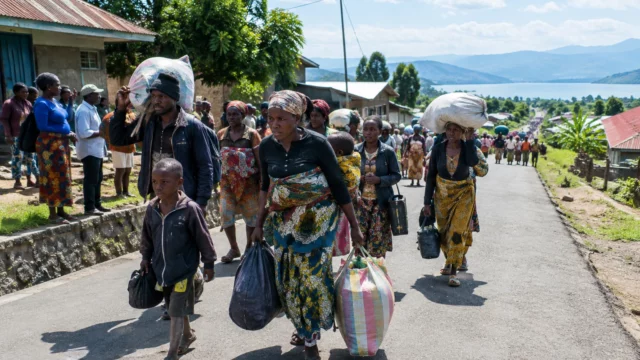
For families, the consequences are immediate. Free public education becomes paid, sometimes amid disruption to school timetables and population displacement. For school administrators, room for manoeuvre is shrinking as they face conflicting orders. For the authorities in Kinshasa, the issue concerns the right to education, territorial integrity and the continuity of the state. This explains the force of its response as the DRC seeks to maintain its social policies in areas where it no longer controls every link in the decision-making chain.
This tension is all the greater because the conflict is unfolding within an active diplomatic framework. In July 2025, Kinshasa and AFC/M23 signed a declaration of principles in Doha, followed by a more detailed framework in November 2025, under Qatari facilitation. In April 2026, talks in Montreux, Switzerland, addressed humanitarian access and judicial protection, with several partners taking part, including the African Union and the United States. More recently, a new coordination meeting in Switzerland resulted in a roadmap for sequencing the negotiations. Each step confirms that war and negotiations are advancing in parallel, without yet reaching a resolution.
A test for peace, and for the Great Lakes region
The significance of this issue extends beyond the DRC alone. In the Great Lakes region, the ability of an armed group to levy school fees and healthcare taxes in occupied areas raises a central question: who protects public services when the front line takes the place of the administration? For the African Union, SADC, the East African Community and regional verification mechanisms, the DRC remains a test of credibility. The issue affects security, the movement of people, local markets and the survival of public institutions.
The healthcare crisis adds a further urgency. Ituri, North Kivu and South Kivu are facing an outbreak of Bundibugyo-strain Ebola. The WHO has confirmed that the epidemic is affecting several provinces and several health zones, with its spread fuelled by insecurity and the forced movement of populations. As of 18 August 2026, WHO Africa reported 5,208 confirmed cases and more than 2,476 deaths in the DRC. In this context, weakening hospitals and care facilities makes the response even more difficult in territories already under pressure.
In Kinshasa, the message is clear: the state wants to retain control of education, healthcare and public revenue, even where its authority is contested. In the east, the population continues to bear the tangible effects of fragmented power. Between the Doha diplomacy, mediation efforts in Switzerland and UN resolutions, the next step will be measured less by declarations than by the real ability to roll back parallel administrations and reopen public services. That is where the true significance of the promised peace, and the place of Congolese citizens in the order that follows, will be measured in concrete terms.