
 Algeria
 Egypt
 Libya
 Morocco
 Sudan
 Tunisia
 Benin
 Burkina Faso
 Cabo Verde
 Côte d'Ivoire
 Ghana
 Guinea
 Guinea-Bissau
 Liberia
 Mali
 Mauritania
 Niger
 Nigeria
 Senegal
 Sierra Leone
 The Gambia
 Togo
 Cameroon
 Central African Republic
 Chad
 Equatorial Guinea
 Gabon
 Republic of the Congo
 São Tomé and Príncipe
 Burundi
 Comoros
 Djibouti
 Eritrea
 Ethiopia
 Kenya
 Madagascar
 Malawi
 Mauritius
 Mozambique
 Rwanda
 Seychelles
 Somalia
 South Sudan
 Tanzania
 Uganda
 Angola
 Botswana
 Eswatini
 Lesotho
 Namibia
 South Africa
 Zambia
 Zimbabwe
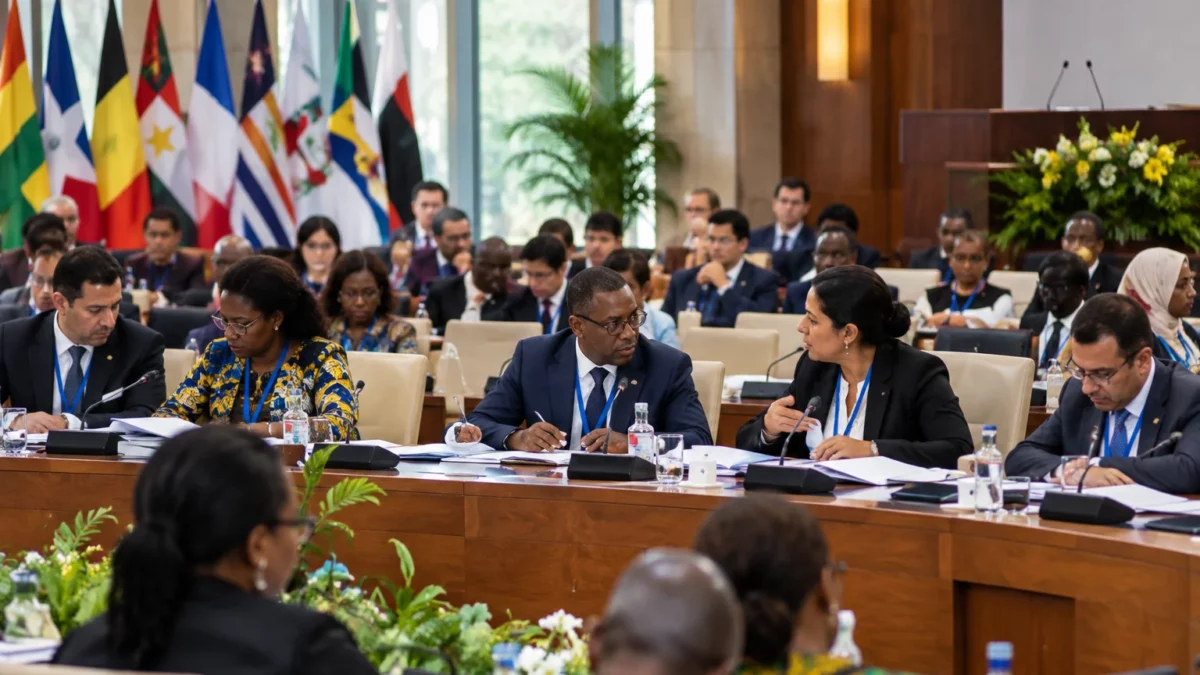
In Phnom Penh, the Francophonie ran up against a disagreement that goes beyond the choice of a leader. The postponement of the election of its secretary-general has highlighted tensions between Kigali and Kinshasa, as well as the difficulty of protecting multilateral institutions from national rivalries.
A compromise that leaves the decision open
The 20th Summit of the International Organisation of La Francophonie (OIF) was held in Phnom Penh, Cambodia, on 15 and 16 November 2026. Member states did not appoint a successor to Louise Mushikiwabo, the Rwandan who has led the organisation since 2019. Her term has been extended by 12 months, allowing time for discussions to resume. The decision therefore amounts neither to her re-election for a full new term nor to a definitive appointment of her successor. Actualite.cd reports on the extension and the secretary-general’s remarks.
Before the summit, the Democratic Republic of the Congo (DRC) had warned that it could leave the OIF if Louise Mushikiwabo secured a third term. Kinshasa backed another candidate. Faced with the deadlock, Rwanda accepted a compromise under which it would not put forward a candidate to succeed her. The outcome avoids an immediate rupture without resolving the dispute between the two countries.
Speaking from Oslo, Rwandan Foreign Minister Olivier Nduhungirehe denounced what he called “Congolese blackmail” and accused France and President Emmanuel Macron of yielding to pressure. He also criticised a letter Macron sent to President Paul Kagame, which he described as a near-ultimatum. These remarks express Kigali’s position; they do not constitute an independent conclusion about the diplomatic exchanges. The Rwandan minister’s interview was broadcast by France 24.
The secretary-general, for her part, called for tensions between the DRC and Rwanda not to be brought into the organisation. The summit therefore did more than defer a choice of individual: it exposed the limits of consensus when member states link an institutional decision to a bilateral crisis.
The Francophonie and rivalries in the Great Lakes region
The dispute is part of a long-strained relationship between Kigali and Kinshasa, against the backdrop of conflict in eastern DRC. Allegations of Rwandan support for the M23, which Kigali denies, and the presence of the Democratic Forces for the Liberation of Rwanda (FDLR) are among the main points of friction. The FDLR is an armed group founded by Rwandan Hutus, some of whose members were involved in the 1994 genocide against the Tutsi. Discussion of these issues requires a distinction between documented facts and allegations made by the parties.
The Washington Accords, signed in December 2025 between the DRC and Rwanda, include security commitments related to the withdrawal of forces and the neutralisation of the FDLR. Their implementation remains a central issue. The United States has imposed sanctions targeting officials and armed actors, a measure Kigali considers unbalanced. Washington, for its part, says it is seeking to ensure that the commitments in the accords are honoured. The US Treasury announced sanctions against FDLR and M23 commanders, while a United Nations report describes the continuation of monitoring mechanisms and tensions over their implementation.
For residents of eastern Congo, the stakes go beyond diplomatic statements: the safety of displaced people, movement and economic activity also depend on developments in the fighting and the accords. In Kigali, the authorities defend their interpretation of the conflict and reject external pressure. The population is not a uniform bloc: people’s circumstances differ between the capital, border areas and regions affected by violence.
Migration scheme, another disputed issue
In the same interview, Nduhungirehe defended the proposed return centre in Rwanda for people whose asylum applications in Europe have been rejected and whose return to their countries of origin has not been possible. On 16 November, Germany, Austria, Denmark, Greece and the Netherlands announced that they were working with Kigali on the initiative. It is a project under preparation, not a centre that is already operational. Rwanda’s foreign ministry says the International Organisation for Migration and the United Nations High Commissioner for Refugees are to provide expertise or advice.
The minister presents the scheme as an opportunity to start a new life in Rwanda and says the issue is not simply about money. Human rights organisations, meanwhile, raise questions about legal safeguards, freedom of movement and the risk of people being sent to countries where they could be in danger. Amnesty International warns that inadequate safeguards could create “black holes” for human rights. Kigali presents the project as a partnership with five European countries, while Amnesty International warns of the risks to human rights.
A test for multilateral institutions
These issues show how Rwanda is seeking to defend its interests in several arenas at once: the OIF, regional security negotiations and partnerships with Europe. For the DRC, the Francophonie crisis has also provided diplomatic leverage amid deteriorating relations. European countries, meanwhile, face a question of responsibility over the migration scheme: outsourcing returns does not remove the obligation to protect the rights of the people concerned.
The next milestone will be the resumption of the process to appoint a secretary-general, expected in 2027. Until then, Louise Mushikiwabo’s extended term keeps a Rwandan official at the head of the OIF but does not settle the debate over her successor. The members’ ability to separate this decision from tensions between Kigali and Kinshasa will be a concrete measure of the organisation’s room for manoeuvre.



