
 Algeria
 Egypt
 Libya
 Morocco
 Sudan
 Tunisia
 Benin
 Burkina Faso
 Cabo Verde
 Côte d'Ivoire
 Ghana
 Guinea
 Guinea-Bissau
 Liberia
 Mali
 Mauritania
 Niger
 Nigeria
 Senegal
 Sierra Leone
 The Gambia
 Togo
 Cameroon
 Central African Republic
 Chad
 Equatorial Guinea
 Gabon
 Republic of the Congo
 São Tomé and Príncipe
 Burundi
 Comoros
 Djibouti
 Eritrea
 Ethiopia
 Kenya
 Madagascar
 Malawi
 Mauritius
 Mozambique
 Rwanda
 Seychelles
 Somalia
 South Sudan
 Tanzania
 Uganda
 Angola
 Botswana
 Eswatini
 Lesotho
 Namibia
 South Africa
 Zambia
 Zimbabwe
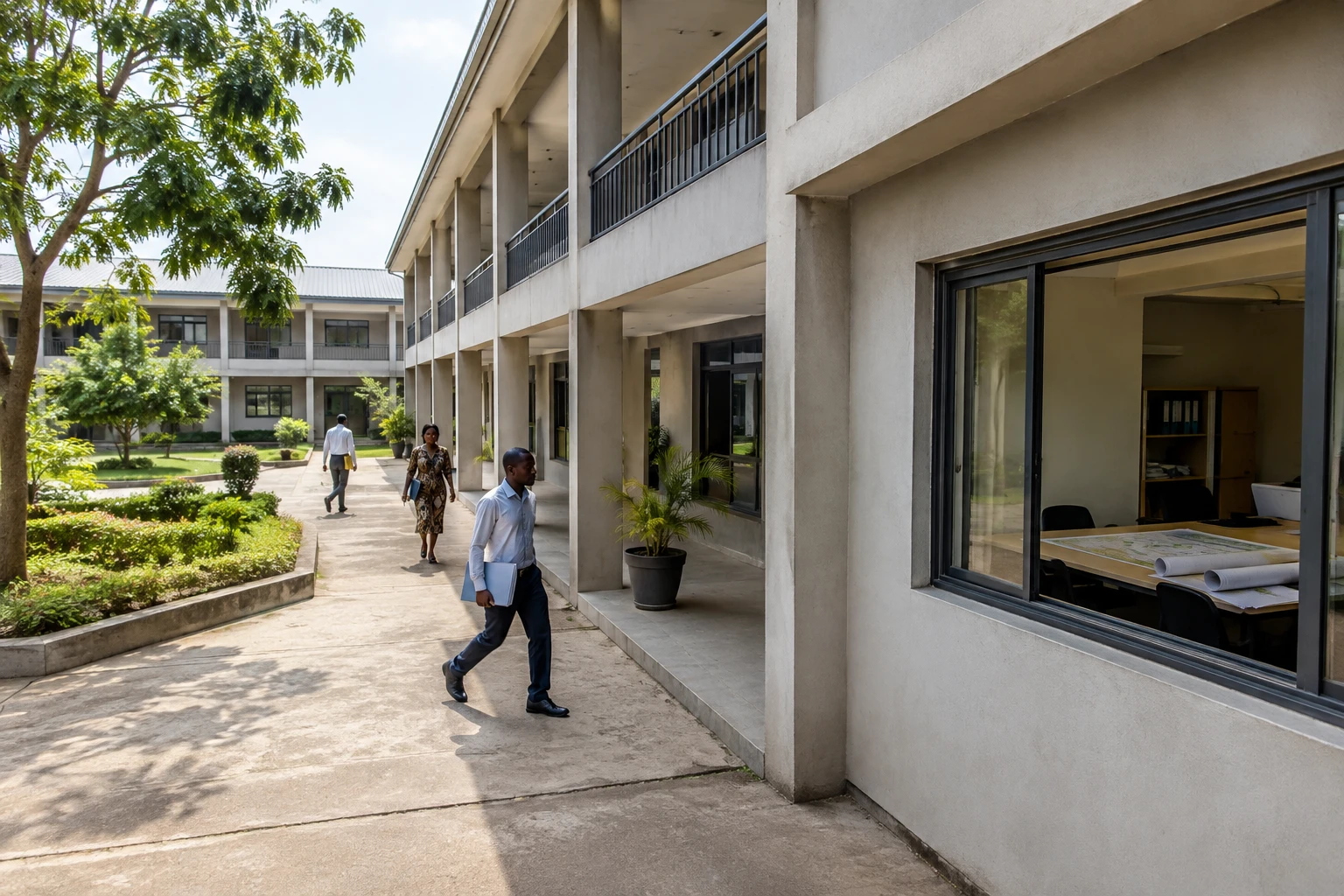
In Maluku, east of Kinshasa, a new city project now combines basketball courts, community facilities and industrial ambitions. The challenge is not limited to building an arena: these facilities will also need to be connected to water, jobs and the services future residents will need.
On 6 November 2026, the Strategic Oversight Committee for the Kinshasa City Expansion Project (CSSPEVK) and Canadian company Quest Water Global signed a memorandum of understanding concerning Kinshasa Kia Mona. The committee announced the agreement on 11 November. The document sets out proposed projects; it is not, in itself, proof that their financing has been secured or that work has begun. The CSSPEVK statement on its agreement with Quest Water Global details the three announced components.
A new expansion east of the capital
Kinshasa Kia Mona is part of an urban trajectory shaped by the capital’s growth and pressure on housing, transport and essential networks. The project is located in the commune of Maluku. The CSSPEVK assigns it an area of about 43,300 hectares, or nearly 430 square kilometres. These figures describe the announced footprint of the project, not an already developed city.
The authorities present this expansion as a response to congestion and an infrastructure deficit. But a new city is measured not only by its size or planned facilities. Its usefulness will depend on links with Kinshasa, access to land, the availability of services and residents’ ability to find work and earn an income there.
The project notably includes industrial, urban and agricultural zones. In August 2026, the Congolese Press Agency reported on a site assessment visit by the CSSPEVK and the Congolese Agency for Major Works. This independent coverage confirms that planning work is under way on the ground, but does not establish the timetable or funding for each component. The ACP report on the visit to Maluku describes the proposed zones.
Facilities announced, details still awaited
The agreement with Quest Water Global brings together three strands. The first includes the Mutombo Arena, described as a multi-purpose venue, and three NBA-standard basketball courts. The second concerns a manufacturing, assembly and technology integration unit. The third combines community infrastructure, drinking-water treatment and supply solutions, and training and skills-transfer programmes.
The CSSPEVK’s announcement does not specify the cost of the works, their sources of funding or a detailed timetable. Nor does it provide information on the companies responsible for the work, procurement procedures or how future users will gain access. These details will be crucial in assessing the partnership’s practical scope. A memorandum of understanding sets a framework for cooperation; the steps for financing, studies and implementation remain to be documented.
Water will be a central test. A workshop held in Kinshasa from 26 to 28 August examined a supply strategy for the future hub. The production capacity discussed is 500,000 cubic metres per day. This is a target under consideration, not capacity already installed. The distinction matters: supply also depends on distribution networks, energy, maintenance and the price paid by households. The CSSPEVK document on the water strategy in Maluku places this capacity within the project’s planning.
The impact will therefore vary for residents depending on where they live and what they do. Future employees of industrial units will depend on jobs actually being created and on transport. Traders and workers in the informal economy will need accessible markets and local networks. People already living in Maluku will also need to be considered in decisions about land, relocation and access to facilities.
Basketball, between Congolese heritage and local reach
The sports component is part of a separate cooperation agreement announced in October between NBA Africa and Quest Water Global. It provides for the construction or renovation of 55 courts in the Democratic Republic of the Congo by 2030, in tribute to Dikembe Mutombo, the Congolese basketball great who died in 2024. The figure 55 refers to the number worn by the former player. An NBA Africa announcement carried by Africa24 confirms the national target and the continental framework: the league also aims to deliver 1,000 courts across the continent over the next decade. Africa24’s report on the 55 courts planned in the DRC sets out these commitments.
This initiative includes the court inaugurated at Cercle Onatra in Kinshasa on 29 September, as well as a court announced in Mbuji-Mayi. It should not be confused with the three courts planned for Kinshasa Kia Mona: those are covered by the 6 November agreement. The distinction makes it possible to track separately the projects already reported as completed and those that have merely been announced.
Delivery will be the real measure
For the Congolese authorities, Kinshasa Kia Mona represents an ambition to decentralise urban growth and economic activity. For the partners, the agreement opens a framework for projects in sport, industry and water. For residents, success will be judged instead by the availability of services, accessible jobs and well-maintained facilities. Construction alone does not guarantee these benefits.
The regional context adds to the significance of this initiative. The DRC belongs to the Economic Community of Central African States (ECCAS), which encourages cooperation between Central African countries. The development of Kinshasa remains a national and provincial responsibility, however; no published information links this agreement to an ECCAS regional programme. At continental level, the court-building plan led by NBA Africa gives the sports project a wider dimension, but results will depend on how courts are distributed and whether they are used sustainably.
The next steps to watch are therefore concrete: publication of costs and deadlines, securing funding, verifiable commencement of work, connections to water and transport networks, and arrangements for local training. Until this information is available, the agreement signals an intention to cooperate rather than a completed infrastructure project. For Kinshasa, the difference between a planned expansion and a genuinely liveable city will come down to these details.



