Algeria
 Egypt
 Libya
 Morocco
 Sudan
 Tunisia
 Benin
 Burkina Faso
 Cabo Verde
 Côte d'Ivoire
 Ghana
 Guinea
 Guinea-Bissau
 Liberia
 Mali
 Mauritania
 Niger
 Nigeria
 Senegal
 Sierra Leone
 The Gambia
 Togo
 Cameroon
 Central African Republic
 Chad
 Equatorial Guinea
 Gabon
 Republic of the Congo
 São Tomé and Príncipe
 Burundi
 Comoros
 Djibouti
 Eritrea
 Ethiopia
 Kenya
 Madagascar
 Malawi
 Mauritius
 Mozambique
 Rwanda
 Seychelles
 Somalia
 South Sudan
 Tanzania
 Uganda
 Angola
 Botswana
 Eswatini
 Lesotho
 Namibia
 South Africa
 Zambia
 Zimbabwe
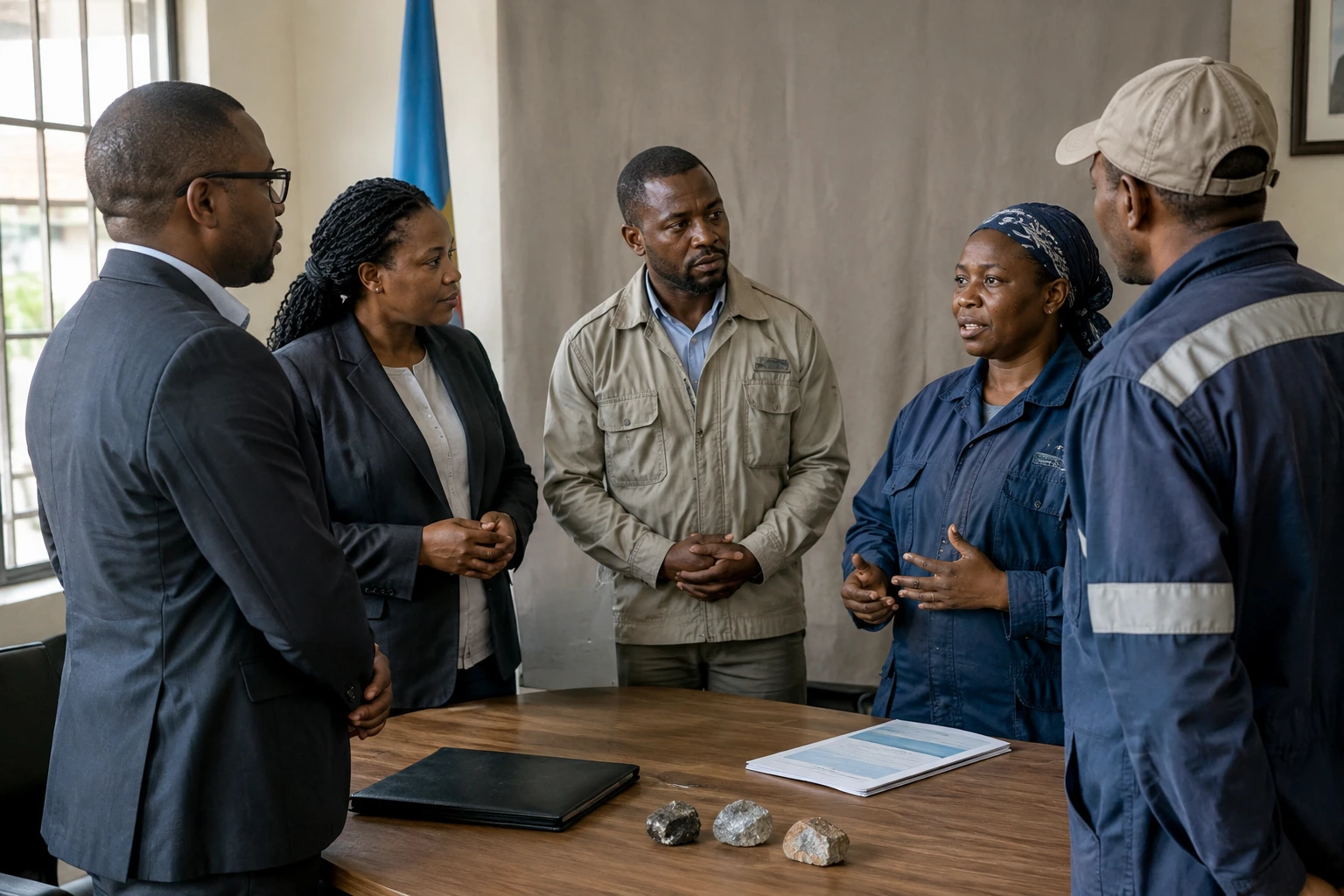
In Kolwezi, mineral checks are not confined to concessions. They also affect miners’ incomes, traders’ activity and confidence in the services responsible for enforcing the rules. The suspension of two SAEMAPE officials places at the centre of the debate the state’s ability to regulate a sector where industrial and artisanal mining coexist.
An inspection mission amid tensions
In Lualaba, a province in the south-east of the Democratic Republic of the Congo, an inter-agency commission sent from Kinshasa has been inspecting processing entities and mineral buying counters since October. The authorities present the operation as a way to check that activities and marketing channels comply with regulations. In Kolwezi, however, miners have denounced the restrictions and expressed fears that their market access could be cut off.
Protests disrupted several neighbourhoods on 19 and 20 October. Calm gradually returned on 21 October, after unrest affected businesses, traffic and school activities. Radio Okapi reported injuries and material damage, citing local sources. Governor Fifi Masuka, for her part, said that no processing plant had been closed. Accounts of the scale and consequences of the operation are therefore not entirely consistent.
These tensions are unfolding in a region where copper and cobalt support both industrial projects and artisanal mining. Access to sites, the purchase of production and checks on its origin have a direct bearing on workers’ incomes and the operations of businesses. Civil society has also pointed to difficulties with representation and dialogue between the authorities and mining cooperatives. The Congolese Press Agency reports a recommendation to establish a permanent forum for dialogue with cooperatives.
Two officials suspended, allegations to be examined
On 21 October 2026, Mines Minister Louis Kabamba Watum suspended Jean-Paul Kapongo Kadiobo, director-general of the Service for Assistance and Supervision of Artisanal and Small-Scale Mining (SAEMAPE), and Georges Nyembo Kitungwa, the service’s provincial director in Lualaba. Both decisions take effect upon signature. The available information does not specify the duration of the suspensions or interim arrangements.
The ministerial allegations include a failure to take adequate measures to prevent unauthorised artisanal mining in mining concessions, particularly in Lualaba and Haut-Katanga. The director-general is also accused of irregularly setting up revenue-collection services within concession areas. According to the decrees as reported, these actions allegedly infringed the rights of concession holders and exposed the state to claims from third parties. The documents do not name the companies concerned or quantify any losses.
These are administrative allegations, not a judicial finding on the responsibility of the two officials. Other Congolese coverage confirms the suspension of the director-general and the grounds given by the ministry. CongoRassure reports on the ministerial decree concerning Jean-Paul Kapongo Kadiobo. A local media outlet has also reported the suspension of the provincial official. The duration of the measures and what follows remain to be clarified.
SAEMAPE’s delicate role
SAEMAPE is the public service responsible for assisting and supervising artisanal and small-scale mining. Its role is not limited to identifying violations: it must also support miners and cooperatives within the framework set by regulations. Its leadership thus faces two demands: preventing illegal mining and making organised artisanal activity viable.
The Congolese Mining Code provides for legal artisanal mining to take place in designated areas, with approved cooperatives and authorised miners. An industrial concession and an artisanal mining zone are therefore not interchangeable. But the rules alone do not resolve tensions when legal sites are difficult to access or buying channels are disputed. An IIED report on artisanal cobalt mining in the DRC documents these challenges of coexistence around concessions and the risk of conflict. The IIED study examines relations between artisanal mining and industrial sites.
For permit holders, controlling incursions and upholding their rights are matters of legal certainty and operational continuity. For miners, restricted access or a halt to purchases can cut off an immediate source of income. Traders and processing plants, meanwhile, must demonstrate that their supplies comply with regulations. A policy that controls sites alone, without making market access and procedures transparent, therefore risks shifting the problem rather than solving it.
A governance issue beyond Lualaba
This sequence of events puts the Congolese state’s credibility in a strategic sector at stake, as well as the place of artisanal workers in the mining economy. The issue is not to pit companies mechanically against miners. It is to enforce mining rights while providing legal, clear and accessible routes for artisanal activity.
The DRC is a member of the Southern African Development Community (SADC), a regional cooperation framework that includes several neighbouring mining countries. Traceability, mineral compliance and the stability of supply chains therefore extend beyond Congo’s borders. For regional partners and buyers, the quality of inspections matters; for the people of Lualaba, their fairness and impact on incomes matter just as much.
The next steps will be decisive: publication of the inspection mission’s findings, clarification of the duration of the suspensions and continuity of SAEMAPE’s work. It will also be important to see whether the authorities open regular dialogue with cooperatives and clarify the conditions for access to artisanal zones and buying centres. It is these outcomes, rather than the number of sanctions alone, that will determine whether the promised clean-up of the sector is achieved.