
 Algeria
 Egypt
 Libya
 Morocco
 Sudan
 Tunisia
 Benin
 Burkina Faso
 Cabo Verde
 Côte d'Ivoire
 Ghana
 Guinea
 Guinea-Bissau
 Liberia
 Mali
 Mauritania
 Niger
 Nigeria
 Senegal
 Sierra Leone
 The Gambia
 Togo
 Cameroon
 Central African Republic
 Chad
 Equatorial Guinea
 Gabon
 Republic of the Congo
 São Tomé and Príncipe
 Burundi
 Comoros
 Djibouti
 Eritrea
 Ethiopia
 Kenya
 Madagascar
 Malawi
 Mauritius
 Mozambique
 Rwanda
 Seychelles
 Somalia
 South Sudan
 Tanzania
 Uganda
 Angola
 Botswana
 Eswatini
 Lesotho
 Namibia
 South Africa
 Zambia
 Zimbabwe
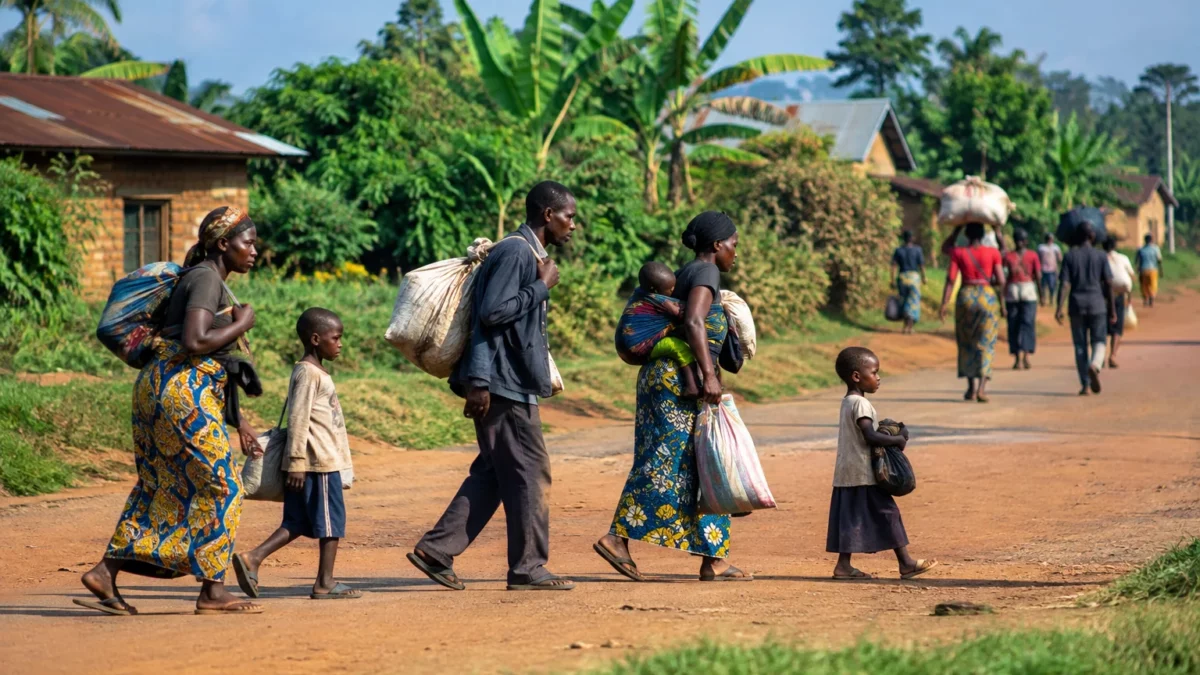
In Mambasa territory, Ituri, repeated attacks are forcing residents to leave their villages and making it harder to reach fields, roads and emergency assistance. The toll put forward by local civil society stands at at least 75 civilians killed in one week. Available cross-checks confirm a deadly series of attacks, but not yet this cumulative total.
A toll that rises with each report
The attacks targeted several locations in Mambasa territory, in the north-east of the Democratic Republic of the Congo. The most recent attack reported in the available information is said to have taken place on Saturday 14 November 2026 in Ekatu. Local civil society reports at least 75 deaths, around 40 abductions and houses destroyed.
This toll must be attributed. Reports published between 10 and 14 November document several separate waves of attacks, with figures varying according to the locations covered and access to villages. On 10 November, Actualité.cd reported that at least 40 bodies had been discovered since the start of the month in several locations in Babila-Babombi. On 11 November, the Associated Press reported that at least 22 civilians had been killed in eight locations, according to two local monitoring groups. Radio Okapi subsequently reported 12 deaths in four villages on 11 November. These tolls may partly overlap and, on their own, do not validate the total of 75.
On 14 November, a local radio station also reported 14 deaths in the Bangole groupement, following an attack two days earlier. The figures are described as provisional: some areas remained difficult to access and searches were not over. It is therefore important to distinguish tolls for individual attacks from cumulative estimates for the week as a whole.
Displacement and disrupted livelihoods
Rams Malikidogo, coordinator of the local organisation ADPF in Mambasa, says residents are fleeing to Beni and Butembo, in North Kivu. He describes departures without food or assistance. These statements do not in themselves establish the scale of displacement, but offer a glimpse of the needs reported by local actors.
The consequences extend beyond the villages directly attacked. When residents leave their land, agricultural work stops and households lose some of their livelihoods. Roads become more dangerous for travel and supplies. Those abducted remain exposed to serious risks. Civil society is particularly concerned about the fate of young captives and possible forced recruitment or indoctrination, although their number and situation have not been independently established.
Concerns have also been raised about the security response. Local representatives accuse security forces of failing to prevent some attacks despite warnings they had received. Other reports refer to operations by the Armed Forces of the Democratic Republic of the Congo (FARDC) in the Nduye and Biakato area and in the Bakaiko forest. Both points should be reported together: operations have been reported, while residents and civil society actors consider protection inadequate in several areas.
A threat spreading across provincial borders
The Allied Democratic Forces (ADF) are an armed group originating in Uganda, active for years in eastern Congo and affiliated with the Islamic State organisation. Their presence and attacks have been documented in several territories in Ituri and North Kivu. In a report presented to the Security Council in 2026, the UN noted an intensification of their activities in Mambasa and along the boundary between the two provinces, particularly around mining sites.
This geography makes civilian protection more difficult. Armed groups can move between widely separated areas, while the authorities have to cover vast expanses and difficult transport routes. A military operation may push fighters out of one area without preventing them from moving to another. The UN has previously described the expansion of joint Congolese and Ugandan operations, known as “Shujaa”, and the movement of ADF fighters into Mambasa territory. This context sheds light on the difficulties, but is not enough to explain every attack or confirm the circumstances of recent events.
A Congolese issue with regional dimensions
The DRC is a member of the East African Community (EAC), which includes Uganda and several neighbouring countries. This membership provides a regional framework for discussions on security and cross-border displacement. It does not, however, replace the Congolese authorities’ responsibility to protect civilians. Monitoring joint operations and coordination between countries remain concrete concerns for people living near the borders.
In Kinshasa, the authorities must respond to a crisis unfolding far from the capital, in areas where access to services and emergency assistance depends heavily on road security. For residents, the need is immediate: to be able to travel, find abducted relatives and resume their activities without fearing another attack. The exact figures will only become more reliable with independent access to the locations and cross-checking of lists of victims.
The next developments to watch are confirmation of the tolls by the authorities and humanitarian organisations, the fate of those abducted and the course of operations in the affected areas. At this stage, local sources and Congolese media corroborate the existence of repeated attacks and dozens of deaths. The total of 75 remains an estimate attributed to civil society, not a toll independently consolidated.



