
 Algeria
 Egypt
 Libya
 Morocco
 Sudan
 Tunisia
 Benin
 Burkina Faso
 Cabo Verde
 Côte d'Ivoire
 Ghana
 Guinea
 Guinea-Bissau
 Liberia
 Mali
 Mauritania
 Niger
 Nigeria
 Senegal
 Sierra Leone
 The Gambia
 Togo
 Cameroon
 Central African Republic
 Chad
 Equatorial Guinea
 Gabon
 Republic of the Congo
 São Tomé and Príncipe
 Burundi
 Comoros
 Djibouti
 Eritrea
 Ethiopia
 Kenya
 Madagascar
 Malawi
 Mauritius
 Mozambique
 Rwanda
 Seychelles
 Somalia
 South Sudan
 Tanzania
 Uganda
 Angola
 Botswana
 Eswatini
 Lesotho
 Namibia
 South Africa
 Zambia
 Zimbabwe
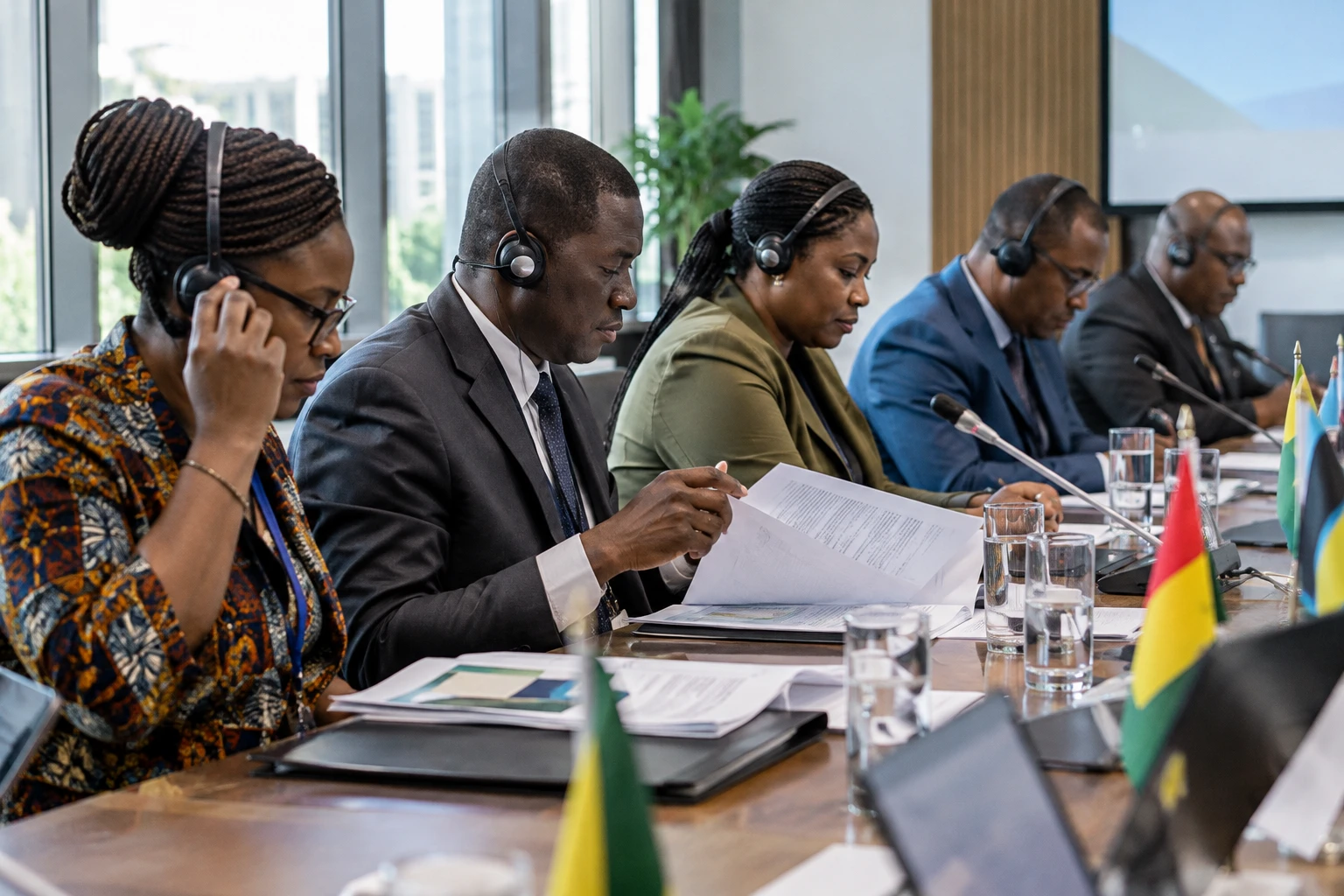
A Congolese shipment can cross several borders and change trucks, trains or boats before reaching its destination. At each stage, paperwork and procedures can slow its journey. A new international framework aims to simplify this chain and give goods in transit a more direct role in business financing.
A tool designed for multimodal journeys
On 26 October 2026, the Democratic Republic of the Congo signed the United Nations Convention on Negotiable Cargo Documents, known as the Accra Convention, in Accra, Ghana. Trade Minister Julien Paluku signed the text on behalf of President Félix Tshisekedi. The Congolese news agency ACP and the United Nations Treaty Collection confirm the signature. DR Congo was among the 26 states recorded as signatories at the ceremony. The announcement by the Congolese Press Agency is corroborated by the UN Treaty Collection.
Adopted by the United Nations General Assembly on 15 December 2025, the convention establishes common rules for a document representing goods during transport. It covers journeys by road, rail, inland waterways and air, including those combining several modes. Until now, negotiable documents have been associated mainly with maritime transport, particularly bills of lading.
The principle is simple: if the parties to the transport agree, a single document can cover the entire route. It can be issued on paper or electronically. Its transfer allows the rights attached to the goods to be transferred, in accordance with the rules set out in the text. In practice, an operator could sell a shipment before it arrives or present it to a bank to seek financing. This does not, however, guarantee that credit will be granted or determine the value the bank will assign to the collateral.
A signature, not yet automatic implementation
The distinction between signature and entry into force is essential. The convention is not yet in force internationally. The UN register states that it will take effect 180 days after the deposit of the tenth instrument of ratification, acceptance, approval or accession. DR Congo’s signature therefore marks a diplomatic step, but is not, by itself, enough to make the framework applicable to transactions in the country. UNCITRAL, the United Nations body that develops international commercial law rules, details the legal mechanisms and conditions of use.
For businesses, the practical impact will also depend on national follow-up: ratification, any necessary amendment of legislation, recognition of electronic documents, and the practices of banks, carriers, insurers and customs services. The convention concerns the issuance and use of negotiable documents. It does not replace existing rules governing carriers’ liability.
Implementation will need to take account of the diversity of routes in DR Congo. Businesses exporting from mining or agricultural areas, importers supplying Kinshasa and regional corridor operators face different constraints. A common document could reduce administrative breaks between transport modes. On its own, it will not eliminate border delays, infrastructure costs or difficulties in accessing credit, particularly for small businesses and informal economy operators.
A Congolese issue at the crossroads of several regions
DR Congo’s geographical position makes the issue particularly tangible. The country shares borders with nine states and relies on several routes to markets, including corridors passing through neighbouring countries. It belongs both to the East African Community (EAC), which seeks to facilitate trade among its members, and to the Southern African Development Community (SADC). These regional memberships do not replace national rules, but they make the compatibility of documents and procedures important for cross-border trade. The EAC confirms DR Congo’s accession in 2022, while SADC also counts the country among its members.
The volume of foreign trade underscores the stakes, without predicting the gains the convention will deliver. For 2024, UNCTAD estimates DR Congo’s merchandise exports at $29.9 billion and its imports at $26.6 billion. These figures describe substantial flows, but do not in themselves measure logistics costs or the future benefits of the new document. DR Congo’s statistical profile published by UNCTAD provides these foreign trade figures.
At continental level, the initiative forms part of efforts to establish common rules capable of making supply chains more efficient. Several African states signed the text in Accra, alongside countries from other regions. For DR Congo, the challenge will be to align this international framework with the realities of the corridors linking producers, ports, border posts and regional markets. The next step to watch is therefore a legal one: the number of ratifications, followed by how the Congolese authorities and economic players prepare to implement the framework.



