Algeria
 Egypt
 Libya
 Morocco
 Sudan
 Tunisia
 Benin
 Burkina Faso
 Cabo Verde
 Côte d'Ivoire
 Ghana
 Guinea
 Guinea-Bissau
 Liberia
 Mali
 Mauritania
 Niger
 Nigeria
 Senegal
 Sierra Leone
 The Gambia
 Togo
 Cameroon
 Central African Republic
 Chad
 Equatorial Guinea
 Gabon
 Republic of the Congo
 São Tomé and Príncipe
 Burundi
 Comoros
 Djibouti
 Eritrea
 Ethiopia
 Kenya
 Madagascar
 Malawi
 Mauritius
 Mozambique
 Rwanda
 Seychelles
 Somalia
 South Sudan
 Tanzania
 Uganda
 Angola
 Botswana
 Eswatini
 Lesotho
 Namibia
 South Africa
 Zambia
 Zimbabwe
When an Ebola outbreak goes beyond a medical emergency
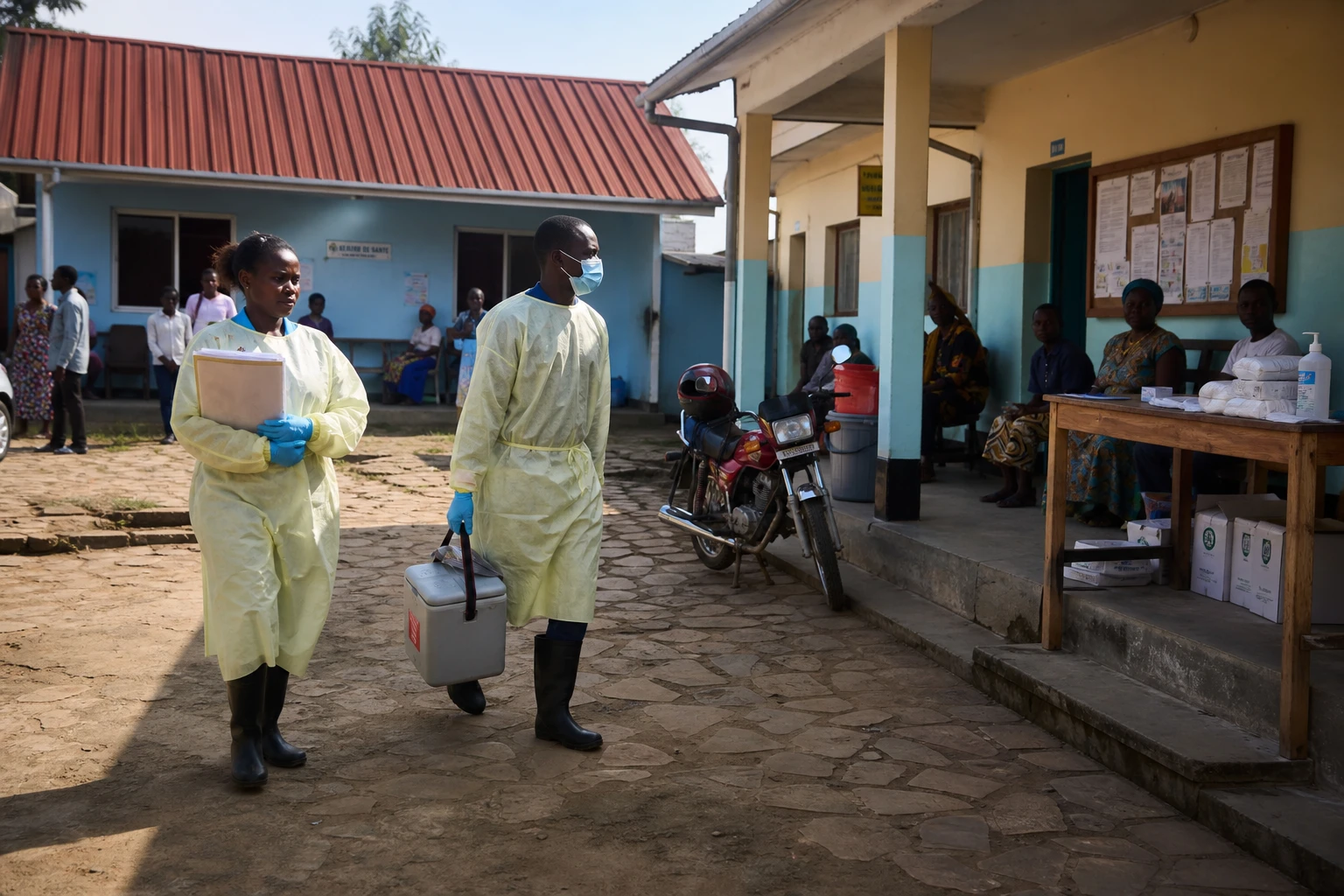
In eastern Democratic Republic of the Congo, an epidemic is never measured in figures alone. It is also measured by the distance between a health centre and a village, the movement of combatants, blocked roads, and whether or not health teams are trusted. It is against this backdrop that the Ebola outbreak linked to the Bundibugyo variant continues to spread, as Congolese authorities report a heavy toll and health partners say they are still trying to contain its spread.
The outbreak began in Ituri, a volatile border province, before spreading to other parts of North Kivu and South Kivu. This geography matters as much as the virus itself. In areas where insecurity, population displacement and weak health infrastructure overlap, the response must tackle a highly contagious disease while contending with conditions that hamper testing, contact tracing and safe burials.
A heavy toll, but an epidemic still on the move
The toll reported by the Congolese authorities stood at 2,011 deaths out of 4,381 confirmed cases. The reported case fatality rate was 45.9%. Yet Health Minister Samuel Roger Kamba said the peak had not yet been reached, while expressing hope that the spread would be brought under control in the coming months. Such projections should be treated with caution: in a crisis this fluid, the curves can change quickly, especially when some patients remain outside health facilities.
This outbreak is a reminder of another reality in the DRC: the country has experience of Ebola, but never confronts it under ideal conditions. It has already faced several outbreaks, including the major 2018-2020 crisis, the deadliest in its history, with nearly 2,300 deaths according to official figures. The new outbreak has therefore crossed a symbolic threshold. It has yet to match the most dramatic episode, but already ranks among the country’s most serious health crises in recent years.
International organisations have treated the outbreak as a regional threat. The WHO declared it a public health emergency of international concern on 17 May 2026, and the response was subsequently raised to continental level by Africa CDC, which declared the outbreak a public health emergency of continental security. This terminology is not merely symbolic: it means an outbreak in Ituri can quickly become an issue for all of Central Africa and the Great Lakes region, particularly when cross-border movements are intense.
Bundibugyo, a less familiar but no less dangerous variant
The most important scientific point concerns the strain involved. The current outbreak is linked to the Bundibugyo virus, an Ebola variant distinct from the Zaire strain, which is better known to the public. The WHO says there is no approved specific treatment or vaccine targeting this variant, although standard public health measures remain effective: rapid isolation, contact tracing, infection prevention, safe burials and community information.
A study published in Nature Medicine provided a key finding: the genome of the Ugandan index case linked to the current outbreak forms a distinct lineage from variants observed in 2007-2008 and 2012. The authors say this points to a new animal-to-human transmission, followed by human-to-human transmission. The animal reservoir has not been identified. This hypothesis reinforces the possibility that the virus can re-emerge through routes that are still poorly documented, including in areas where surveillance remains patchy.
The study also highlights an often under-estimated challenge: diagnosis. The first Ugandan patient described had travelled from the DRC and was identified only after a post-mortem examination. In areas where Ebola fever initially resembles common illnesses such as malaria or certain gastrointestinal infections, delays in confirmation allow the virus to spread undetected. This is precisely where genomic sequencing, community surveillance and the capacity of laboratories in Kinshasa and the provinces become decisive.
Trust, mobility and funerals: three decisive fronts
On the ground, response teams face a familiar obstacle: mistrust. In several previous outbreaks, some people were reluctant to report the sick or accept the safe burial of the dead. This time too, the WHO stresses the central role of communities, religious leaders, women’s associations and young people in adapting the health response to local realities. Public health measures cannot be sustained without trusted social networks.
The authorities and their partners must also contend with another fact: many deaths occur outside health facilities. Speaking in Bunia, the WHO Regional Director for Africa said teams were seeing only a proportion of those affected. Although this picture may vary between areas and over time, it reflects a reality widely documented in Congolese epidemic crises: unrecorded deaths distort the toll, delay alerts and make it harder to break chains of transmission.
The response now relies on Ervebo, the vaccine already used against some Ebola outbreaks. The WHO says a global stockpile of 500,000 doses is available for emergency responses, with a ring vaccination strategy targeting contacts and the most exposed personnel. But the vaccine is not specific to Bundibugyo, and experts recommend assessing its use in the current outbreak. This points to a structural limitation: Central Africa remains exposed to variants for which fewer tools are available than for the Zaire strain, despite years of accumulated experience.
For the DRC, the stakes therefore go beyond this health crisis. They concern the state’s capacity to maintain essential services in fragile provinces, co-operation with neighbouring Uganda, and Africa’s role in preparing for emerging epidemics. The situation shows how a local event can quickly become cross-border, then continental. It is also a reminder that in the Great Lakes region, public health is shaped as much by laboratories as by roads, markets, health centres and regional co-ordination mechanisms.