Egypt
 Libya
 Morocco
 Sudan
 Tunisia
 Benin
 Burkina Faso
 Cabo Verde
 Côte d'Ivoire
 Ghana
 Guinea
 Guinea-Bissau
 Liberia
 Mali
 Mauritania
 Niger
 Nigeria
 Senegal
 Sierra Leone
 The Gambia
 Togo
 Cameroon
 Central African Republic
 Chad
 DR Congo
 Equatorial Guinea
 Gabon
 Republic of the Congo
 São Tomé and Príncipe
 Burundi
 Comoros
 Djibouti
 Eritrea
 Ethiopia
 Kenya
 Madagascar
 Malawi
 Mauritius
 Mozambique
 Rwanda
 Seychelles
 Somalia
 South Sudan
 Tanzania
 Uganda
 Angola
 Botswana
 Eswatini
 Lesotho
 Namibia
 South Africa
 Zambia
 Zimbabwe
A first at the head of the lower house
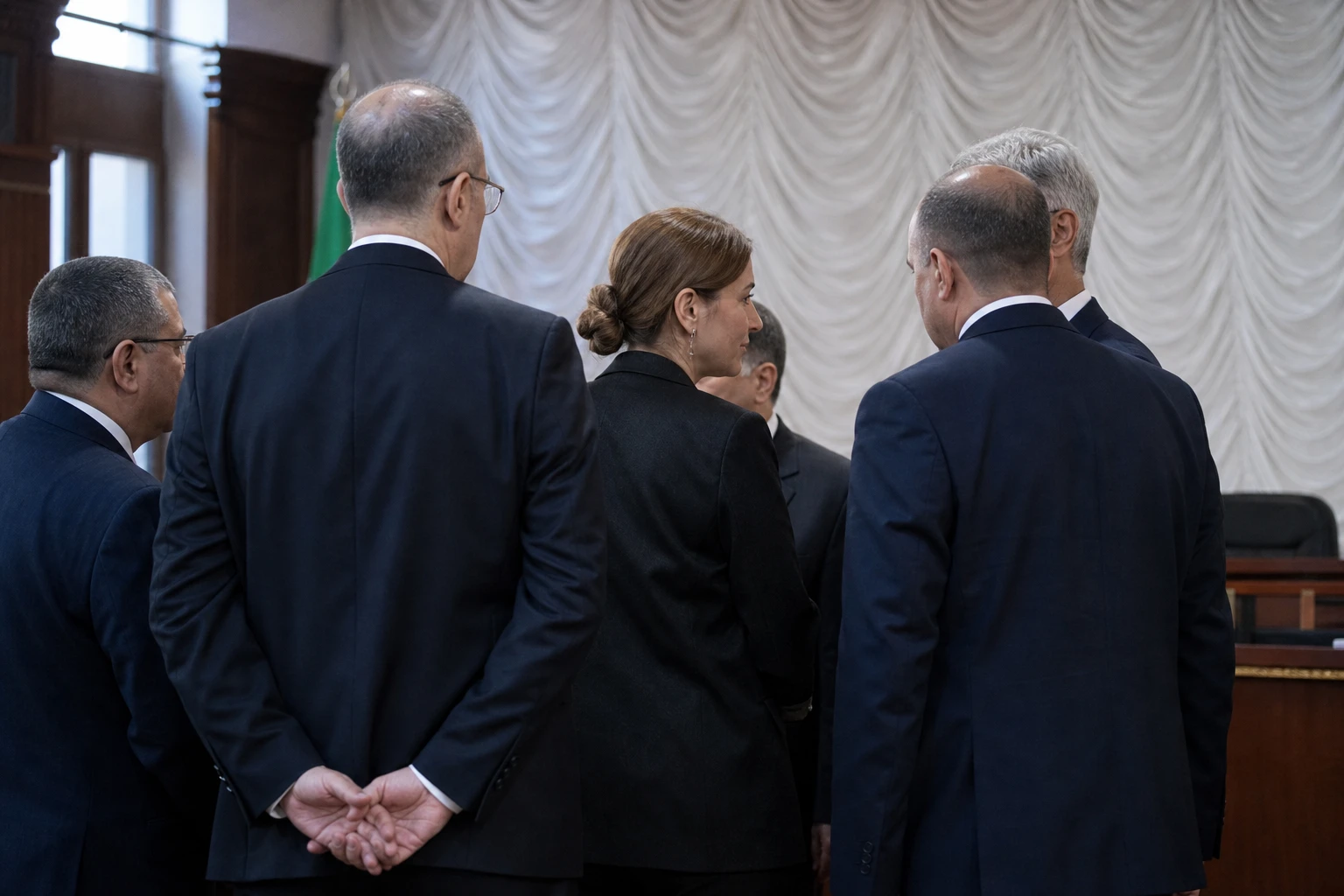
In Algiers, a signal often matters as much as the decision itself. The election of a woman as president of the National People’s Assembly (APN, the lower house of Parliament) opens a political chapter that Algerians view both as an institutional marker and as a test of the credibility of national representation.
The new president is a member of the National Liberation Front (FLN), the historic party of independence. A doctor specialising in allergology and clinical immunology, she worked at Béni Messous University Hospital, then at the Algiers health directorate. Her elected career took her through the municipality of Bordj El Bahri and the Algiers Provincial People’s Assembly before she entered the APN in 2026.
The choice is not insignificant in a country where parliamentary life remains closely shaped by national political balances. The APN is emerging from legislative elections held on 2 July 2026, amid low turnout and a measured reshaping of political forces. Provisional results put the FLN in first place with 90 of 407 seats, pending final confirmation of the new parliamentary balance.
A Parliament still far from gender parity
The female symbolism carries particular weight here. The first results released after the legislative elections reported 25 women elected to just over 400 seats, or slightly more than 6% of the chamber. However, data from the Inter-Parliamentary Union indicate that, as of recently, Algeria has 32 women MPs out of 407 seats, showing that the picture of women’s representation can change as results are confirmed and members are replaced.
This discrepancy points to a broader reality: women’s access to political responsibility is advancing, but slowly. During the campaign before the vote, the National Independent Authority for Elections had also stressed that waiving the requirement for female representation on candidate lists did not remove the goal of women’s presence, but only the quota required in certain cases. In other words, the place of Algerian women in institutions remains a political question, not merely an arithmetic one.
Low voter turnout also sheds light on this appointment. According to APS, turnout in the 2 July 2026 legislative elections stood at 21.24% inside the country and 10.75% among the national community abroad. In this context, the visibility of the first woman at the head of the APN has a strong institutional effect, but it resolves neither the question of abstention nor that of the relationship between voters and Parliament.
What this means for Algeria and beyond
In Algeria, the presidency of the APN occupies a key place in the architecture of the state. It comes after the president of the republic, the president of the Council of the Nation and the president of the Constitutional Court in the order of precedence. Entrusting this role to a woman for the first time says something about changing forms of representation, but also about how the authorities are seeking to give the new legislature a more open face.
The new president’s profile is central to this. A doctor by training, rooted in the public hospital system and a long-standing FLN activist, she was elected locally before entering Parliament. She embodies a conventional career path in Algerian politics, where administrative and party experience matter as much as media exposure. This kind of profile reassures party structures, but also invites scrutiny of how the APN will exercise its powers of debate, oversight and voting on legislation.
For Algerian women, the stakes go beyond the appointment itself. A woman president can open symbolic doors in a space where under-representation remains pronounced. But this does not amount to automatic transformation. The real measure of change will be seen in the composition of parliamentary leadership, women MPs’ access to strategic committees and the institution’s ability to bring social, health and economic priorities to the fore rather than settling for a display of balance.
Regionally, Algeria’s case also resonates across North Africa and, more broadly, the continent. In several African parliaments, women’s representation is increasing, but unevenly and often depending on quotas, dominant parties or the balance of forces during political transitions. Algeria is part of a continental trend closely monitored by the Inter-Parliamentary Union: women are becoming more visible, but their access to leadership posts is progressing more slowly than their entry into assemblies.
A chapter to follow over time
The significance of this election will therefore be measured by what follows. The immediate institutional timetable involves completing the installation of the tenth legislature, forming parliamentary groups and setting legislative priorities. In a Parliament dominated by the FLN, with the RND gaining ground and independents losing seats, the question will be whether this first woman president of the APN brings in a more transparent way of working or merely a change of face.
Across Africa, this chapter is a reminder of an often-underestimated truth: representation is not only about numbers, but also about positions of power. A woman leading Algeria’s lower house, in a country at the crossroads of the Maghreb and an influential diplomatic actor in the Mediterranean and African basins, sends a political signal that extends beyond the elected official herself. The question now is whether the institution will follow through with actions, debates and decisions worthy of its new image.