Algeria
 Egypt
 Libya
 Morocco
 Sudan
 Tunisia
 Benin
 Burkina Faso
 Cabo Verde
 Côte d'Ivoire
 Ghana
 Guinea
 Guinea-Bissau
 Liberia
 Mali
 Mauritania
 Niger
 Nigeria
 Senegal
 Sierra Leone
 The Gambia
 Togo
 Cameroon
 Chad
 DR Congo
 Equatorial Guinea
 Gabon
 Republic of the Congo
 São Tomé and Príncipe
 Burundi
 Comoros
 Djibouti
 Eritrea
 Ethiopia
 Kenya
 Madagascar
 Malawi
 Mauritius
 Mozambique
 Rwanda
 Seychelles
 Somalia
 South Sudan
 Tanzania
 Uganda
 Angola
 Botswana
 Eswatini
 Lesotho
 Namibia
 South Africa
 Zambia
 Zimbabwe
Bangui’s nights still tell a story
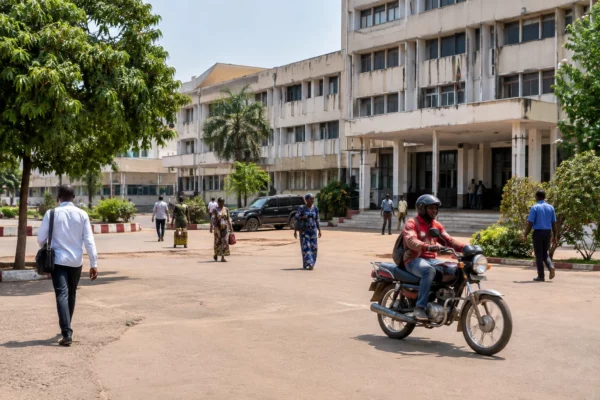
In Bangui, some places are more than just addresses. They are part of the collective memory. At Km5, in the city’s third district, a former bar and dance hall still evokes an era when the Central African capital lived to the beat of orchestras, electric guitars and long weekend evenings.
This setting speaks to several generations of Central Africans. It recalls a time when music was more than entertainment. It also shaped social gatherings, neighbourhood solidarity and part of the nighttime economy. In a city marked by successive crises, this cultural memory has particular value.
Km5, where culture and commerce meet
Km5, often called Cinq Kilos, remains one of Bangui’s main commercial crossroads. It is home to shops, workshops, transport services, makeshift restaurants and a constant flow of goods and people. In the Central African capital, the area has long been described as an economic lifeline, despite the tensions that have affected it over the years.
Part of the modern Central African music scene also flourished in this same environment. Dance venues served as neighbourhood stages, informal rehearsal rooms and showcases for orchestras. Before the rise of social media and major cultural venues, a lively bar could launch a career and establish a style.
The Central African Republic is a member of CEMAC, the Economic and Monetary Community of Central Africa. Within this regional bloc, Bangui shares with Brazzaville, Kinshasa, Libreville and Yaoundé a musical history shaped by exchanges, cross-pollinating influences and the movement of rhythms. Rumba, urban popular music and dance music have long travelled from one bank of the Congo River to the other.
A dance hall turned musical incubator
The former ABC bar and dance hall held a distinctive place in this history. Accounts preserved in Bangui’s cultural memory describe it as one of the venues where Central African orchestras found their first audiences. Musicians performed there for regulars from different parts of the city. The venue was not just a place to dance. It launched careers and established repertoires.
The Central African music scene was built in spaces of this kind. Popular accounts of the country’s musical history recall that Bangui had several iconic dance halls, including the ABC, the Rex, the Bar Étoile and other venues that became landmarks for music lovers. They hosted orchestras blending Congolese influences, songs in local languages, accounts of everyday life and the concerns of urban youth.
At Km5, the ABC also embodied a distinctly Bangui social life. People went there after work, on Saturday nights or to hear the latest songs. They ate, listened and watched the city. The venue was part of the popular nighttime economy that provided livelihoods for technicians, waiters, brochette sellers, small-scale transport operators and artists.
What nostalgia says about the country’s ruptures
Today, the building has a new use. It serves as a goods depot. This shift says much about Bangui’s recent history. Political and security crises have weakened the city’s social spaces. In several neighbourhoods, nightlife venues have lost their central role as more immediate economic survival activities take priority.
This transformation affects more than music. It also touches on the place of culture in the Central African economy. When a dance hall becomes a warehouse, an entire chain contracts: fewer stages for bands, fewer jobs for freelance performers and technicians, and fewer spaces in which to pass on living heritage. The loss is therefore artistic as well as social.
For residents of Km5, however, the memory of the ABC remains tangible. It is a reminder that Bangui was a place of creativity, not merely a territory in crisis. It also shows that a neighbourhood often described through its tensions has supported, and continues to support, intense commercial and cultural vitality.
A Bangui memory that extends beyond the Central African Republic
The story of the ABC also speaks to Central Africa as a whole. Across the region, major capitals have often built their musical identities around popular venues: bars and dance halls, neighbourhood clubs, modest studios and nighttime stages. This urban fabric nurtured part of the continent’s cultural heritage long before the arrival of major entertainment industries.
Its reach is continental for another reason. African urban music has always developed amid regional movement and exchange. In Bangui, artists drew as much on local traditions as on sounds from neighbouring Congo. This cultural fluidity shaped a distinctly Central African musical modernity, rooted in everyday life and open to outside influences.
Ultimately, what the former ABC represents is a broader question: how can the places that hold a city’s popular memory be preserved when economic urgency, pressure on land and political upheaval transform them? In Bangui, the answer may lie less in nostalgia than in recognising these spaces as part of the urban heritage. The continuity of the Central African capital’s culture is at stake, in part, here.