Algeria
 Egypt
 Libya
 Morocco
 Sudan
 Tunisia
 Benin
 Burkina Faso
 Cabo Verde
 Côte d'Ivoire
 Ghana
 Guinea
 Guinea-Bissau
 Liberia
 Mali
 Mauritania
 Niger
 Nigeria
 Senegal
 Sierra Leone
 The Gambia
 Togo
 Cameroon
 Chad
 DR Congo
 Equatorial Guinea
 Gabon
 Republic of the Congo
 São Tomé and Príncipe
 Burundi
 Comoros
 Djibouti
 Eritrea
 Ethiopia
 Kenya
 Madagascar
 Malawi
 Mauritius
 Mozambique
 Rwanda
 Seychelles
 Somalia
 South Sudan
 Tanzania
 Uganda
 Angola
 Botswana
 Eswatini
 Lesotho
 Namibia
 South Africa
 Zambia
 Zimbabwe
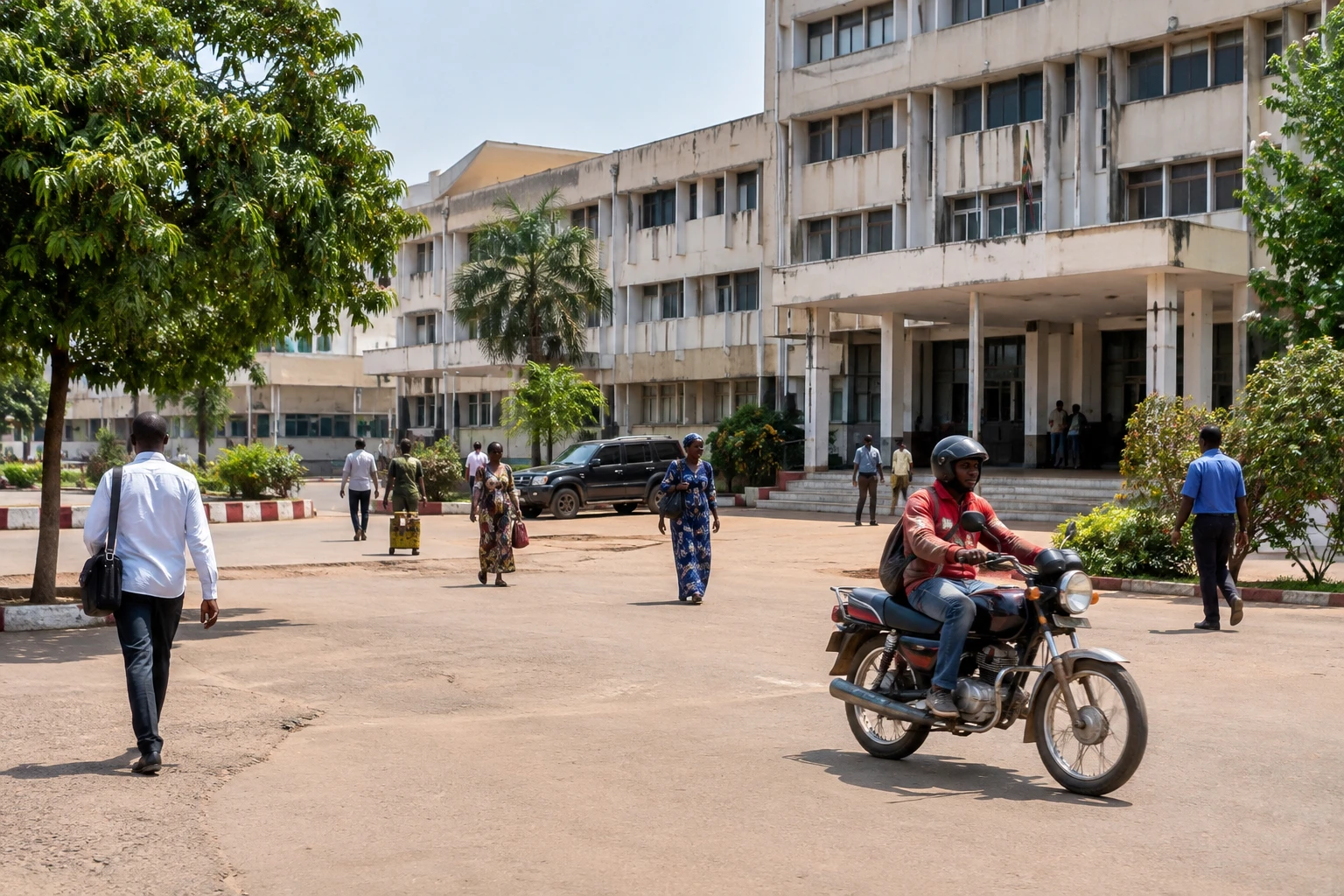
In Bangui, the cost of fuel does not stop at the pump. It feeds into taxi-moto fares, deliveries and everyday journeys. The march announced for Friday 13 November by the Republican Bloc for the Defence of the Constitution (BRDC) therefore carries an immediate demand, but also raises a broader question: who absorbs rising costs in an economy where transport affects almost every activity?
A rise felt across the economy
The Central African Republic produces no oil and relies on imports to supply its market. Some fuel passes through the port of Douala in Cameroon. The country’s landlocked position makes prices sensitive to transport costs, supply pressures and movements in international markets.
The new price schedule came into force on 2 October. For consumers, the price of a litre of petrol rose from 1,050 to 1,150 CFA francs, while diesel rose from 1,250 to 1,400 CFA francs. These figures have been reported by several Central African and international media outlets. The government justified the decision by citing higher supply costs and pressure on public finances. President Faustin-Archange Touadéra explained, in particular, that the state could no longer absorb the increase through subsidies alone.
Protests first took shape on 12 October, when civil society organisations called for a “city-wide shutdown” in Bangui. The response was uneven: shops and a few schools closed, while civil servants went to work. Accounts differ on the scale of the mobilisation, so it should not be described as a general shutdown of the capital.
Against this backdrop, the BRDC, an opposition platform, is calling for a march starting at 6am. According to the arrangements communicated by the authorities, the procession is to set off from Marabéna roundabout, proceed along Avenue des Martyrs and Avenue Conjugo, then reach United Nations roundabout. The Ministry of Public Security has authorised the gathering, while asking organisers to ensure it remains peaceful and does not disrupt traffic.
Conditional approval amid tension
The authorisation was granted after several days of controversy. The ministry noted that the BRDC was not formally registered with the Ministry of Territorial Administration, but said it would uphold the principle of public freedoms. The platform’s leaders have been urged to prevent disturbances and follow the security forces’ instructions.
The BRDC is also calling for the release of five civil society leaders arrested after the call for the 12 October shutdown. Their situation adds a judicial and political dimension to the mobilisation. On 21 October, at a meeting with civil society representatives, President Touadéra said the individuals concerned were in the hands of the justice system. The organisations present also called for a regular forum for consultation with the authorities.
The march does not have universal support. Organisations close to the government have called for a boycott and carried out awareness-raising activities in Bangui neighbourhoods. Threats of a counter-demonstration have also been reported. These calls do not prove that a confrontation will take place, but they make the management of routes and the safety of participants particularly important. Minusca, the United Nations peacekeeping mission in the Central African Republic, said it was ready to help ensure security, according to information released before the gathering.
Different effects on households and businesses
The increase hits first those who buy fuel to work: taxi-moto drivers, chauffeurs, small traders and informal workers. They face a difficult choice: raise their fares and risk losing customers, or keep prices unchanged and accept lower margins. Costs can then be passed on to transported goods and services.
Bangui residents feel the pressure in their daily journeys. Outside the capital, the effects also depend on distances, roads and the availability of transport. Fuel costs can make it more expensive to move goods to secondary cities and rural areas, but the scale of the impact varies by region and sector. The effect is therefore not uniform across the Central African population.
The government points to another imperative: limiting the cost of subsidies in order to fund public spending. The debate thus pits immediate protection of purchasing power against the state’s budgetary capacity. Transparency over how prices are set, import costs, taxes and margins could make this discussion more concrete. Civil society organisations have specifically called for the detailed publication of this price structure.
A political test that goes beyond the pump
The march comes amid a period in which fuel prices intersect with questions of freedom of assembly, dialogue with civil society and the treatment of those arrested. Its conduct will also show whether administrative approval can translate into a gathering without obstruction or confrontation. At this stage, established facts must be distinguished from concerns expressed by the various parties.
At regional level, reliance on imports and transport corridors highlights vulnerabilities shared by several landlocked countries in Central Africa. The Central African Republic belongs to CEMAC, an economic and monetary community of six Central African states. But this integration does not remove the specific constraints on its supply, including transit through Cameroon and logistical difficulties.
The next steps will unfold on two fronts: the authorities’ response to demands for lower prices and dialogue, and the judicial handling of the five detained leaders. For households and businesses alike, the immediate question remains the same: whether the increase will continue to be passed on to travel and goods, or whether an adjustment and consultation mechanism can limit its effects.