
 Algeria
 Egypt
 Libya
 Morocco
 Sudan
 Tunisia
 Benin
 Burkina Faso
 Cabo Verde
 Côte d'Ivoire
 Ghana
 Guinea
 Guinea-Bissau
 Liberia
 Mali
 Mauritania
 Niger
 Nigeria
 Senegal
 Sierra Leone
 The Gambia
 Togo
 Central African Republic
 Chad
 DR Congo
 Equatorial Guinea
 Gabon
 Republic of the Congo
 São Tomé and Príncipe
 Burundi
 Comoros
 Djibouti
 Eritrea
 Ethiopia
 Kenya
 Madagascar
 Malawi
 Mauritius
 Mozambique
 Rwanda
 Seychelles
 Somalia
 South Sudan
 Tanzania
 Uganda
 Angola
 Botswana
 Eswatini
 Lesotho
 Namibia
 South Africa
 Zambia
 Zimbabwe
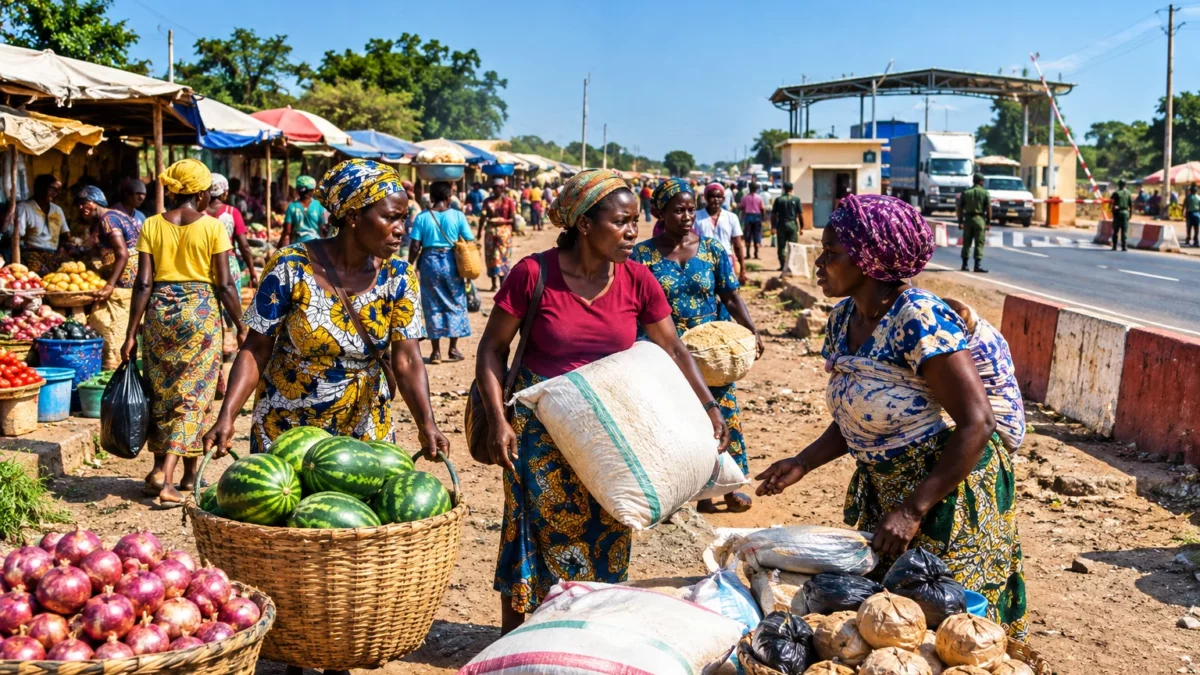
In Yagoua, in Cameroon’s Far North, selling rice biscuits, ginger or sesame oil in Chad can require much more than a journey of a few kilometres. Customs checks, fees and insecurity complicate trade on which thousands of small traders depend. The border connects markets; it can also slow their business.
A shared area, several regional frameworks
The Lake Chad Basin directly concerns Cameroon, Chad, Niger and Nigeria, but its institutional structure extends further. The Lake Chad Basin Commission (LCBC), established in 1964 by these four states, also includes the Central African Republic and Libya. Its mandate covers cooperation and shared resources, among other things. Trade, meanwhile, falls within different regional economic areas: CEMAC for Cameroon, Chad and the Central African Republic; ECOWAS for Niger and Nigeria.
These memberships do not always align with traders’ daily routes. A product can cross a border between two neighbouring countries without benefiting from simple, uniform procedures. The African Continental Free Trade Area (AfCFTA), which aims to facilitate trade between African countries, adds a common framework, but its benefits depend on its practical implementation.
The LCBC thus distinguishes between the basin shared by six states and the narrower area where some trade flows are concentrated. In Yaoundé, the regional forum held from 3 to 5 November 2026 brought together institutions, economic stakeholders and civil society representatives to discuss employment and cross-border trade. The difficulties raised relate in particular to routes linking Cameroon with Chad, Niger and Nigeria. Cameroon’s Ministry of the Economy, Planning and Regional Development confirms that the meeting was held in Yaoundé.
Formalities weigh on small consignments
A women’s cooperative in Yagoua illustrates the gap between the market’s potential and the conditions for accessing it. Its members sell agricultural and processed products in Chad: watermelons, onions, rice, ginger, rice biscuits and sesame oil. For these women traders, crossing the border involves customs formalities on both sides. When procedures cost time and money, small consignments are particularly exposed: they have less room to absorb delays and fees.
Data cited by the LCBC during the Yaoundé discussions put women’s share of cross-border trade in the basin at between 60 and 70 per cent. A separate figure, also cited at the forum, estimates their share at 74 per cent in Nigeria’s Borno State. In the absence of a published detailed methodology that would allow these estimates to be compared, they should be read as attributed estimates of scale, not as a uniform measure of all trade.
Informal does not mean that these activities are insignificant. The term often refers to trade that falls outside official procedures and statistics, even as it supplies markets and supports household incomes. The Economic Commission for Africa says this under-reporting distorts the measurement of regional trade. It also notes that women traders face specific obstacles: procedures that are difficult to understand, crossing costs, informal payments and risks of harassment. An ECA initiative launched in Central Africa in 2026 aims specifically to document these activities more effectively and make it easier for women-owned businesses to access AfCFTA mechanisms.
Security and trade cannot be addressed separately
In Borno State, in north-eastern Nigeria, traders must also contend with violence by Boko Haram and other armed groups. At the forum, the Nigerian state’s commissioner for planning and economic development described the fear for people and their goods. This statement reflects a real risk, without reducing the region’s entire economy to insecurity. Trade, agriculture, livestock farming and fishing continue to shape local activity, under conditions that vary greatly by place and time.
Checks and restrictions may serve security imperatives, but their proliferation or lack of transparency also complicates movement and the circulation of goods. The effects are not evenly distributed. Businesses able to pay for transport, storage and administrative procedures are better placed to withstand delays. Women selling small quantities, young entrepreneurs and producers far from major routes have fewer resources to get around a closed checkpoint or an unexpected cost.
The response cannot therefore be limited to announcing a regional market. ECA experts at the Yaoundé forum called for one-stop cross-border facilities to bring procedures together, as well as rules of origin adapted to small businesses. These rules determine the conditions under which a product can be considered to originate in a country and qualify for trade benefits. They also recommended a regional mechanism to monitor non-tariff barriers — obstacles other than customs duties, such as repeated checks or differing procedures.
From promised integration to measurable change
For traders, integration is judged less by the signing of agreements than by the time spent at the border, the cost of transport and the ability to report an obstacle without risking the loss of their goods. The recommendations made in Yaoundé will therefore need to translate into accessible procedures, reliable information and a system for following up complaints. Simplified rules can encourage a shift to formal channels, provided costs and requirements remain proportionate to small consignments.
The challenge is also institutional. The countries concerned belong to several regional economic communities, while the LCBC provides a framework for cooperation across the basin. Coordination between customs administrations, local authorities and regional organisations is needed to prevent measures adopted in one country from being contradicted at the next checkpoint. The LCBC, headquartered in N’Djamena, can facilitate this dialogue, but implementation of the reforms depends on the states.
At the continental level, AfCFTA promises to broaden market access, but it will not automatically remove the obstacles encountered in Yagoua, Bongor or along north-eastern Nigeria’s trade corridors. The challenge is to connect continental commitments with the realities of border markets. Progress will be measured by the effective establishment of one-stop facilities, a reduction in redundant checks and women traders’ ability to benefit from preferential rules without facing procedures beyond their means.



