Algeria
 Egypt
 Libya
 Morocco
 Sudan
 Tunisia
 Benin
 Burkina Faso
 Cabo Verde
 Côte d'Ivoire
 Ghana
 Guinea
 Guinea-Bissau
 Liberia
 Mali
 Mauritania
 Niger
 Nigeria
 Senegal
 Sierra Leone
 The Gambia
 Togo
 Cameroon
 Chad
 DR Congo
 Equatorial Guinea
 Gabon
 Republic of the Congo
 São Tomé and Príncipe
 Burundi
 Comoros
 Djibouti
 Eritrea
 Ethiopia
 Kenya
 Madagascar
 Malawi
 Mauritius
 Mozambique
 Rwanda
 Seychelles
 Somalia
 South Sudan
 Tanzania
 Uganda
 Angola
 Botswana
 Eswatini
 Lesotho
 Namibia
 South Africa
 Zambia
 Zimbabwe
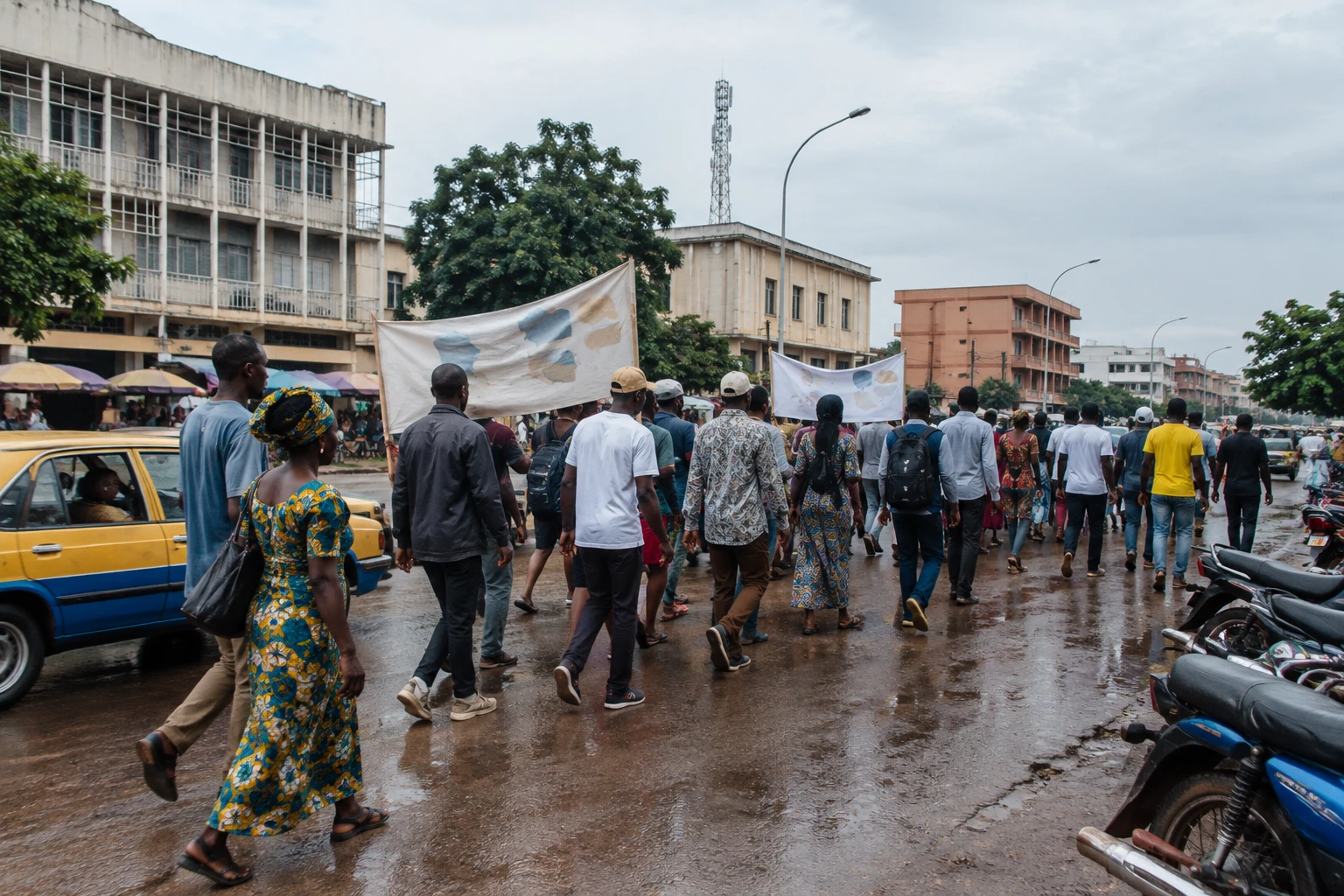
In Bangui, the price of fuel affects far more than travel: it also drives up delivery costs, work-related journeys and, indirectly, the prices of goods sold in markets. On 13 November 2026, a march organised by the Republican Bloc for the Defence of the Constitution (BRDC) brought several hundred people together over this concern and another demand: the release of five civil society leaders arrested in October.
A protest at the intersection of economic concerns and civil liberties
The march took place in the Central African capital, along Avenue des Martyrs, despite the rain. Participants walked with banners and sang patriotic songs. According to reports from the scene, Central African security forces and the United Nations Multidimensional Integrated Stabilization Mission in the Central African Republic (Minusca) escorted the procession. No major incidents were reported.
The BRDC, a coalition of opposition parties, had called for a protest against the recent rise in fuel prices and the high cost of living. It also demanded the release of five activists arrested on 15 October, following a call for a “dead city” day on 12 October. The names of Élysée Nguémalé and Quentin Ngouando were cited by one participant; the other people were not identified in the information available.
BRDC coordinator Crépin Mboli-Goumba called for fuel prices to return to 850 FCFA. He also denounced the decline in purchasing power and called for justice to be applied without distinction between citizens and political leaders. These remarks express the opposition’s demands; on their own, they do not constitute independent verification of price levels or the legal situation of those detained.
Price rises have effects beyond the pump
In the Central African Republic, a Central African country, the cost of travel directly affects everyday activity. A rise in fuel prices can make taxi or motorbike journeys, the transport of goods and workers’ travel expenses more expensive. Households that rely on these services are therefore exposed to knock-on effects, while traders must decide whether to absorb the costs or pass them on in their prices.
The consequences are not the same for everyone. In Bangui, people who travel regularly and small transport businesses may feel the increase quickly. In areas far from the capital, the delivery of goods and access to services also depend on the cost and availability of fuel. The protest nevertheless took place in Bangui: on its own, it cannot measure the extent of discontent across the country.
The call to bring the price per litre down to 850 FCFA is a political demand made by the BRDC. Assessing the increase and its causes would require the official price schedule, the date it came into force and data on supply. The information cross-checked here does not allow these points to be established independently. The figure must therefore remain attributed to the opposition platform.
Arrests fuel political dispute
The march thus links an economic issue to the exercise of civil liberties. The BRDC connects the arrests made after the call for a “dead city” day to its demands for the restoration of the rule of law. As the authorities are not mentioned in the information available about the gathering, the precise reasons for the arrests and subsequent legal proceedings cannot be presented here as established facts.
This dispute forms part of tense relations between the opposition and the Central African authorities. In October, the BRDC called for a protest intended to disrupt economic activity. The 13 November march gave the coalition a new platform from which to voice its demands on the streets. Organisations close to the authorities, for their part, have challenged the protest and announced plans to organise a counter-protest calling for the BRDC to be dissolved. This announcement points to political competition over the streets, but does not prove that another gathering will actually take place.
A national issue in a regional context
The Central African Republic is a member of the Economic and Monetary Community of Central Africa (CEMAC), which brings together six Central African countries and shares the Central African CFA franc. Crépin Mboli-Goumba’s reference to the “CFA franc zone” refers to this wider monetary area. It is not, however, enough to establish that prices in the Central African Republic are the highest in the region: a reliable comparison would require dated, comparable prices across countries.
For Bangui, the immediate challenge is to address difficulties with purchasing power and the treatment of those arrested. For political actors, the way the authorities manage demonstrations and respond to demands will affect trust between institutions, the opposition and civil society. Minusca features in the security arrangements reported for this march; its role does not replace that of the national authorities in maintaining public order.
Two developments are therefore worth watching: changes to official fuel prices and decisions concerning the five detained leaders. A possible counter-protest, announced by organisations close to the authorities, could also prolong the political stand-off. At this stage, the 13 November gathering establishes the visibility of these demands in Bangui, but does not make it possible to conclude how much support they have among the population across the country.