
 Egypt
 Libya
 Morocco
 Sudan
 Tunisia
 Benin
 Burkina Faso
 Cabo Verde
 Côte d'Ivoire
 Ghana
 Guinea
 Guinea-Bissau
 Liberia
 Mali
 Mauritania
 Niger
 Nigeria
 Senegal
 Sierra Leone
 The Gambia
 Togo
 Cameroon
 Central African Republic
 Chad
 DR Congo
 Equatorial Guinea
 Gabon
 Republic of the Congo
 São Tomé and Príncipe
 Burundi
 Comoros
 Djibouti
 Eritrea
 Ethiopia
 Kenya
 Madagascar
 Malawi
 Mauritius
 Mozambique
 Rwanda
 Seychelles
 Somalia
 South Sudan
 Tanzania
 Uganda
 Angola
 Botswana
 Eswatini
 Lesotho
 Namibia
 South Africa
 Zambia
 Zimbabwe
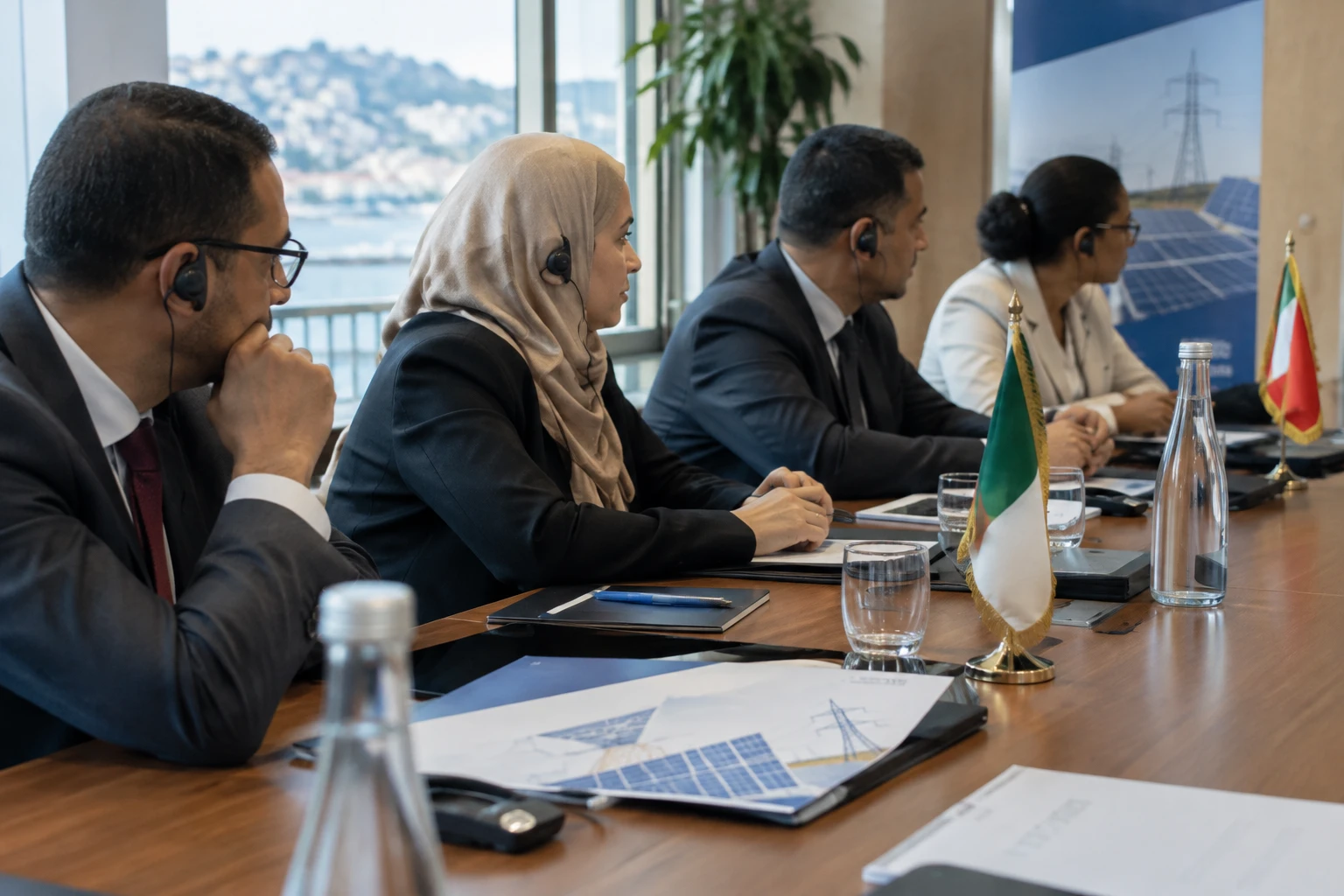
Solar electricity is gaining ground in El Oued, in a country where almost all power generation still relies on gas. The gap between these two realities sums up Algeria’s challenge: rapidly building renewable capacity, then ensuring it plays a greater role in actually supplying the grid.
A new milestone in south-eastern Algeria
On 26 October 2026, Algerian authorities inaugurated the Foulia solar power plant in El Oued province. Its announced capacity is 300 megawatt-peak (MWp), a measure of the panels’ theoretical maximum output under standard conditions. Algerian television and several national media outlets reported that it had entered service.
Foulia joins the plants at Tendla, in El Meghaïer province, and El Ghrous, in Biskra province. Both have a capacity of 200 MW and entered service in 2026, according to Algerian Radio. Together, the three installations represent 700 MW of announced solar capacity.
This total exceeds the 437 MW of photovoltaic capacity recorded in Algeria at the end of 2024 in statistics from the International Renewable Energy Agency (IRENA), the latest year covered by the table consulted. This comparison gives an idea of the scale of the change, but it does not directly measure the electricity actually generated: a plant can be installed without operating at full capacity all the time.
Installed capacity is not enough
Solar’s share of the electricity mix remains very small compared with gas. In its report Electricity 2026, the International Energy Agency (IEA) estimates that gas-fired power plants supply 99% of Algeria’s electricity. The report also forecasts average annual growth of more than 3.6% in gas-fired electricity generation between 2026 and 2030.
The expansion of solar plants therefore does not, by itself, mean that gas consumption will fall. If electricity demand rises rapidly, new renewable installations can meet some of that increase without immediately replacing thermal power plants. This is one of the issues behind Algeria’s target of raising solar capacity to 15,000 MW by 2035.
To assess the projects’ actual impact, it will be necessary to track the energy they feed into the grid, not just their rated capacity. Grid connections, equipment availability, maintenance and the balance between generation and demand also matter. Solar output depends on sunshine; the grid must therefore be able to manage these fluctuations and call on other sources when generation falls.
Impacts also play out locally
These projects shift part of energy investment towards inland and south-eastern provinces. However, local benefits will depend on lasting returns: jobs in operation and maintenance, training, contracts for businesses and stronger electricity infrastructure. Capacity announcements alone do not show how many jobs will be created or how many local businesses will benefit.
The change also affects consumers. In large cities such as Algiers, demand depends in particular on households, services and industry. In areas where the plants are located, their contribution will also depend on the grid’s capacity to transport electricity to places of consumption. An installation in a sunny region therefore does not automatically ensure a more reliable power supply for nearby residents.
Gas also retains a central role in Algeria’s economy and energy trade. Reducing its share of electricity generation is therefore a matter of how the grid operates, but also of balancing domestic needs, export revenues and investment. Renewables could help preserve more gas for other uses or for sale, but this effect will depend on the pace of demand growth and actual solar generation.
A transition to be embedded in regional co-operation
In North Africa, Algeria’s solar development is part of a region where several countries are seeking to diversify their supplies and strengthen electricity interconnections. The Arab Maghreb Union (AMU), a regional organisation that includes Algeria, Tunisia, Libya, Morocco and Mauritania, provides a political framework for co-operation. However, the realisation of regional exchanges depends on decisions, infrastructure and agreements between states.
Across the continent, Algeria’s contrasting picture is a reminder that increasing renewable capacity and transforming the electricity mix are two distinct steps. The challenge is not limited to installing panels: power plants must be connected, their output integrated into the grid, and supplementary supply from other sources organised. The next measure to watch will therefore be the electricity actually delivered by the new units, as well as solar’s share in national statistics.
With Foulia, Algeria is adding a significant installation to its photovoltaic fleet. But in the long run, the decisive figure will not simply be the number of megawatts inaugurated. It will be the share of solar electricity actually fed into a system still powered almost entirely by gas.



