
 Egypt
 Libya
 Morocco
 Sudan
 Tunisia
 Benin
 Burkina Faso
 Cabo Verde
 Côte d'Ivoire
 Ghana
 Guinea
 Guinea-Bissau
 Liberia
 Mali
 Mauritania
 Niger
 Nigeria
 Senegal
 Sierra Leone
 The Gambia
 Togo
 Cameroon
 Central African Republic
 Chad
 DR Congo
 Equatorial Guinea
 Gabon
 Republic of the Congo
 São Tomé and Príncipe
 Burundi
 Comoros
 Djibouti
 Eritrea
 Ethiopia
 Kenya
 Madagascar
 Malawi
 Mauritius
 Mozambique
 Rwanda
 Seychelles
 Somalia
 South Sudan
 Tanzania
 Uganda
 Angola
 Botswana
 Eswatini
 Lesotho
 Namibia
 South Africa
 Zambia
 Zimbabwe
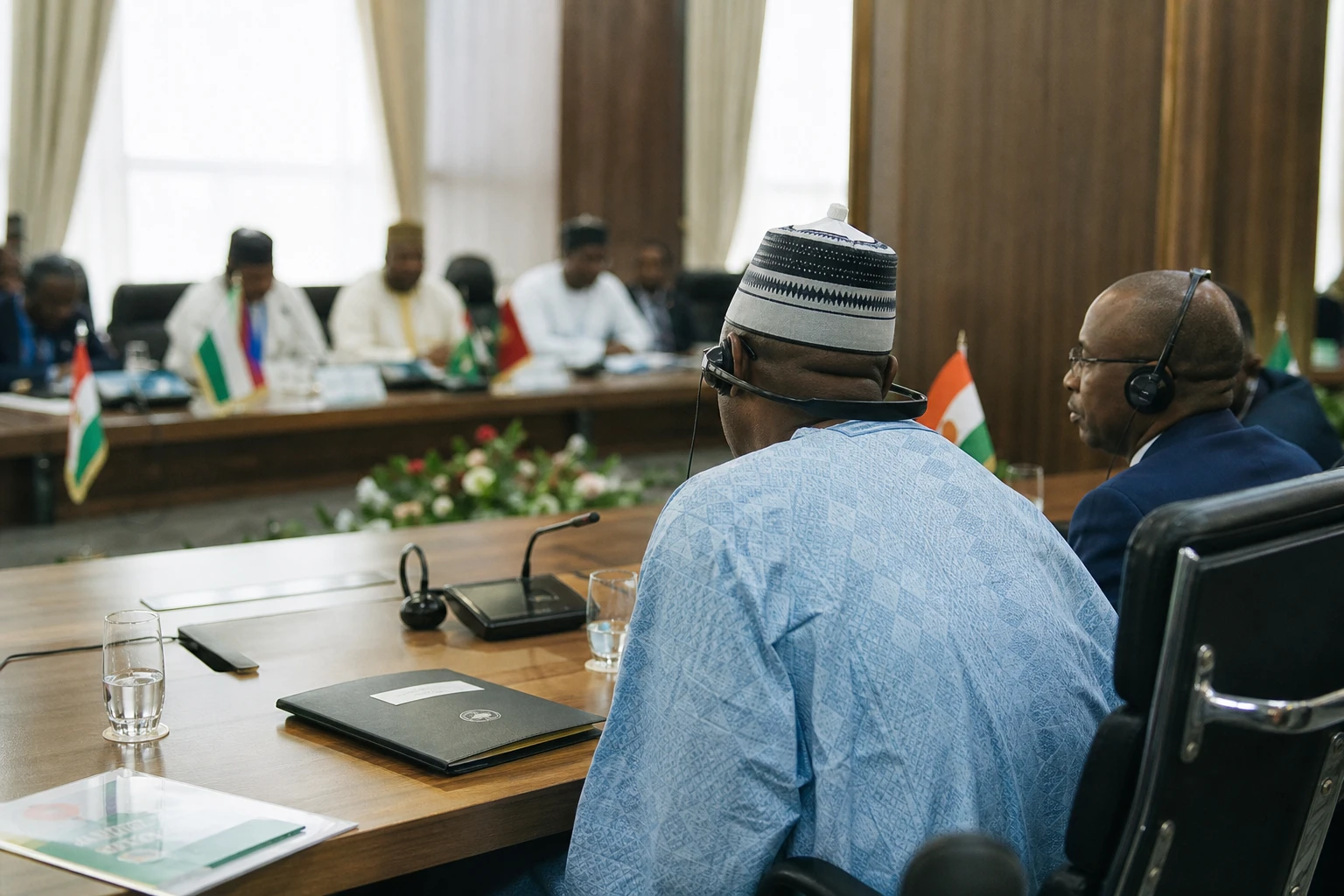
Niamey on edge as Algiers-Niamey ties tighten
In Niamey, security is no longer determined solely on the military front. It is also reflected in the speed of alliances, the signals sent to neighbours and a state’s ability to control its skies as well as its borders. Following the mutiny in the Nigerien capital on 28-29 August 2026, Niger received military support from Algeria that says much about the new Sahelian landscape.
Algiers’ move is part of a bilateral relationship that the two capitals have sought to present as strategic. It also comes amid a reshaped Sahel, where Niger, Mali and Burkina Faso have left ECOWAS, the Economic Community of West African States, to strengthen their common framework, the Alliance of Sahel States. In this context, every equipment delivery and diplomatic statement carries immediate regional weight.
What happened in Niamey
According to information corroborated by several sources, soldiers attempted to take control of Air Base 101, located within the grounds of Diori Hamani International Airport, during the night of 28-29 August 2026, and fired on several sensitive sites in Niamey. The Nigerien authorities later announced that the situation had been contained. Niger’s official news agency and several African media outlets confirmed that dozens of arrests had followed, while information about the human toll initially circulated as claims attributed to security forces and state television.
The next day, the capital appeared to have returned to calm. This rapid restoration of order mattered as much politically as militarily. In a country ruled since 2023 by General Abdourahamane Tiani, the possibility of a split within the security apparatus served as a reminder of a simple reality: Niger’s stability still rests on fragile balances between the military hierarchy, the presidential guard, the air force and units stationed in the capital.
The regional response was immediate. The AES denounced an attempt at destabilisation and expressed support for Niger’s loyalist forces. Algiers, for its part, was among the first capitals to express solidarity with Niger. Algeria’s foreign ministry spoke of « full solidarity » and « firm support ». This wording is not merely diplomatic. It reflects Algiers’ consistent doctrine: to prevent a Sahelian neighbour from collapsing and to favour African responses to African crises.
From helicopters to fighter jets: cooperation scales up
Algeria’s delivery went beyond words. On 9 August 2026, Algiers had already handed Niger four Mi-24V and Mi-171 helicopters, along with spare parts, ammunition and maintenance equipment. Three weeks later, Niamey received four Sukhoi Su-30 fighter jets, accompanied by an Ilyushin Il-76 transport aircraft and an Ilyushin Il-78 tanker. The arrival of these aircraft was confirmed by Niger’s official news agency, Algeria’s news agency and several African media outlets.
This detail matters. Helicopters support tactical mobility and transport in difficult theatres. The Su-30s, by contrast, give air defence greater reach. They signal an upgrade. For Niamey, the stakes are not merely symbolic. The aim is to strengthen the deterrent capacity of a state facing jihadist threats, cross-border trafficking and internal vulnerabilities inherited from successive political crises on several fronts.
For Algiers, the equation is just as clear. Southern Algeria borders a Sahelian zone through which armed groups, logistics networks and illicit economies move. Supporting the Nigerien army also helps keep instability away from Algeria’s borderlands. Finally, it enables Algeria to maintain a presence in a Sahelian arc where Russia, Türkiye and other partners are also seeking to consolidate their positions.
A political message for Niger, the Sahel and Algeria
The timing was no accident. Nigerien Prime Minister Ali Mahaman Lamine Zeine had just made a working visit to Algeria on 26 and 27 August 2026, during which the two sides praised the depth of their relationship and progress in bilateral commitments. The mutiny attempt occurred less than two days after the visit. The speed of Algeria’s support shows that the discussions were not merely ceremonial. They led to concrete steps.
This sequence also sheds light on the regional realignment under way. Niger, Mali and Burkina Faso have tightened their cooperation within the AES, an organisation born of the break with ECOWAS and designed as a tool for security and political sovereignty. In this new space, Algeria is seeking to remain a useful neighbour: neither a preacher nor a mere arms supplier, but a border and transit partner.
The continental significance extends beyond security. Niger occupies a central place in the Trans-Saharan Gas Pipeline project, which is intended to link Nigeria to Algeria via Nigerien territory. In June 2026, the three countries approved the final report of the updated feasibility study, and Algiers began work on the Algerian section. In other words, Niamey’s stability is also a condition for a major energy project designed to link West Africa to Algeria and then to other markets.
Niger therefore finds itself at the intersection of several dynamics. It must consolidate its security apparatus. It must preserve cohesion within its armed forces. It must also keep diplomatic and economic channels with its neighbours open. The delivery of four Su-30s will not resolve everything on its own. But it clearly shows that, in today’s Sahel, power is measured as much by the ability to hold an air base as by the ability to maintain a coherent regional line.



