
 Egypt
 Libya
 Morocco
 Sudan
 Tunisia
 Benin
 Burkina Faso
 Cabo Verde
 Côte d'Ivoire
 Ghana
 Guinea
 Guinea-Bissau
 Liberia
 Mali
 Mauritania
 Niger
 Nigeria
 Senegal
 Sierra Leone
 The Gambia
 Togo
 Cameroon
 Central African Republic
 Chad
 DR Congo
 Equatorial Guinea
 Gabon
 Republic of the Congo
 São Tomé and Príncipe
 Burundi
 Comoros
 Djibouti
 Eritrea
 Ethiopia
 Kenya
 Madagascar
 Malawi
 Mauritius
 Mozambique
 Rwanda
 Seychelles
 Somalia
 South Sudan
 Tanzania
 Uganda
 Angola
 Botswana
 Eswatini
 Lesotho
 Namibia
 South Africa
 Zambia
 Zimbabwe
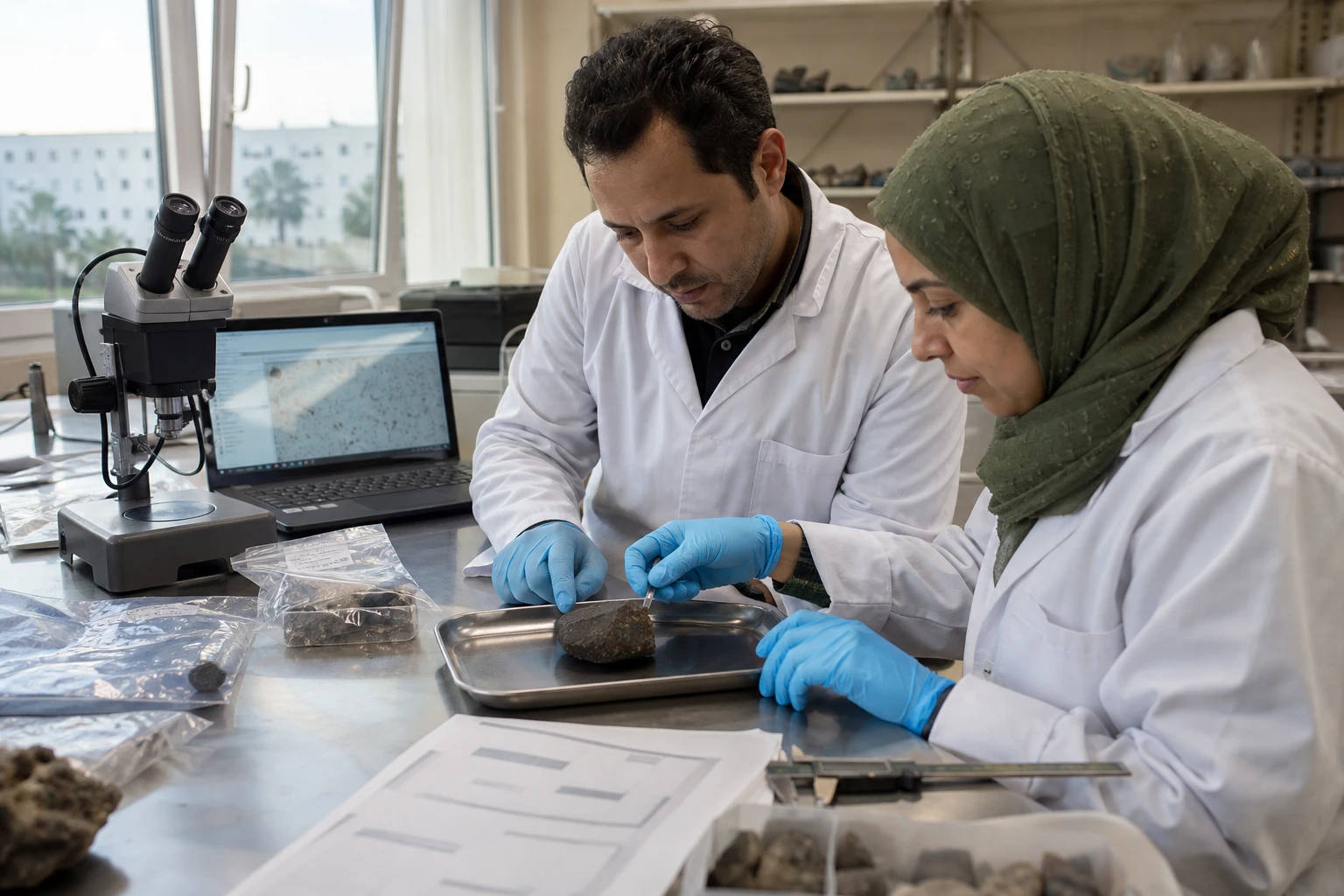
A rock from Mars, found in the Algerian Sahara, brings an entire period into focus
In the Algerian desert, some fragments of stone tell more than the story of their own journey. They can also fill gaps in the history of another planet. Such is the case with a small Martian meteorite collected in 2019 near Rafsa, in the Oum El Assel region, in Algeria’s far south-west. A study published in Geochimica et Cosmochimica Acta dates it to about 1.27 billion years ago.
The significance goes beyond scientific curiosity. Some periods in Mars’ history remain poorly documented for want of comparable samples. The rock, named Northwest Africa 13441, is one of the few known Martian meteorites from an intermediate age range between the major groups already studied. It therefore helps researchers connect fragments of history that have not fitted together well until now.
What we know about NWA 13441 and why it matters
The Meteoritical Bulletin states that NWA 13441 was found in Algeria in 2019 and is a Martian meteorite of the shergottite type. The database also specifies that a group of camel herders found four fragments weighing a total of 84.69 grams near Rafsa. The weight is modest. Its scientific significance is much greater.
Shergottites are Martian volcanic rocks. They come from basaltic lava ejected from Mars by a violent impact, before falling to Earth after a long journey through space. In this case, researchers say the age of 1.27 billion years places NWA 13441 in a very poorly represented interval among the Martian meteorites classified so far. That is what makes it valuable for studying the mantle and volcanism of the Red Planet.
Popular science publications and several leading media outlets have summed up the same central point: this meteorite falls within a “gap” of several hundred million years in the Martian record available on Earth. In other words, it does not explain the whole history of Mars, but it provides a rare piece for an incomplete puzzle.
Real scientific significance, but no revolution
For meteorite specialists, the significance is clear. A precisely dated rock can be compared with other Martian samples in terms of chemistry, isotopes and textures. It helps establish whether certain volcanic episodes involved several magma reservoirs or a single deep source. This is a process of correlation, not a magical reading of the Red Planet.
Researcher Anthony Lagain, cited in several reports on the study, says this is the only known meteorite to offer an intermediate age of this kind among the shergottites described so far. Its rarity makes it possible to investigate geological conditions on Mars at that time, which are still poorly understood. Other experts, such as Brigitte Zanda, point out, however, that this is an incremental advance: useful, but not a complete shift in our understanding of Mars.
The result matters for a simple reason. Martian meteorites remain the only Martian samples accessible outside space missions. They therefore serve as a substitute laboratory. When a new rock covers a poorly documented period, it refines models of Mars’ internal evolution without replacing future in-situ analyses or sample returns.
What it also says about the Algerian Sahara
The find site matters. The Algerian Sahara has long been a major meteorite-collecting area, particularly in the vast Saharan corridor where dark rocks stand out against pale ground. This has fuelled a highly active research, prospecting and identification market around “Northwest Africa” meteorites, a catalogue name referring to finds in north-west Africa, often in the Sahara.
This activity reveals a subtle but real issue for Algeria. On the one hand, the desert is yielding discoveries of global interest. On the other, the traceability, reporting and preservation of fragments remain essential if science is to make the most of them. In this field, value is not only mineralogical. It is also documentary: a well-located sample is worth more than a mere stone with no context.
This discovery should also be seen in the context of the country’s scientific trajectory. Algeria has a broader university and research ecosystem than is sometimes thought from the outside. When a Martian meteorite is found on its territory, it is a reminder that the Sahara is not just a geographical backdrop. It is also a field of study for Earth and space sciences, as well as natural resources. This aspect is rarely highlighted, though it deserves to be.
A pan-African story worth following closely
Across the continent, this kind of discovery has both symbolic and scientific significance. Symbolic, because it is a reminder that African sites contribute to planetary research. Scientific, because it reinforces the idea that the deserts of North Africa and the Sahel are key areas for global meteoritics. Several of the best-known Martian meteorites have been found there, confirming the continent’s role in providing access to these rare materials.
What happens next will depend above all on further scientific study of the sample. Researchers have announced additional analyses to clarify the origin, composition and formation conditions of NWA 13441. This is where the rock’s true value lies: not in the fact that it is “a meteorite from Mars”, but in the ability to use it to build a more detailed chronology of Martian volcanism and, through that, a more precise account of the evolution of terrestrial planets.



