Egypt
 Libya
 Morocco
 Sudan
 Tunisia
 Benin
 Burkina Faso
 Cabo Verde
 Côte d'Ivoire
 Ghana
 Guinea
 Guinea-Bissau
 Liberia
 Mali
 Mauritania
 Niger
 Nigeria
 Senegal
 Sierra Leone
 The Gambia
 Togo
 Cameroon
 Central African Republic
 Chad
 DR Congo
 Equatorial Guinea
 Gabon
 Republic of the Congo
 São Tomé and Príncipe
 Burundi
 Comoros
 Djibouti
 Eritrea
 Ethiopia
 Kenya
 Madagascar
 Malawi
 Mauritius
 Mozambique
 Rwanda
 Seychelles
 Somalia
 South Sudan
 Tanzania
 Uganda
 Angola
 Botswana
 Eswatini
 Lesotho
 Namibia
 South Africa
 Zambia
 Zimbabwe
A partnership being reshaped around energy, industry and healthcare
In Berlin, Algiers is seeking not so much a simple diplomatic gesture as useful support for its real economy. Against a European backdrop of efforts to find stable suppliers, Algeria is highlighting its energy assets, as well as less prominent sectors such as healthcare, training and the pharmaceutical industry. Abdelmadjid Tebboune’s official visit to Germany is part of this diversification drive, with a clear objective: to broaden cooperation beyond traditional exchanges of gas and industrial goods.
This visit comes amid a longstanding bilateral relationship. Diplomatic relations between Algeria and Germany date back to 3 July 1962, the German Federal Foreign Office notes. Berlin is now one of Algeria’s main suppliers in Europe, while Algerian exports to Germany remain dominated by hydrocarbons and petrochemicals. In 2023, German exports to Algeria reached €2.1 billion, compared with €1.5 billion in German imports from Algeria.
This longstanding foundation matters, but is no longer enough. Algeria now wants to integrate its economy into broader value chains, particularly in hydrogen, industrial equipment and healthcare. Germany, for its part, is seeking reliable partners on the Mediterranean rim at a time when Europe’s energy transition requires it to secure new flows and stabilise supplies. The meeting therefore responds to two expectations: a political one, to consolidate regular dialogue; and an economic one, to prepare concrete projects.
What Tebboune and Merz agreed in Berlin
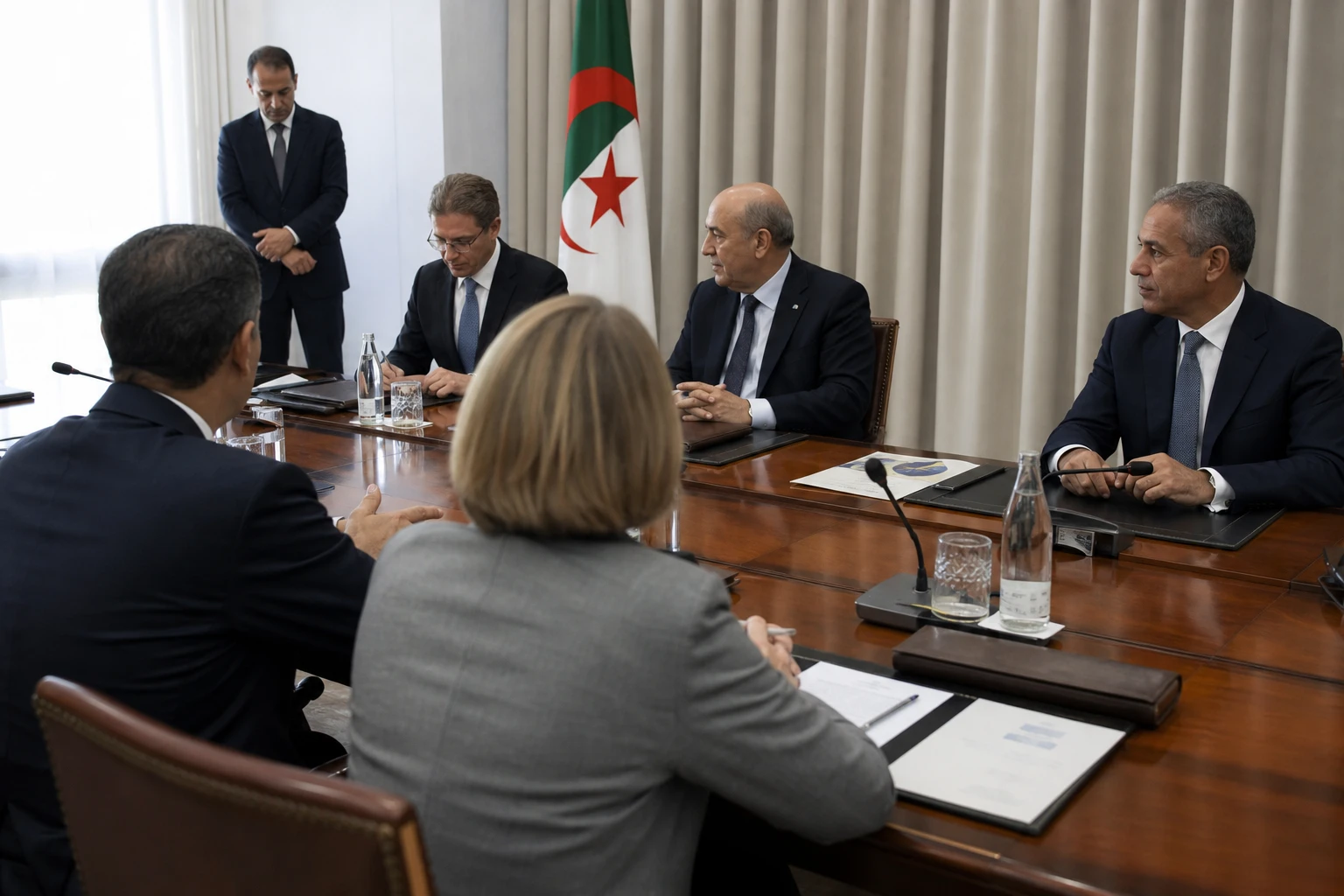
On 16 July 2026, Abdelmadjid Tebboune and Chancellor Friedrich Merz expressed their desire to deepen bilateral relations. A joint declaration on a strategic partnership agenda was made public by the German Chancellery. The text provides for regular political dialogue, in-depth consultations on bilateral relations, regional and international issues, as well as migration and security. It also refers to enhanced cooperation in energy, infrastructure, healthcare, critical minerals, agriculture and industry.
The two sides also discussed practical economic matters. The declaration mentions reviving the Algerian-German Joint Economic Commission, as well as the planned creation of a bilateral business council, with the support of organisations such as AHK Algeria, CREA and CACI. A bilateral economic forum is also scheduled for 17 July 2026. This timetable shows that the visit is more than a diplomatic photo opportunity: it launches a follow-up process involving public and private-sector players who have already been identified.
Energy remains central to the agenda. The German side says it wants to deepen cooperation on the energy transition and on power-to-X projects, meaning the conversion of renewable electricity into hydrogen or other synthetic fuels. This direction builds on discussions held over several years on green hydrogen and the so-called Southern H2 Corridor project, which aims to transport hydrogen from North Africa to Europe.
Another strong signal concerns healthcare. In Berlin, Tebboune referred to a project involving gene cells, presented as a possible avenue for scientific and medical cooperation. The issue is significant for Algeria, which is seeking to modernise some parts of its healthcare system and strengthen its research capacity. For Germany, there is also an industrial dimension: the bilateral declaration explicitly names healthcare and pharmaceuticals among the sectors to be developed.
A visit marked by grief in Algiers and questions about institutions
The presidential visit was also marked by a tragedy in Algiers. On 16 July, a fire at the Mohammadia Institution for Children in Care killed 11 people and injured 19, according to the General Directorate of National Security, cited by the Algerian Press Service. The Civil Protection service had earlier reported that 19 injured people had been rescued and five children with special needs taken into care. The authorities later said an electrical spark from an air conditioner was believed to have caused the fire.
Before turning to diplomatic matters, Tebboune offered his condolences to the families. Prime Minister Sifi Ghrieb and several members of the government visited the injured and attended the victims’ funerals. In a country where the safety of care facilities, hospitals and social institutions remains a sensitive issue, this episode is a reminder that modernising the state also means better-monitored infrastructure and stricter prevention procedures. The political message is clear: the executive wants to project continuity, but also an institutional capacity to respond.
The visit also prompted a question about French journalist Christophe Gleizes. Tebboune referred the matter to the Algerian judiciary and declined to comment on a case he considers to fall within the remit of the country’s institutions. In substance, this position reflects a recurring message from Algiers: the judiciary operates within its own framework and does not allow its pace to be dictated by diplomatic pressure. This matters because it underlines how closely Algeria’s foreign relations remain tied to domestic interpretations of the role of its institutions.
What this visit says about Algeria in its European and African neighbourhood
Ultimately, Berlin is more than just another European partner. For Algiers, Germany can provide a gateway to wider technologies, financing and industrial networks, as the country seeks to reduce its dependence on hydrocarbon revenues alone. For Europe, and Germany in particular, Algeria remains a strategic Mediterranean neighbour at the intersection of energy, migration and security issues. The joint declaration also explicitly refers to sovereignty, territorial integrity, multilateral cooperation and regional issues.
Across Africa, the significance goes beyond a simple bilateral meeting. Discussions on hydrogen, critical minerals and healthcare show that the continent’s countries are now negotiating with Europe on the basis of mutual interests, rather than solely as suppliers of raw materials. Algeria, located in North Africa and committed to the African Union, wants to exert influence as an energy, industrial and scientific player. This meeting with Berlin illustrates that ambition and shows how Algerian economic diplomacy is seeking to turn its regional room for manoeuvre into concrete projects.