Egypt
 Libya
 Morocco
 Sudan
 Tunisia
 Benin
 Burkina Faso
 Cabo Verde
 Côte d'Ivoire
 Ghana
 Guinea
 Guinea-Bissau
 Liberia
 Mali
 Mauritania
 Niger
 Nigeria
 Senegal
 Sierra Leone
 The Gambia
 Togo
 Cameroon
 Central African Republic
 Chad
 DR Congo
 Equatorial Guinea
 Gabon
 Republic of the Congo
 São Tomé and Príncipe
 Burundi
 Comoros
 Djibouti
 Eritrea
 Ethiopia
 Kenya
 Madagascar
 Malawi
 Mauritius
 Mozambique
 Rwanda
 Seychelles
 Somalia
 South Sudan
 Tanzania
 Uganda
 Angola
 Botswana
 Eswatini
 Lesotho
 Namibia
 South Africa
 Zambia
 Zimbabwe
When security becomes a test of credibility
In Algeria, fires are not just a matter of forests burning. They also test the state’s ability to protect residents, investigate swiftly and respond without overstatement. The events that began in late August have brought a broader question to the fore: how should a natural disaster be dealt with when it may also conceal criminal acts?
The debate concerns a country already tightening its arsenal against drugs. Algeria adopted legislation in 2025 strengthening the crackdown on drug trafficking, with harsher penalties in some cases, including the death penalty for specific offences involving psychotropic substances. At the same time, the country remains a member of the African Union, where security, stability and cooperation against transnational crime are central priorities.
What the High Security Council decided
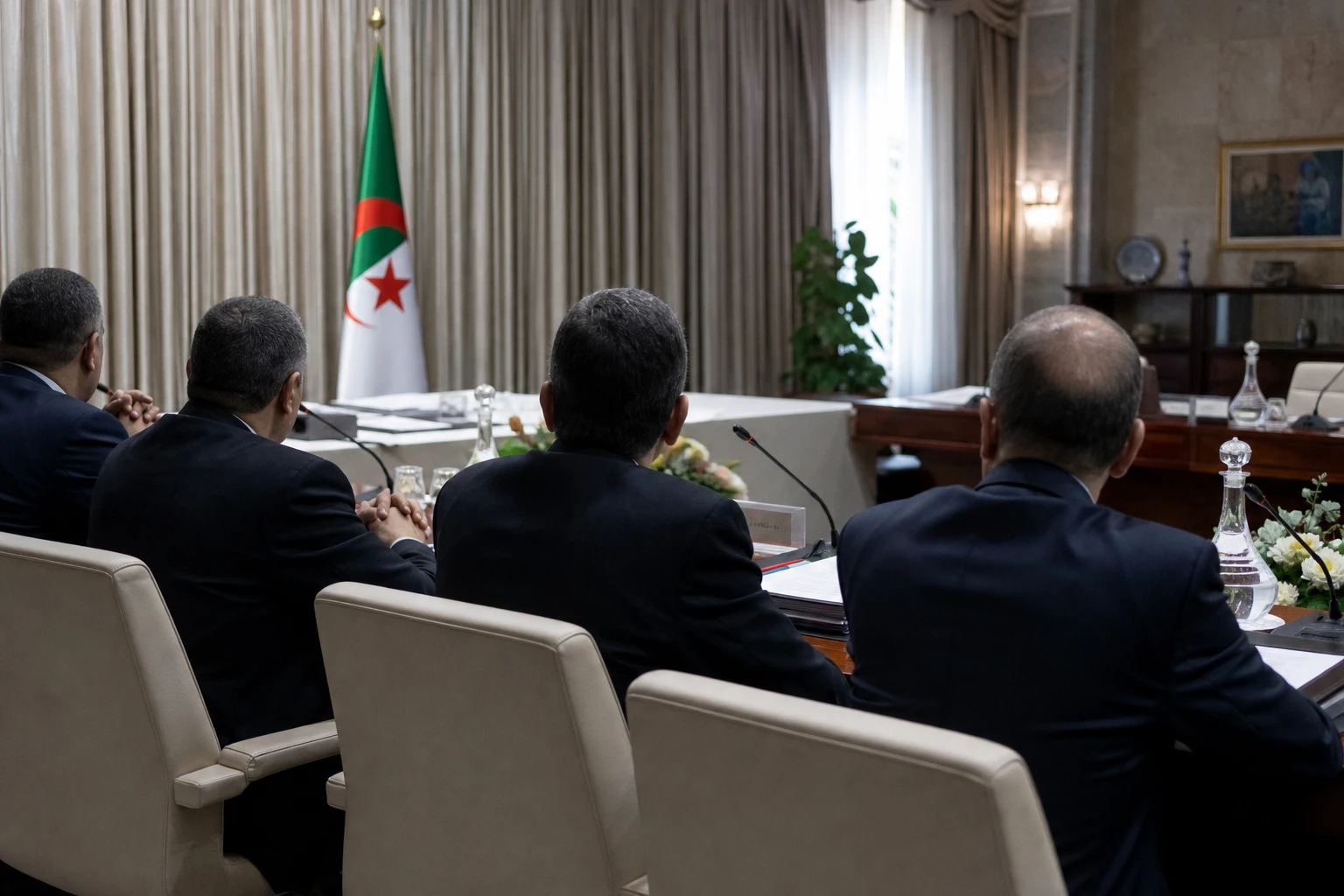
On Wednesday 2 September 2026, President Abdelmadjid Tebboune chaired a meeting of the High Security Council devoted to fires that had affected several regions of the country, the fight against drug trafficking and the general situation along the borders. At the end of the meeting, the authorities called for the death penalty to be applied to crimes involving deliberate arson, while announcing the creation of a body specialising in the fight against drugs.
The presidency also ordered the conversion of a former barracks of the National People’s Army in Tanezrouft into a high-security prison for drug traffickers considered the most dangerous. The same day, Algeria’s state media also reported on the progress of investigations by the gendarmerie and police, as well as the coordination announced between the two services to make their findings known.
This approach did not come out of nowhere. On 30 August, Abdelmadjid Tebboune had called for the Penal Code to be amended to explicitly reintroduce the death penalty for those responsible for deliberate arson and resume its implementation. The presidential message came a few days before the High Security Council meeting, showing that the course had already been set before the security briefing on 2 September.
Deadly fires, but investigations still under way
The fires began multiplying from 26 August in several central and eastern wilayas. At the height of the crisis, Civil Protection recorded 193 fires in 13 wilayas, of which 147 had been brought under control and 46 were still active on the morning of 27 August. The areas most exposed to the fires were concentrated in Béjaïa, Jijel, Skikda and Tizi Ouzou.
The human toll most often reported by corroborated sources was 12 dead, including five in Jijel, four in Béjaïa and three in Tizi Ouzou. In Béjaïa, 54 injured people were also reported, six of them seriously. On this point, the authorities stressed that investigations were still incomplete: no official statement said that all the fires had a single criminal origin.
On 30 August, Civil Protection said that all the fires reported since 26 August had been brought under control. Since then, priorities have shifted to restoring water and energy networks, compensating affected families and caring for the injured. In some areas, residents have therefore begun returning to places where material damage remains extensive, particularly to orchards, livestock farms and rural homes.
Death penalty, drugs and the politics of announcement
The debate over capital punishment in Algeria is longstanding, but the current developments give it new substance. According to Amnesty International, no executions have been carried out in the country since 1993, although the death penalty remains part of Algerian law and courts continue to impose it in some cases. In 2025, amendments on narcotics had already expanded the range of offences that could expose defendants to it.
The new drug-related framework that has been announced follows a different logic from that of a simple criminal law. It is more focused on operational action, intelligence and security coordination. Algeria already has the National Office for the Fight against Drugs and Drug Addiction, which is attached to the Ministry of Justice. The structure promised by the authorities therefore adds a more directly security-focused layer, at a time when trafficking networks take advantage of the long Saharan borders and cross-border routes.
The planned high-security prison in Tanezrouft follows the same logic: isolating prisoners considered the most dangerous, far from major urban centres. This location is not neutral. It sends a strong political signal, but also raises practical questions about costs, logistics and conditions of detention in a sparsely populated area of the far south. It is a state policy combining punishment, deterrence and separation.
What this says about Algeria and the region
For Algiers, the immediate aim of these developments is to reassert public authority after a disaster that struck wilayas already highly exposed to climate pressures and weaknesses in local services. It also seeks to reassure an opinion shocked by how quickly the fires spread and by memories of other fire crises in the country. But this kind of response affects different groups in different ways: affected families first want emergency aid, investigations and compensation; the security forces are seeking tools to act; and the authorities want to project control.
At the continental level, the case is a reminder that African states face environmental risks, cross-border trafficking and strong public expectations on security at the same time. The African Union is working to promote stronger integration across the continent, through its regional economic communities and instruments against organised crime. Algeria, located in North Africa and embedded in this continental architecture, is seeking to show that it wants to remain a force for stability in a Sahel-Maghreb neighbourhood under pressure.
What happens next will play out on two fronts. First, the promised Penal Code amendment will have to be presented and debated. Second, investigations into the fires will have to establish whether deliberate acts were committed and, if so, on what scale. That is where the strength of Algeria’s response will be measured: not by the forcefulness of its words, but by the precision of the evidence and the consistency of its decisions.