
 Egypt
 Libya
 Morocco
 Sudan
 Tunisia
 Benin
 Burkina Faso
 Cabo Verde
 Côte d'Ivoire
 Ghana
 Guinea
 Guinea-Bissau
 Liberia
 Mali
 Mauritania
 Niger
 Nigeria
 Senegal
 Sierra Leone
 The Gambia
 Togo
 Cameroon
 Central African Republic
 Chad
 DR Congo
 Equatorial Guinea
 Gabon
 Republic of the Congo
 São Tomé and Príncipe
 Burundi
 Comoros
 Djibouti
 Eritrea
 Ethiopia
 Kenya
 Madagascar
 Malawi
 Mauritius
 Mozambique
 Rwanda
 Seychelles
 Somalia
 South Sudan
 Tanzania
 Uganda
 Angola
 Botswana
 Eswatini
 Lesotho
 Namibia
 South Africa
 Zambia
 Zimbabwe
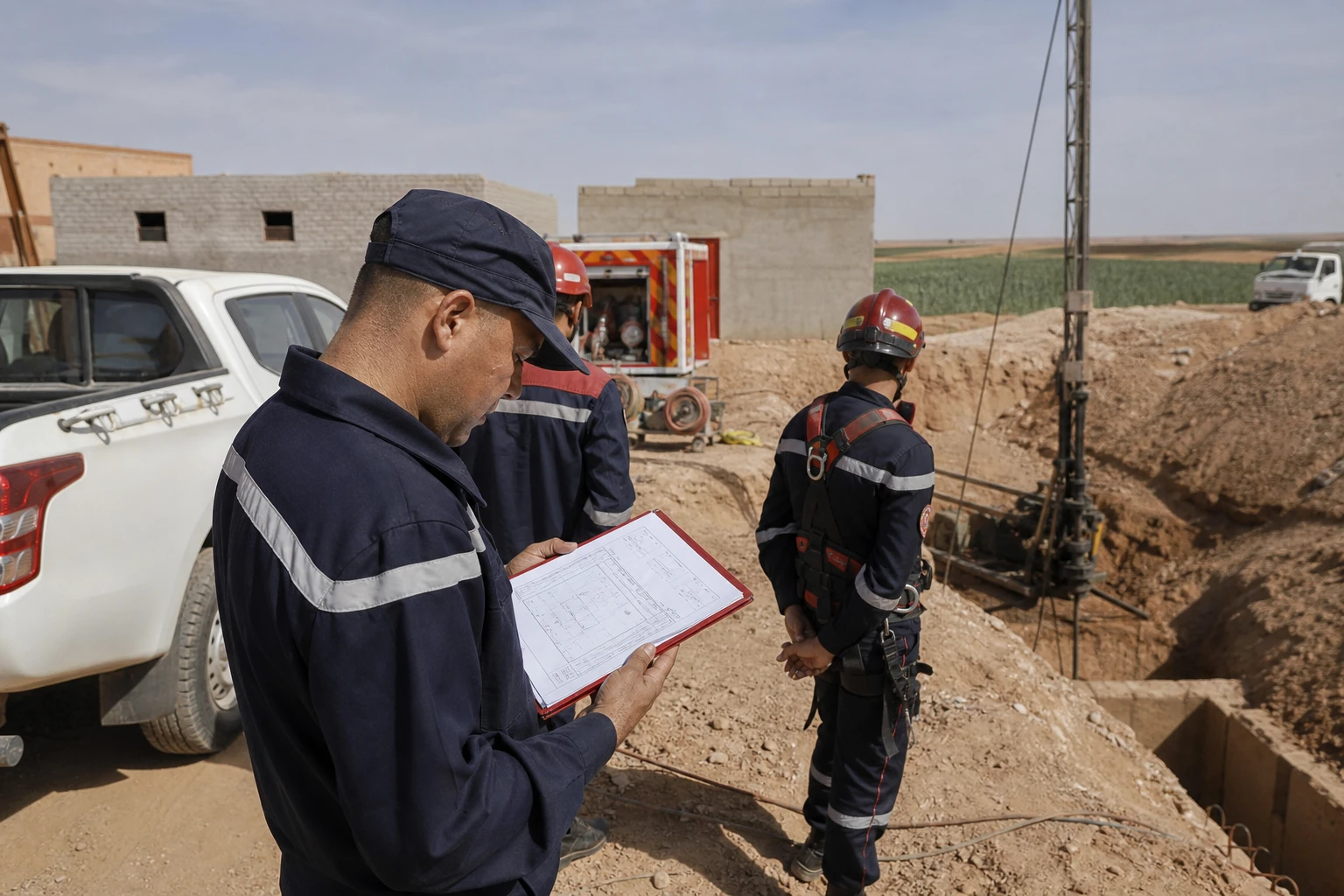
A tragedy highlighting the challenges of rescue in confined spaces
In El Bayadh province, an accident in a well triggered a rescue operation lasting four days and involving an unusual level of effort. The 10-year-old boy did not survive. Beyond the grief, the case highlights a very real risk in several rural areas of Algeria: old wells, sometimes dry, narrow openings and unstable ground can turn a simple hole into a deadly trap.
The tragedy occurred in El Ghassoul, in El Bayadh province, in south-western Algeria. Rescuers said a child had fallen into a dry artesian well with a very small diameter, complicating every attempt to reach him. Images and messages of support circulated widely across the country, showing that in Algeria, too, some news stories become national affairs when they involve a child and expose the limitations of local infrastructure.
El Bayadh, a vast, rural and strategic territory
El Bayadh is not an anonymous outlying area. The province is part of the High Plateaux, a region where settlements are scattered, distances are long and facilities are sometimes far from villages and agricultural areas. The Algerian administration has recently strengthened its territorial divisions by creating new districts, in a stated effort to bring decision-making closer and improve coverage of the territory. This policy highlights that local governance remains a major issue in Algeria, particularly outside major urban centres such as Algiers.
In this region, agricultural wells are part of the economic landscape. They are used for irrigation, livestock farming and small family-run farms. But safety measures vary. When a well is abandoned or inadequately protected, the danger falls first on children, shepherds and informal-sector workers. The accident in El Ghassoul therefore serves as a reminder of a structural reality: rural safety depends as much on the condition of water infrastructure as on the speed of the emergency response.
What the facts say about the rescue operation
The authorities said the boy fell on Wednesday 2 September 2026 into a dry artesian well in the Rekna area, in the municipality of El Ghassoul, El Bayadh province. After four days of searching and excavation, Civil Protection services recovered the child’s body on Saturday evening. Initial accounts described a well about 40 centimetres wide; other reports cited a depth of up to 80 metres. This above all highlights the need for caution with figures circulating at the start of a rescue operation.
The Civil Protection spokesperson explained that teams had combined two methods: digging a parallel vertical shaft and carrying out large-scale excavation work to reach the victim. He also said the child was “trapped beneath a thick layer of earth”. The director-general of Civil Protection travelled to the site to monitor the operation, underlining the strong institutional mobilisation around the case.
This episode says something about how emergency services operate in Algeria. The country has an experienced Civil Protection service, regularly deployed to forest fires, severe weather and road accidents. In 2026, the national news agency also reported that the service had been ranked 10th globally in an international study, and was the only African organisation among the top 30. Without overstating the significance of this ranking, it confirms one point: technical capacity exists, but it cannot make up for everything when the terrain, depth and unstable soil make access almost impossible.
Beyond the news story, the question of prevention
The El Bayadh tragedy cannot be reduced to a single rescue operation. It raises questions about the safety of water sources, the maintenance of agricultural land and the marking of abandoned structures. In rural areas, prevention matters as much as the response. Sealing a well, covering it securely or filling it in after use is not a technical detail. It is a public safety measure, especially in areas where children move freely between homes, fields and tracks.
There is also a social issue. In tragedies of this kind, families in the interior regions expect swift, visible resources suited to their surroundings. Cities often benefit from a greater concentration of facilities, hospitals and roads. More isolated municipalities, by contrast, depend on lengthy emergency response chains and operations that can take considerable effort to launch. This is where the gap between the promise of territorial equity and the reality on the ground becomes clear.
For Algeria, this case is part of a broader trajectory: strengthening local government, improving coverage of vast areas and reducing vulnerabilities in the interior provinces. Across the Maghreb and Africa, the case is a reminder that a territory can have a robust emergency response system while remaining exposed to preventable accidents. The next question is therefore not only about mourning. It also concerns the mapping of wells, the safety of rural sites and the place given to prevention in local development policies.



