Algeria
 Egypt
 Libya
 Morocco
 Sudan
 Tunisia
 Benin
 Burkina Faso
 Cabo Verde
 Côte d'Ivoire
 Ghana
 Guinea
 Guinea-Bissau
 Liberia
 Mali
 Mauritania
 Niger
 Nigeria
 Senegal
 Sierra Leone
 The Gambia
 Togo
 Cameroon
 Central African Republic
 Chad
 DR Congo
 Equatorial Guinea
 Gabon
 Republic of the Congo
 São Tomé and Príncipe
 Burundi
 Comoros
 Djibouti
 Eritrea
 Ethiopia
 Kenya
 Madagascar
 Malawi
 Mauritius
 Mozambique
 Rwanda
 Seychelles
 Somalia
 South Sudan
 Tanzania
 Uganda
 Angola
 Botswana
 Eswatini
 Lesotho
 Namibia
 South Africa
 Zambia
 Zimbabwe
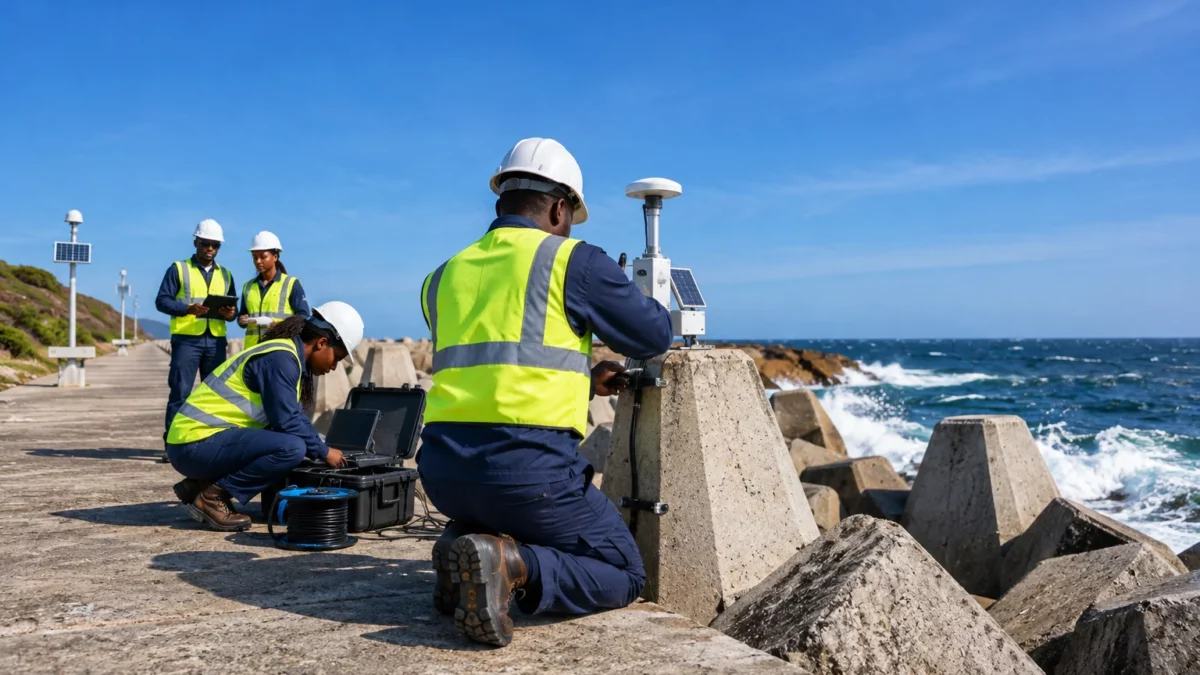
A letter of intent can open a path, but it cannot power a grid. That is the difference between announcing a wave-energy project and having a power plant capable of supplying electricity to households, businesses or public services.
On 24 November 2026, Swedish company Eco Wave Power announced that an African electricity company wished to explore a project of up to 100 megawatts (MW). The country and operator were not named. At this stage, no construction or financing has been confirmed.
A marine resource that remains largely untapped
In the electricity strategies of many African countries, solar power, hydropower and wind are already playing an increasingly important role. Wave energy, by contrast, remains at an early stage. It involves converting the movement of the sea into electricity using devices adapted to the conditions of each coastline.
The continent’s coastlines do not all have the same characteristics. The South Atlantic, Indian Ocean and Gulf of Guinea coasts differ in the power and regularity of their waves, as well as in their ports, electricity grids and coastal activities. A favourable estimate for one site therefore does not guarantee that another can be exploited under comparable conditions.
A 2021 study by the African Development Bank describes significant theoretical potential in African waters. These estimates indicate a natural resource, not an amount of electricity that could be produced at a competitive cost. Turning potential into a power plant requires, among other things, measuring waves on site, testing equipment and assessing possible effects on the marine environment.
The International Renewable Energy Agency’s 2026 statistics record 2 MW of marine energy capacity in Africa at the end of 2025, attributed to São Tomé and Príncipe. Worldwide, they record 490 MW. The gap is a reminder that the sector remains marginal on the continent, despite the extent of its coastlines.
Two Eco Wave Power prospects, two levels of uncertainty
The new letter of intent concerns exploration of a project of up to 100 MW. According to information published by the company, it is intended to enable discussions on a feasibility study. It is neither a final construction contract nor an electricity purchase agreement. The location, commercial terms and financing remain unknown.
This initiative follows work carried out in South Africa with Africa Great Future Development Ltd. A study completed in February 2026 estimated the technical potential of the Port of Ngqura, in the Eastern Cape province, at about 8.3 MW. The proposed solution would use floats installed on existing breakwaters. The movement of the waves would operate equipment that would then transmit the energy ashore.
This result is a feasibility estimate, not capacity already installed. Nor should the 8.3 MW assessed at Ngqura be confused with the 100 MW mentioned in the new letter: the second figure refers to a potential target, with no completed study announced at this stage. The country’s identity is also unknown, making it harder to assess grid requirements, permits and local benefits.
Ghana’s experience highlights the importance of financing
Ghana offers a useful example of the obstacles separating an announcement from commissioning. At Ada Foah, on the Gulf of Guinea, a wave-energy demonstration project was followed by several agreements aimed at developing a larger facility. In July 2020, TC’s Energy, Seabased and Power China Huadong Engineering Corporation announced that the project would be revived.
Yet the announced commercial plant has not been commissioned. In March 2024, the Ghana News Agency reported that the Queen Mother of the Ada Traditional Area was urging the companies involved to honour their commitment to revive the project. Ghana’s power purchase agreement portal, updated on 30 October 2026, still lists financial close for TC’s Energy’s wave and tidal project at Ada as undetermined. The listing gives a capacity of 1,000 MW, a figure that does not match the 100 MW often associated with earlier announcements: these figures must not be conflated.
Financial close is the point at which the funds and agreements needed for construction are secured. Without this step, a project can remain in documents or be the subject of new partnerships without generating electricity. The Ada case also highlights the importance of keeping local communities informed, particularly when uses of the sea affect coastal activities and traditional authorities.
The next stage will hinge on the details
For national electricity grids, a wave-energy plant could diversify generation sources and complement other renewables, if its operation and costs are suited to the site. But developers still need to demonstrate that equipment is reliable at sea, resistant to corrosion and storms, and compatible with port infrastructure and the grid.
Potential benefits are not automatically shared. The electricity company and investors assess profitability and risks; public authorities must consider permits, grid connections and environmental effects; coastal communities may be affected by uses of the coastline. Job creation or lower electricity costs therefore cannot be presented as guaranteed before the project is defined.
What happens next with the initiative announced on 24 November will depend first on identifying the country and partner, then on whether a study is actually launched, its findings and financing decisions. Ghana’s experience shows why announcing a capacity, however large, is not enough. For wave energy in Africa, the decisive test remains turning a measured resource into generation that is connected, financed and useful to the communities concerned.