Algeria
 Egypt
 Libya
 Morocco
 Sudan
 Tunisia
 Benin
 Burkina Faso
 Cabo Verde
 Côte d'Ivoire
 Ghana
 Guinea-Bissau
 Liberia
 Mali
 Mauritania
 Niger
 Nigeria
 Senegal
 Sierra Leone
 The Gambia
 Togo
 Cameroon
 Central African Republic
 Chad
 DR Congo
 Equatorial Guinea
 Gabon
 Republic of the Congo
 São Tomé and Príncipe
 Burundi
 Comoros
 Djibouti
 Eritrea
 Ethiopia
 Kenya
 Madagascar
 Malawi
 Mauritius
 Mozambique
 Rwanda
 Seychelles
 Somalia
 South Sudan
 Tanzania
 Uganda
 Angola
 Botswana
 Eswatini
 Lesotho
 Namibia
 South Africa
 Zambia
 Zimbabwe
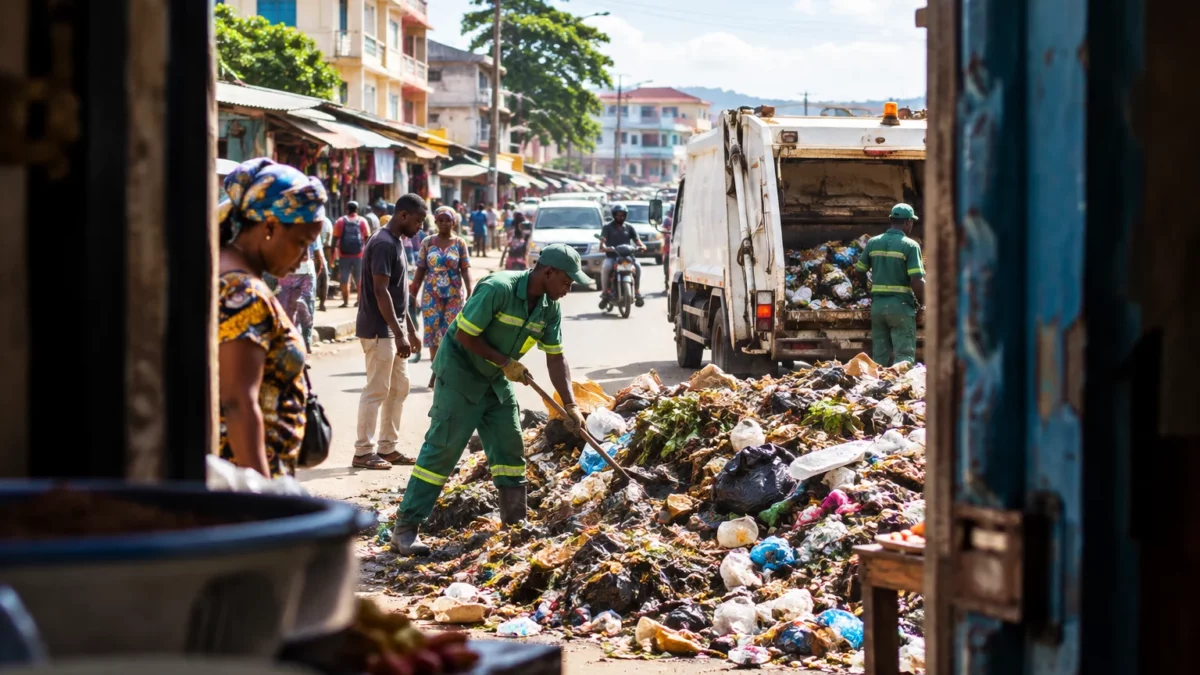
In Conakry, clearing waste from the streets depends on more than the number of trucks deployed. It also requires the capacity to transport and treat it, and to fund the entire chain sustainably. The closure of the Dar es Salaam landfill has disrupted this system. Residents are already seeing the consequences outside their homes and along busy roads.
A local emergency, a challenge for Greater Conakry
Guinea’s capital concentrates the difficulties of a system in which neighbourhood collection, transport and final treatment must work together. Greater Conakry produces more than 2,000 tonnes of solid waste a day, according to the National Agency for Sanitation and Public Health (ANASP). The government, meanwhile, puts the figure at close to 3,000 tonnes. The estimates may not use the same boundaries or methodology. They nevertheless indicate the scale of the waste flows to be managed.
The closure of Dar es Salaam, a landfill located in the city, removed an essential outlet before a replacement solution could immediately absorb all the waste. The problem therefore goes beyond collection. It also concerns transfer sites, distances, vehicle availability and treatment capacity at the destination. In November, residents interviewed by AFP described collections becoming irregular. Local pre-collection companies also said they were losing customers because there was no reliable disposal site.
Guinea is a member of the Economic Community of West African States (ECOWAS), a regional organisation for co-operation among West African countries. For sanitation in Conakry, however, the immediate challenge remains national and municipal: allocating responsibilities between the state, municipalities and operators, while protecting local residents and workers in the sector.
A political deadline, with resources still to be clarified
On Wednesday, 25 November, Prime Minister Amadou Oury Bah called on municipalities and residents to join a campaign to clean up Conakry by the end of December. He was speaking at the opening of the National Sanitation Forum, according to the Guinean press. The timetable is ambitious: it gives local authorities about five weeks to remove visible waste piles and get collection routes moving again.
The head of government said the state was spending 15 billion Guinean francs each month on sanitation in the capital’s municipalities. He also said equipment to transfer waste from sorting and transit areas to Baritodé was expected within two to three weeks. The announcement concerns a temporary transfer system. It does not mean that the permanent centre is already operating at full capacity.
At Baritodé, in Coyah prefecture, ANASP is presenting a project for a technical landfill centre to organise waste treatment in Greater Conakry. The agency says the project has funding of €70mn, combining a grant and a concessional loan from the European Union and the French Development Agency. The future site is to include transfer equipment and, according to the project description, enable the recovery of biogas, among other things. The timetable and the ramp-up of this infrastructure will determine whether the announced transfer can become a lasting solution.
Dar es Salaam, the human cost of a breakdown
The site was closed after its deadly collapse on 23 August 2026. Accounts published the day after the disaster gave different tolls: the Associated Press reported at least 30 deaths, according to the central authorities, while Africanews’ first report put the figure at 31. In the absence of a single final toll corroborated by the sources consulted, the landslide should be said to have killed at least 30 people, according to the figure cited by the AP.
The disaster brought greater attention to an already dangerous situation for people living or working near the landfill. It is also a reminder that a necessary closure is not enough to resolve the day-to-day management of waste: without an operational replacement site, rubbish can be displaced into streets, vacant plots and the areas around homes. Local residents then bear a substantial share of the nuisance, while private collectors lose income when their rounds have nowhere accessible to take the waste.
The authorities have also announced plans to rehabilitate Dar es Salaam and turn it into an urban park. This redevelopment first requires the stabilisation and treatment of an old waste mound. It cannot therefore be treated as a simple landscaping project. Site safety, pollution control and the monitoring of works will matter as much as the future opening of a public space.
Collection, between public service and economic activity
The government also wants to strengthen pre-collection, meaning the removal of waste from neighbourhoods to transfer points. Amadou Oury Bah called on municipalities to organise this stage and encourage the emergence of local small and medium-sized businesses. The sector can create jobs, particularly for young people, but encouraging businesses alone is not enough: they need clear contracts, regular payments, equipment and reliable access to disposal sites.
The announced funding will therefore need to be tracked in practice. Who collects the waste, in which municipality, how often and with what equipment? How do municipalities co-ordinate operators? And how can they prevent more remote or less profitable neighbourhoods from receiving a poorer service? These questions will determine whether a one-off clean-up campaign can become a regular service, including on the outskirts, where journeys are longer.
The government has also raised the possibility of creating a national sanitation fund. For it to improve the situation, its funding rules, governance and the respective responsibilities of the state and local authorities will need to be known. The volume of waste reported in Conakry points to the need for an organised waste-management chain: reducing illegal dumping, improving sorting and transfer, and then treating residual waste in appropriate facilities.
The test will be continuity after December
The 31 December date is a measurable political target, but the outcome will not be judged only by whether the streets are clean at the end of the year. It will be necessary to check whether waste piles reappear, whether collection rounds continue and whether waste is actually reaching Baritodé. The construction of the technical centre, the rehabilitation of Dar es Salaam and the stability of funding will be the next indicators to watch.
For Guinea, the challenge is to turn an emergency mobilisation into a predictable urban service. For residents, that means regular collections and neighbourhoods less exposed to waste. For municipalities and local businesses, it requires a clear division of tasks and resources. The deadline set by Conakry is testing all three requirements; a lasting response will be measured in the months that follow, long after the December campaign.