Algeria
 Egypt
 Libya
 Morocco
 Sudan
 Tunisia
 Benin
 Burkina Faso
 Cabo Verde
 Côte d'Ivoire
 Ghana
 Guinea
 Guinea-Bissau
 Liberia
 Mali
 Mauritania
 Niger
 Nigeria
 Senegal
 Sierra Leone
 The Gambia
 Togo
 Cameroon
 Central African Republic
 Chad
 Equatorial Guinea
 Gabon
 Republic of the Congo
 São Tomé and Príncipe
 Burundi
 Comoros
 Djibouti
 Eritrea
 Ethiopia
 Kenya
 Madagascar
 Malawi
 Mauritius
 Mozambique
 Rwanda
 Seychelles
 Somalia
 South Sudan
 Tanzania
 Uganda
 Angola
 Botswana
 Eswatini
 Lesotho
 Namibia
 South Africa
 Zambia
 Zimbabwe
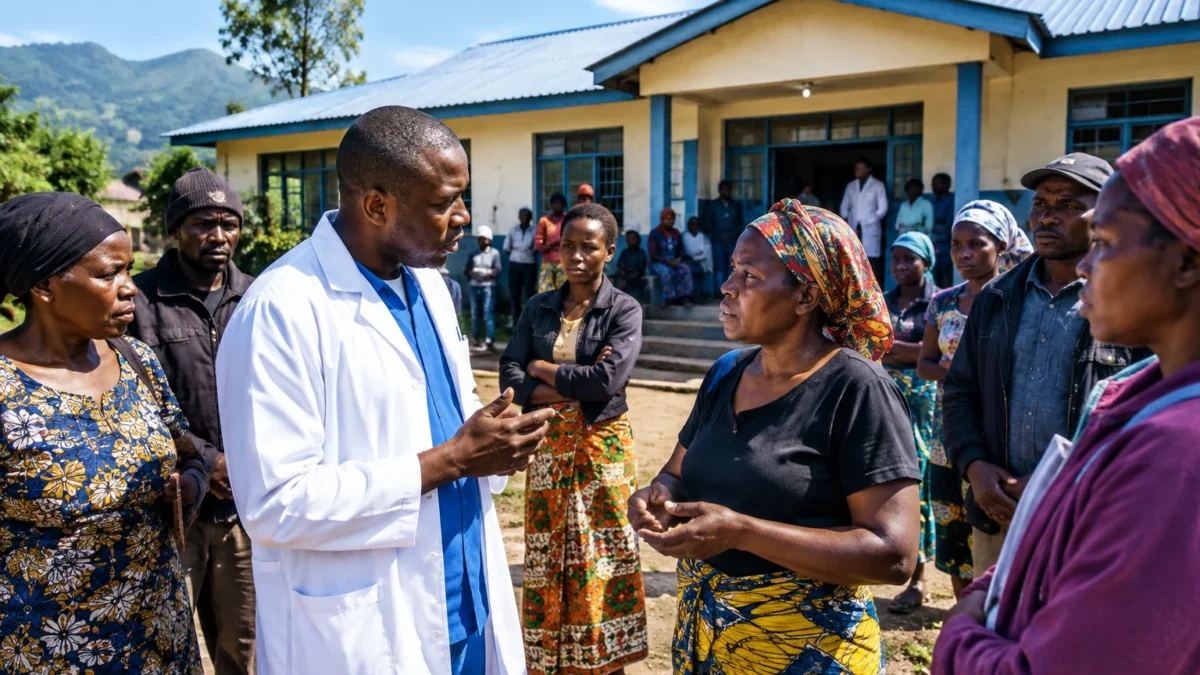
In Bulambo-Isale, in North Kivu, the fight against Ebola also depends on the languages people speak, relationships of trust and the rites that accompany the dead. When health teams intervene without taking these realities into account, a protective measure can be seen as a constraint imposed from outside.
An epidemic extending beyond local boundaries
The Democratic Republic of the Congo has been facing its 17th Ebola outbreak since 15 May 2026. First declared in Ituri, it has spread to several provinces. The virus identified is the Bundibugyo strain, for which there is no licensed vaccine. The World Health Organization has declared the outbreak a public health emergency of international concern.
The toll is changing rapidly. On 18 November, the US Centers for Disease Control and Prevention reported 11 680 confirmed cases and 5 720 deaths in the DRC. On 26 November, the Associated Press reported more than 12 000 confirmed cases, according to data from the Congolese health ministry. These figures, compiled on different dates, describe an outbreak of unprecedented scale in the country.
The spread is taking place in a region where people cross borders and healthcare capacity remains uneven. Coordination therefore involves the Congolese authorities, the WHO and neighbouring countries, particularly through regional health cooperation. Within the DRC, access to villages, insecurity and trust in institutions affect the ability to identify cases and trace their contacts.
In Bulambo-Isale, trust is a condition of the response
In this North Kivu locality, local youth council president Roland Vivaya highlights a grievance that goes beyond the disease. He asks why the authorities are mobilising substantial resources against Ebola when other everyday difficulties seem to receive less attention. This feeling fuels mistrust of teams coming from outside.
Language is another practical obstacle. Vivaya believes some health professionals sent from Kinshasa cannot communicate in local languages. Yet explaining symptoms, preventive measures or the reasons for isolation requires more than an instruction translated in haste. Without an exchange people can understand and the opportunity to ask questions, rumours can take hold.
The response is also facing protests and attacks targeting health workers. Salama Mwengesyali, communications officer for the Vuhovi health district, has spoken of plans to reintegrate people who disrupted activities into communication committees. This highlights a practical issue: reducing tensions sometimes means making room for residents who know the area’s networks and concerns.
Funeral rites are particularly sensitive. In Bulambo-Isale, described as a Nande cultural and religious centre, families may reject safe burials carried out by specialist teams. Traditional leader Pimbo Kakule stresses the importance of burying the dead according to the community’s customs. The health risk is real: the body of someone who has died of Ebola can still transmit the virus. But banning funeral practices without dialogue can drive families away from healthcare workers and delay the reporting of deaths.
Protecting people without breaking community ties
The choice is not between public health and culture. It is about reducing risks while involving families and local authorities in arranging funerals. Safe and dignified burials can incorporate some practices, provided it is clearly explained what can be done safely. Traditional leaders, religious figures, youth associations and community health workers can help define these arrangements.
This approach does not replace healthcare or epidemiological surveillance. It can, however, encourage people to seek care at health centres, accept teams and take part in contact tracing. The crisis also highlights that residents judge the Ebola response against their broader experience of public services. A visible mobilisation against the virus, if it contrasts with a perceived absence of support for other problems, risks being seen as selective.
Those involved are not exposed to the same risks. Field teams must work in conditions that can be dangerous. Families, meanwhile, must accept measures that affect illness, separation and bereavement. In remote areas, distances and roads make access to care difficult; in cities, density and mobility accelerate interactions. A uniform strategy does not address these differing realities.
A challenge for the DRC and the regional response
The current outbreak extends beyond the DRC’s administrative borders: surveillance, the rapid sharing of information and coordination with neighbouring countries are important to limit cross-border transmission. The African Union, through its health institutions, and the WHO have a role in coordination and support. However, the effectiveness of these mechanisms also depends on trust built in each health zone.
Previous outbreaks in the DRC have shown that medical mobilisation is not enough if communities feel excluded from decisions. In the east of the country, insecurity, displacement and distrust of institutions add to the obstacles, although they do not by themselves explain resistance. The question to watch is therefore as much operational as political in terms of public services: will the authorities be able to adapt communication and funeral practices to local realities while protecting families and healthcare workers?
Testimonies gathered in Bulambo-Isale on communication and funeral rites shed light on this local tension. The outbreak figures were checked against data from the US Centers for Disease Control and Prevention and recent information from the Associated Press on Congolese data.