Algeria
 Egypt
 Libya
 Morocco
 Sudan
 Tunisia
 Benin
 Burkina Faso
 Cabo Verde
 Côte d'Ivoire
 Ghana
 Guinea
 Guinea-Bissau
 Liberia
 Mali
 Mauritania
 Niger
 Nigeria
 Senegal
 Sierra Leone
 The Gambia
 Togo
 Cameroon
 Central African Republic
 Chad
 DR Congo
 Equatorial Guinea
 Gabon
 Republic of the Congo
 São Tomé and Príncipe
 Burundi
 Comoros
 Djibouti
 Eritrea
 Ethiopia
 Kenya
 Madagascar
 Malawi
 Mauritius
 Mozambique
 Rwanda
 Seychelles
 Somalia
 South Sudan
 Tanzania
 Uganda
 Angola
 Botswana
 Eswatini
 Lesotho
 Namibia
 South Africa
 Zambia
 Zimbabwe
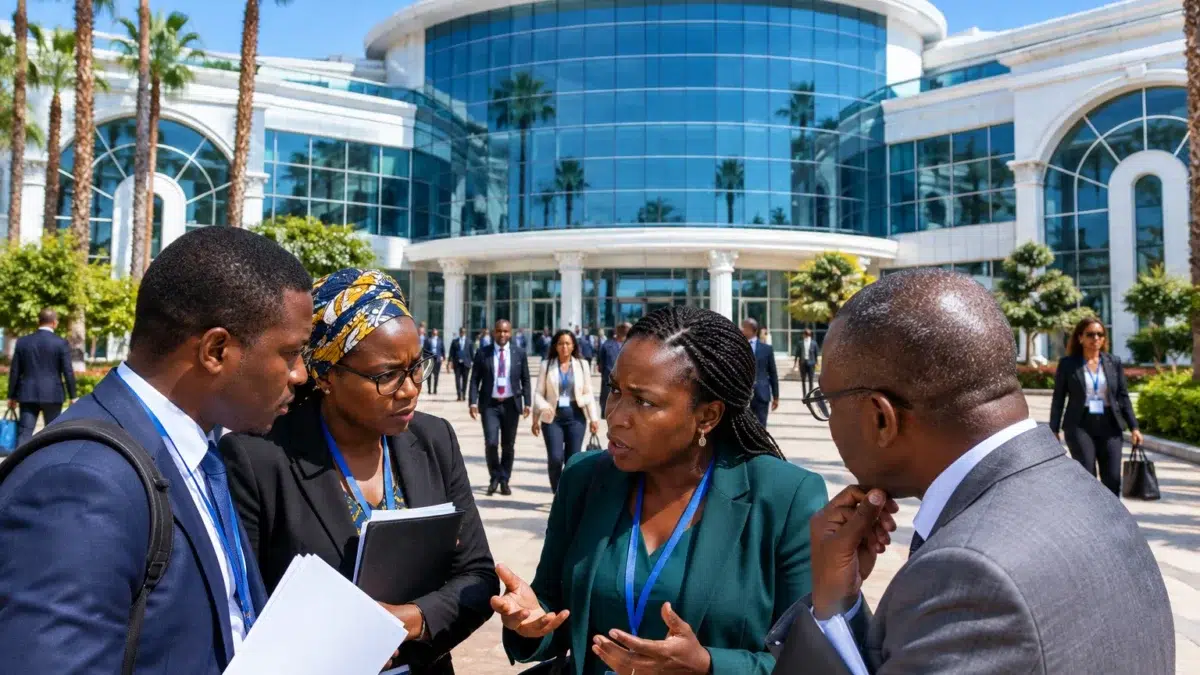
In Antalya, the climate debate is also playing out in public accounts: who will pay for adaptation, and how can African countries transform their energy systems without adding to their debt? On the eve of COP31’s close, these questions remain at the heart of discussions, as the draft political text has been significantly narrowed.
A compromise text that leaves questions open
The United Nations climate conference is being held in Antalya, Türkiye, from 9 to 20 November 2026. Türkiye is hosting the summit, while Australia is leading the negotiations. The “umbrella decision” being discussed by delegations is intended to provide broad political direction for the proceedings. It does not, however, replace the decisions negotiated on individual issues.
On 19 November, the presidency published a new version of the text. This draft no longer explicitly mentions oil, gas and coal. Nor does it retain the call for a transition away from fossil fuels included in the previous version. Independent reports from the conference confirm the change, while funding and adaptation remain contested issues.
The sequence is a reminder of a persistent challenge at COPs: decisions are made by consensus. Any wording can therefore become a point of contention between countries that want to accelerate the phase-out of fossil fuels and producer countries, or between states that disagree over how costs should be shared. At COP28 in Dubai in 2023, governments agreed to “transition away” from fossil fuels. Since then, negotiations have not established a precise global timetable.
For African negotiators, ambition must be backed by funding
African representatives are not only calling for more ambitious climate targets. They want commitments to be matched by resources that are accessible, predictable and suited to states’ financial capacities. The African Group of Negotiators on Climate Change (AGN), which coordinates the continent’s countries’ positions in the talks, has made funding, adaptation and a just transition priorities in Antalya.
The group is advocating, in particular, for funding in the form of grants or highly concessional loans. Its argument is that additional loans can worsen debt burdens, when governments already have to fund infrastructure, public services and climate resilience. The AGN also stresses that developed countries’ financial support obligation, set out in Article 9 of the Paris Agreement, must not be replaced by broader discussions about redirecting financial flows.
This distinction has practical consequences. For a government, a funding promise in a political declaration guarantees neither that a sum will be available nor that there will be rules for disbursing it. For local authorities, farmers and residents exposed to droughts, floods or extreme heat, adaptation requires real spending: early-warning systems, water management, resilient infrastructure and support for affected livelihoods.
At a press briefing reported on 19 November by Kenyan outlet Africa Science News, African negotiators called for financial commitments to be made verifiable and enforceable. Their position echoes that expressed by AGN chair Nana Antwi-Boasiako Amoah in a statement issued by the group the previous day: decisions must turn ambition into concrete measures without weakening existing commitments under the Paris Agreement.
The energy transition is about more than a global target
The latest draft retains a target for increasing electricity’s share of global energy consumption, but its ambition has been weakened over successive versions. Moreover, greater electrification does not automatically mean abandoning coal, oil or gas. The outcome will depend on the sources used to generate that electricity and the investments made.
For African countries, the challenge is twofold: to cut emissions and meet the energy needs of populations and industries whose access to electricity remains uneven. These priorities differ from one country to another. Nigeria, a major hydrocarbons producer, does not start from the same position as Kenya, where geothermal energy plays an important role, or countries facing severe constraints on access to electricity grids.
African negotiators therefore support a just transition that takes account of national pathways and the right to development. They are calling for funding, technology and capacity to drive this transformation. Without such support, a uniform demand for a rapid shift in energy systems risks placing a disproportionate share of the costs on less-equipped economies and households.
This call does not deny the role of fossil fuels in global warming. Rather, it raises the question of how the effort should be shared: which countries should cut emissions faster, who will fund the investments, and how can affected workers and communities be protected? A final text that no longer names fossil fuels could leave these trade-offs without clear political direction.
Adaptation funding is a test of credibility
Adaptation funding remains another sensitive issue. Discussions include how to deliver on the target of tripling adaptation finance and how to measure progress. African countries are calling for a timetable and clear benchmarks. Without a baseline for calculation or a monitoring mechanism, a target can be difficult to assess, even when it is included in a final text.
Interests do not always align across the continent. Coastal states, Sahelian countries, island states and economies dependent on hydrocarbon exports face different risks and choices. Yet they share an interest in ensuring that promised assistance is accessible and that the burden of the transition does not fall solely on already constrained public budgets.
The Turkish-Australian presidency says it is seeking the most ambitious compromise possible within the limits of consensus. But African organisations and negotiators judge the text by its ability to make commitments actionable. The two approaches collide over a central question: should the priority be a short text acceptable to all, or should more specific obligations be retained at the risk of a deadlock?
Beyond Antalya, implementation will be the test
As delegations approach the official end of COP31, set for 20 November, several issues remain under discussion, including climate finance, the adaptation fund and the just transition programme. The text published on 19 November is a draft, not a final agreement. Last-minute consultations could still change its wording, and COPs sometimes run beyond their scheduled end.
The outcome’s significance for the continent will therefore be measured on two levels: the language adopted in the umbrella decision and the financial and technical decisions negotiated separately. For African countries, a general reference to resilience will not replace the resources needed to prepare cities, rural areas and infrastructure for the effects of global warming.
The next step will be to check whether the commitments agreed in Antalya come with implementation rules, identifiable funding and regular monitoring. Only then can international announcements influence energy choices and adaptation policies in each country.
For official texts, consult the COP31 page published by the United Nations Framework Convention on Climate Change, as well as the positions of the African Group of Negotiators on Climate Change.