Algeria
 Egypt
 Libya
 Sudan
 Tunisia
 Benin
 Burkina Faso
 Cabo Verde
 Côte d'Ivoire
 Ghana
 Guinea
 Guinea-Bissau
 Liberia
 Mali
 Mauritania
 Niger
 Nigeria
 Senegal
 Sierra Leone
 The Gambia
 Togo
 Cameroon
 Central African Republic
 Chad
 DR Congo
 Equatorial Guinea
 Gabon
 Republic of the Congo
 São Tomé and Príncipe
 Burundi
 Comoros
 Djibouti
 Eritrea
 Ethiopia
 Kenya
 Madagascar
 Malawi
 Mauritius
 Mozambique
 Rwanda
 Seychelles
 Somalia
 South Sudan
 Tanzania
 Uganda
 Angola
 Botswana
 Eswatini
 Lesotho
 Namibia
 South Africa
 Zambia
 Zimbabwe
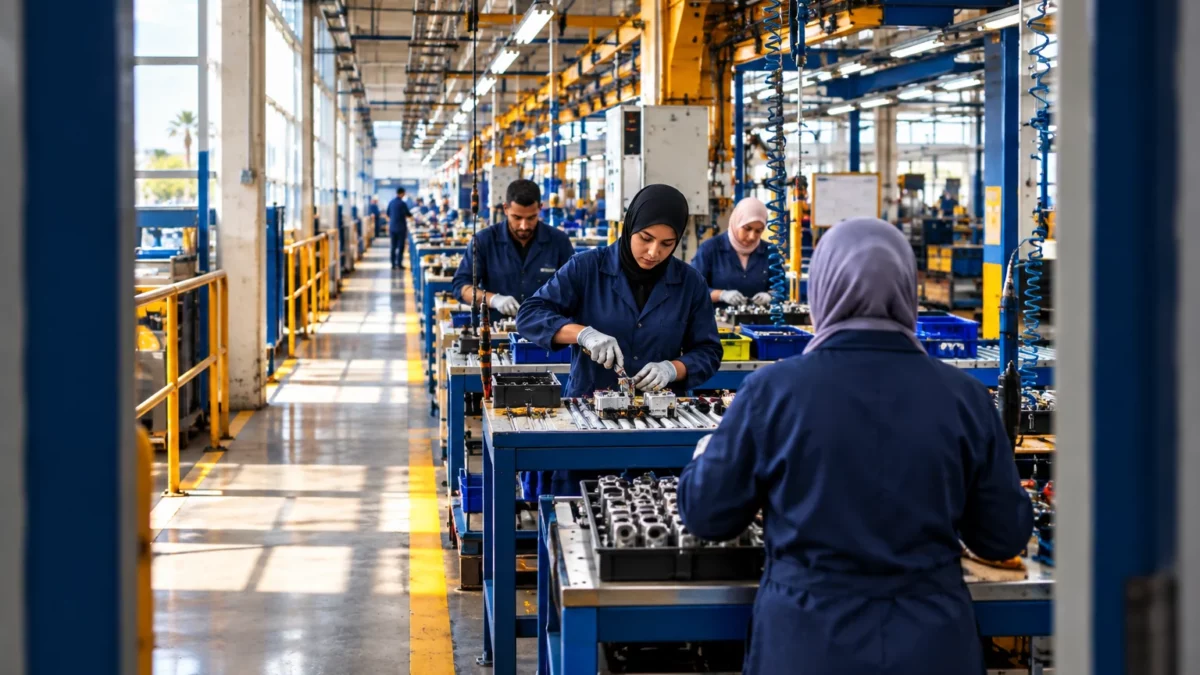
Manufacturing more defence equipment in Morocco could open a new industrial path beyond the automotive and aerospace sectors. But the ambition announced for 2035 also raises a practical question: how many lasting jobs and local skills will this industry actually create?
An industrial strategy amid high unemployment
On 18 November 2026, at the Royal Palace in Rabat, King Mohammed VI chaired a meeting on the “Morocco Offer” and the roadmap for the national defence and security industry. The Hassan II Fund for Economic and Social Development is to contribute 4 billion dirhams towards launching the initiative. These details were reported by Moroccan media and confirmed by several independent publications. The account of the meeting in Rabat sets out this contribution and the priorities presented.
The roadmap sets three targets for 2035: creating nearly 50,000 direct and indirect jobs, meeting about 40% of the needs of the Royal Armed Forces and security services, and generating more than 65% of the sector’s revenues through exports. These are announced targets, not results already achieved.
The timetable comes as the labour market remains under strain. According to the High Commission for Planning (HCP), national unemployment reached 10.5% in the third quarter of 2026. It stood at 30.5% among young people aged 15 to 24. These official figures show the scale of the challenge, but do not indicate in advance what share of the announced jobs will go to them.
The strategy is also part of the Kingdom’s ongoing industrial transformation. Morocco has developed assembly, wiring and component-production activities for the automotive and aerospace industries. Some skills and infrastructure could provide a basis for new manufacturing. However, experience in these sectors alone does not guarantee mastery of complex military technologies or their transfer to Moroccan companies.
Industrial zones and governance still to be established
The “Morocco Offer” provides for two additional defence industrial zones, in Benguérir and Benslimane, alongside industrial acceleration zones already launched. The project aims to cover several stages: design, manufacturing, maintenance, testing and storage. Priority sectors include drones and autonomous systems, land and naval equipment, electronics, cyber defence and artificial intelligence.
Two bodies are to organise the rollout. A strategic agency would support investors and coordinate public policy. An industrial holding company would be tasked with structuring the sector and fostering the emergence of national companies. The 4 billion dirham funding is an announced initial contribution; full financing arrangements, the distribution of projects and the operational timetable remain to be specified.
This implementation will be decisive for the economic benefits. Direct jobs could involve production, engineering and maintenance. Indirect employment will depend in particular on local suppliers, training and the services required around the sites. The impact will therefore vary for workers and small businesses according to their access to skills, public contracts and supply chains.
The export target raises another requirement: competitiveness. An industry generating more than 65% of its revenue abroad will need to find customers, comply with the rules governing arms transfers and maintain technological partnerships. It will also have to balance the needs of the national forces against external orders. Industrial diversification can strengthen supply autonomy, but does not necessarily mean complete independence from foreign components, licences or expertise.
A regional issue, with results yet to be demonstrated
The project is unfolding in a region where security and military capabilities play an important role in relations between states. At Maghreb level, the Arab Maghreb Union is the relevant regional framework, although political and economic integration there remains limited. The development of a Moroccan industry could also attract interest from African markets, but the announcements available do not specify future customers or which equipment would be exported.
At continental level, the initiative raises a broader question: how can African industrial capabilities be developed while ensuring transparency, export controls and uses consistent with the law? Local production can reduce some external dependencies. In itself, however, it is neither proof of technological autonomy nor a guarantee that the benefits will be shared.
The next steps will show the roadmap’s actual scope: whether the announced bodies are established, the launch of the Benguérir and Benslimane zones, company financing, workforce training, and the publication of indicators on jobs and exports. For Moroccans, then, the issue is not simply the targets set for 2035. It will depend on whether the initiative can turn public investment into local expertise, accessible jobs and lasting industrial activity.