Egypt
 Libya
 Morocco
 Sudan
 Tunisia
 Benin
 Burkina Faso
 Cabo Verde
 Côte d'Ivoire
 Ghana
 Guinea
 Guinea-Bissau
 Liberia
 Mali
 Mauritania
 Niger
 Nigeria
 Senegal
 Sierra Leone
 The Gambia
 Togo
 Cameroon
 Central African Republic
 Chad
 DR Congo
 Equatorial Guinea
 Gabon
 Republic of the Congo
 São Tomé and Príncipe
 Burundi
 Comoros
 Djibouti
 Eritrea
 Ethiopia
 Kenya
 Madagascar
 Malawi
 Mauritius
 Mozambique
 Rwanda
 Seychelles
 Somalia
 South Sudan
 Tanzania
 Uganda
 Angola
 Botswana
 Eswatini
 Lesotho
 Namibia
 South Africa
 Zambia
 Zimbabwe
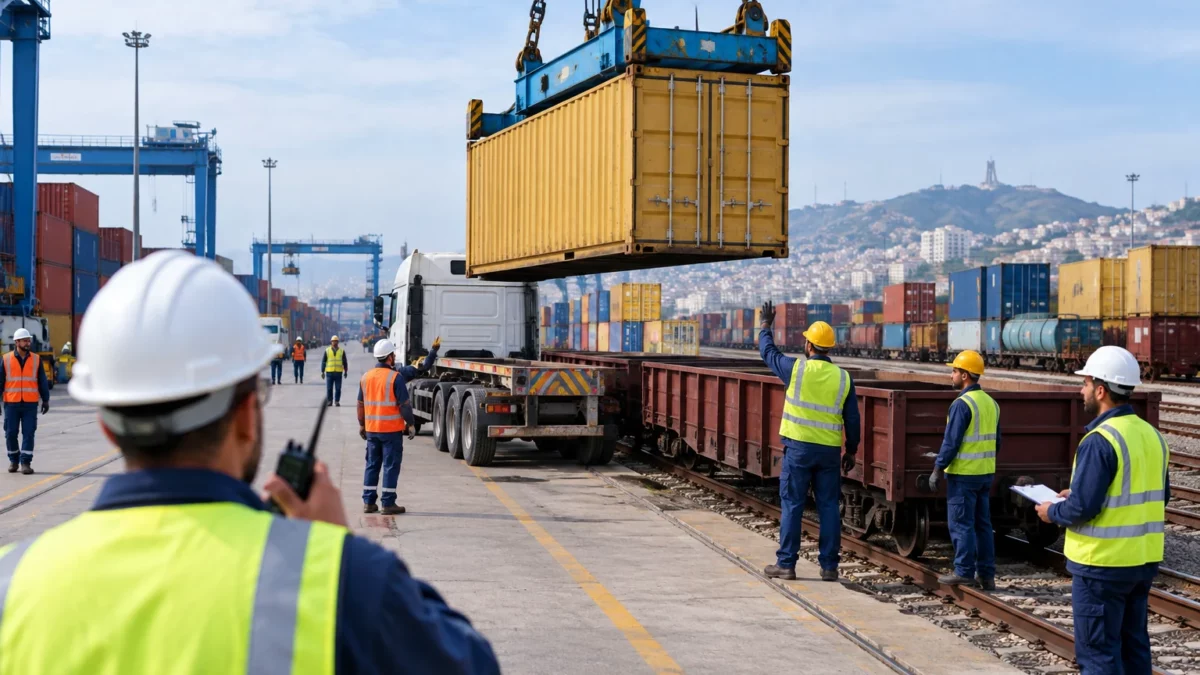
For an Algerian company exporting goods, saving time at the port is not enough if the cargo then has to wait for a train, a lorry or a formality. It is the entire journey — from factory to customer — that determines the predictability of deliveries and, with it, a measure of competitiveness.
The issue was highlighted in Algiers at the ninth edition of the International Transport and Logistics Exhibition, LOGISTICAL, held from 17 to 19 November 2026. The event brings together public- and private-sector players across a supply chain encompassing sea transport, rail, road, warehousing and cargo handling. The Algerian Chamber of Commerce and Industry’s presentation of LOGISTICAL confirms the dates and venue of the exhibition.
A journey that does not end at the port
Port delays are just one link in the chain. A shipment may be ready at the factory but lose time if a vessel is waiting offshore, cargo-handling equipment is unavailable or onward transport by land is not coordinated. At every stage, delays can tie up stock and make it harder to meet deadlines agreed with the buyer.
At LOGISTICAL, Djamel Bekkara, head of a private transport and logistics company, called for shorter waiting times for vessels offshore and a steady pace of production. Algeria Press Service (APS), which reported his remarks on 17 November, presents these two conditions as ways to ensure timely delivery and limit logistics costs.
The National Company for Rail Transport (SNTF), for its part, is emphasising multimodal transport: the coordinated use of several modes, such as rail, road and sea. Its central director, Farid Halliche, spoke of partnerships with maritime and road operators and the creation of logistics platforms connected to the rail network. The stated aim is to bring goods closer to different modes of transport, rather than treating each stage separately. APS’s report on proposals put forward at the exhibition also mentions a rail network expected to reach 12,000 kilometres.
Ambitions, but results to be measured
These announcements outline broad directions. At this stage, they provide no detailed timetable for the platforms mentioned, no new formalised agreements and no estimate of the expected savings. The projected length of the rail network alone is not enough to conclude that exporters will soon benefit from shorter lead times.
For a business, the relevant measure will therefore not simply be the number of kilometres of track or a port’s capacity. It will need to know how long it takes for goods to travel from the factory gate to delivery to the customer, how much that time varies from one shipment to another and what the total cost to the exporter is. An improvement at the quay can lose its impact if containers then wait for available inland transport.
Any gains would not be distributed evenly. Larger operators can more easily organise regular volumes and negotiate transport contracts. For small and medium-sized businesses, unpredictable delays can put greater pressure on cash flow and their ability to fulfil an order. The availability of services beyond the main port hubs also matters: a platform improves access to markets only if it is connected to production areas and operates to schedules and procedures that meet businesses’ needs.
Coordination between government departments, ports, carriers and producers is therefore as important as infrastructure. The chain must operate as a continuous journey. That means making schedules, formalities and responsibilities clear, as well as tracking results using comparable indicators. Without such data, it is difficult to distinguish lasting progress from a one-off operation.
The challenge of continuity in Algeria and the region
The exhibition is part of a broader debate about the role of non-hydrocarbon exports in Algeria’s economy. More predictable transport could make it easier for businesses in various sectors to access markets. But logistics is only one condition among several: consistent production, trade rules and customer-specific requirements remain decisive.
The issue extends beyond Algeria’s borders. In North Africa, more reliable links between production areas, ports and land networks could matter for regional trade and commercial ties with the rest of the continent. Algeria is a member of the Arab Maghreb Union (AMU), a regional organisation comprising five Maghreb countries. However, statements made at the exhibition do not in themselves amount to an announcement of a cross-border scheme or a new regional agreement.
The point to watch, then, is whether the proposals put forward are translated into concrete decisions: the locations and timetable for the platforms, arrangements for coordination with ports and carriers, and the publication of results on lead times and costs. It is on this complete journey, rather than at any single stage, that businesses will be able to judge whether the promise of smoother logistics translates into more reliable deliveries.