
 Egypt
 Libya
 Morocco
 Sudan
 Tunisia
 Benin
 Burkina Faso
 Cabo Verde
 Côte d'Ivoire
 Ghana
 Guinea
 Guinea-Bissau
 Liberia
 Mali
 Mauritania
 Niger
 Nigeria
 Senegal
 Sierra Leone
 The Gambia
 Togo
 Cameroon
 Central African Republic
 Chad
 DR Congo
 Equatorial Guinea
 Gabon
 Republic of the Congo
 São Tomé and Príncipe
 Burundi
 Comoros
 Djibouti
 Eritrea
 Ethiopia
 Kenya
 Madagascar
 Malawi
 Mauritius
 Mozambique
 Rwanda
 Seychelles
 Somalia
 South Sudan
 Tanzania
 Uganda
 Angola
 Botswana
 Eswatini
 Lesotho
 Namibia
 South Africa
 Zambia
 Zimbabwe
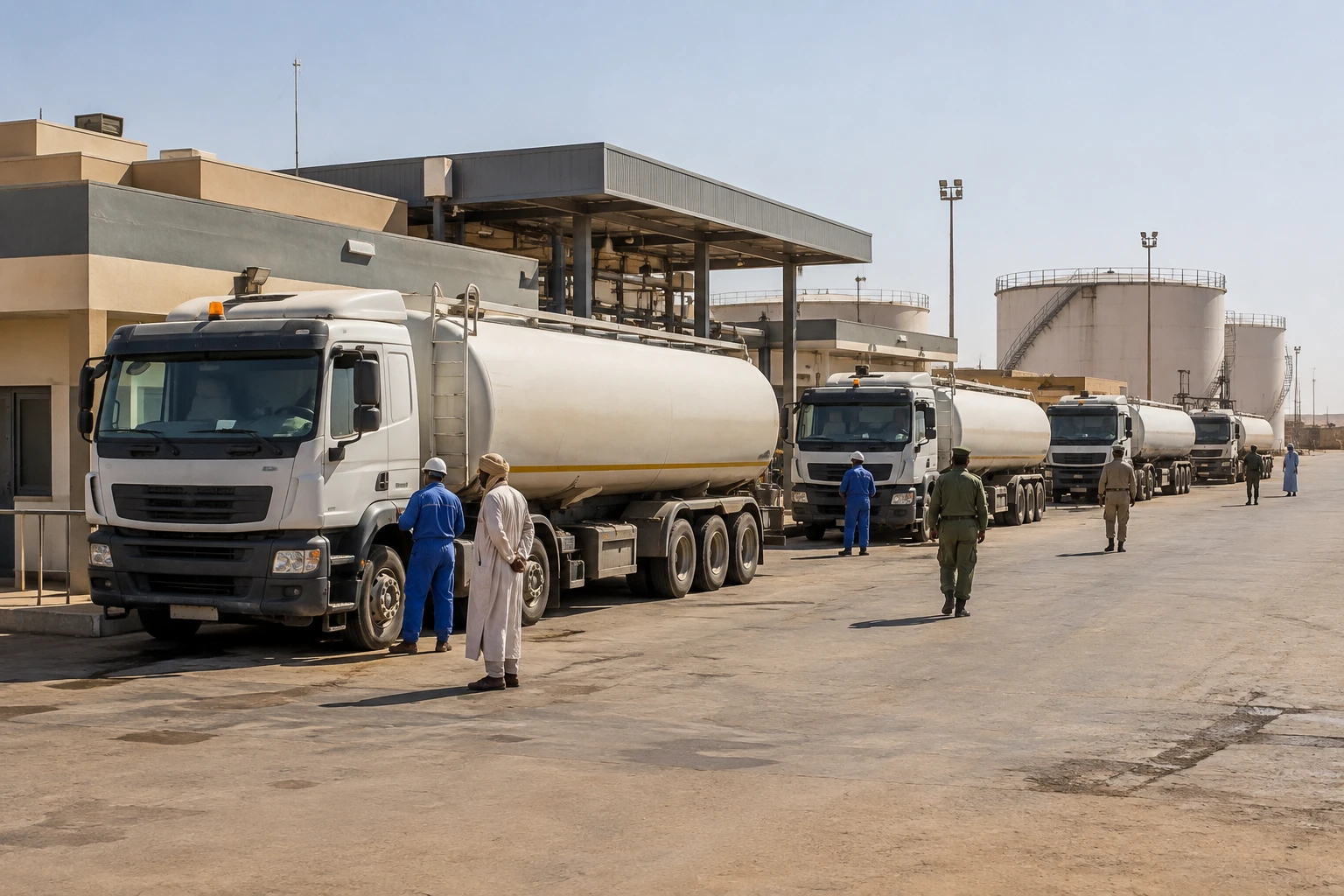
In Agadez, the arrival of fuel from Algeria meets an immediate need. But the Algerian military escort accompanying the lorries gives the delivery broader significance: it marks a new level of cooperation between two Sahelian neighbours, in a region where energy and security intersect.
A much-needed supply for northern Niger
The convoy reached Agadez, in northern Niger, on Saturday 31 October 2026. The following day, Niger’s Minister of Petroleum, Hamadou Tinni, received the delivery at the depot of the Société nigérienne des produits pétroliers (SONIDEP). Algeria’s APS news agency and Nigerien media report that 53 tankers were carrying about 1.65 million litres of fuel. RFI, for its part, describes around 60 lorries. Figures therefore vary across the available reports; the official quantity communicated by the Nigerien authorities is 1.65 million litres. The Nigerien account of the fuel delivery in Agadez and Algeria’s APS news agency give the announced volumes.
Algerian military personnel escorted the lorries, according to reports by RFI and the Mauritanian outlet Madar. Nigerien Armed Forces personnel are said to have joined the convoy at the border. The route thus involved resources from both countries on a road linking southern Algeria to Agadez. This is distinct from a simple commercial delivery, although the authorities have not made all the operational details of the escort public.
The delivery comes as fuel supplies are a concern for authorities in the region. In September, the governor of Agadez had reported difficulties with supplies from SONIDEP and mentioned efforts to obtain fuel from Algeria. This logistical dependence is particularly sensitive in a vast region far from Niamey and the main storage centres. The Nigerien News Agency reported the supply difficulties raised in Agadez.
A security rapprochement takes concrete shape
The convoy came a few days after a major political decision in Algiers. President Abdelmadjid Tebboune announced on 26 October that units of the People’s National Army would be sent to Niger. Algeria’s parliament subsequently approved the notification. The Algerian presidency presented the decision as a way to protect shared energy and economic interests, without publicly detailing the composition, duration or precise missions of the units concerned. The Algerian presidency announced the deployment of military units to Niger, and the People’s National Assembly approved the notification.
The move marks a departure from Algeria’s historical caution over deploying its forces beyond its borders. However, it is not in itself enough to conclude that an enduring Algerian military presence is being established in Agadez. For now, the confirmed details concern a decision to send units and the escort of a fuel convoy. The mission’s terms remain unclear.
For Niamey, cooperation could secure the transport of energy products and support fragile regional supplies. For Algiers, Niger is a neighbouring country and a strategic partner in an unstable Sahelian region. Protecting flows and energy interests could therefore serve both capitals. But these aims do not yet explain how the forces will be deployed, or what control Nigerien authorities will exercise over their operations.
Practical effects beyond the capitals
In Agadez, fuel is essential to the transport of people and goods, business activity and the operation of many services. A delivery of this scale may ease local supply, but cannot by itself guarantee lower prices or regular availability. That will depend on distribution by SONIDEP, existing stocks and the frequency of future convoys. People in remote parts of the region, where journeys are long, may be more severely affected by shortages and transport costs than those operating in urban centres.
Road transport also creates security risks for drivers and cargo. An escort can reduce some risks along the route, but it will not resolve structural supply difficulties or security tensions in the north. The authorities have not said whether this arrangement will be repeated. Monitoring is therefore central: a one-off operation provides a useful volume, while a regular system would require further logistical and political guarantees.
Public announcements also carry diplomatic weight. The Nigerien government can present the partnership as cooperation between neighbours in response to practical needs. On the Algerian side, the protection of economic interests is at the forefront of the official justifications. These statements must still be distinguished from operational details, which have not been published. This caution is important: the arrival of military personnel does not, by itself, reveal the precise mandate of the escort or the scope of the announced presence.
A regional signal to watch
The rapprochement is part of the reconfiguration of Sahelian alliances since the July 2023 coup in Niger. The country, alongside Mali and Burkina Faso, formed the Alliance of Sahel States (AES), a framework for cooperation between the three states. Their withdrawal from the Economic Community of West African States (ECOWAS), the West African regional organisation, took effect on 29 January 2025. Algeria, which is not an ECOWAS member, shares a border with Niger and plays an important role in the balance of power in the Sahara and Sahel. The three countries’ departure from ECOWAS marked a new stage in this regional reconfiguration.
The Agadez convoy will not, on its own, redraw the continent’s alliances. It does, however, show how a practical issue — transporting fuel — can accompany more visible security cooperation. What happens next will depend on the regularity of deliveries, clarification of the Algerian units’ mandate and the Nigerien authorities’ ability to turn this one-off support into predictable supplies for the population and local economy.



