
 Egypt
 Libya
 Morocco
 Sudan
 Tunisia
 Benin
 Burkina Faso
 Cabo Verde
 Côte d'Ivoire
 Ghana
 Guinea
 Guinea-Bissau
 Liberia
 Mali
 Mauritania
 Niger
 Nigeria
 Senegal
 Sierra Leone
 The Gambia
 Togo
 Cameroon
 Central African Republic
 Chad
 DR Congo
 Equatorial Guinea
 Gabon
 Republic of the Congo
 São Tomé and Príncipe
 Burundi
 Comoros
 Djibouti
 Eritrea
 Ethiopia
 Kenya
 Madagascar
 Malawi
 Mauritius
 Mozambique
 Rwanda
 Seychelles
 Somalia
 South Sudan
 Tanzania
 Uganda
 Angola
 Botswana
 Eswatini
 Lesotho
 Namibia
 South Africa
 Zambia
 Zimbabwe
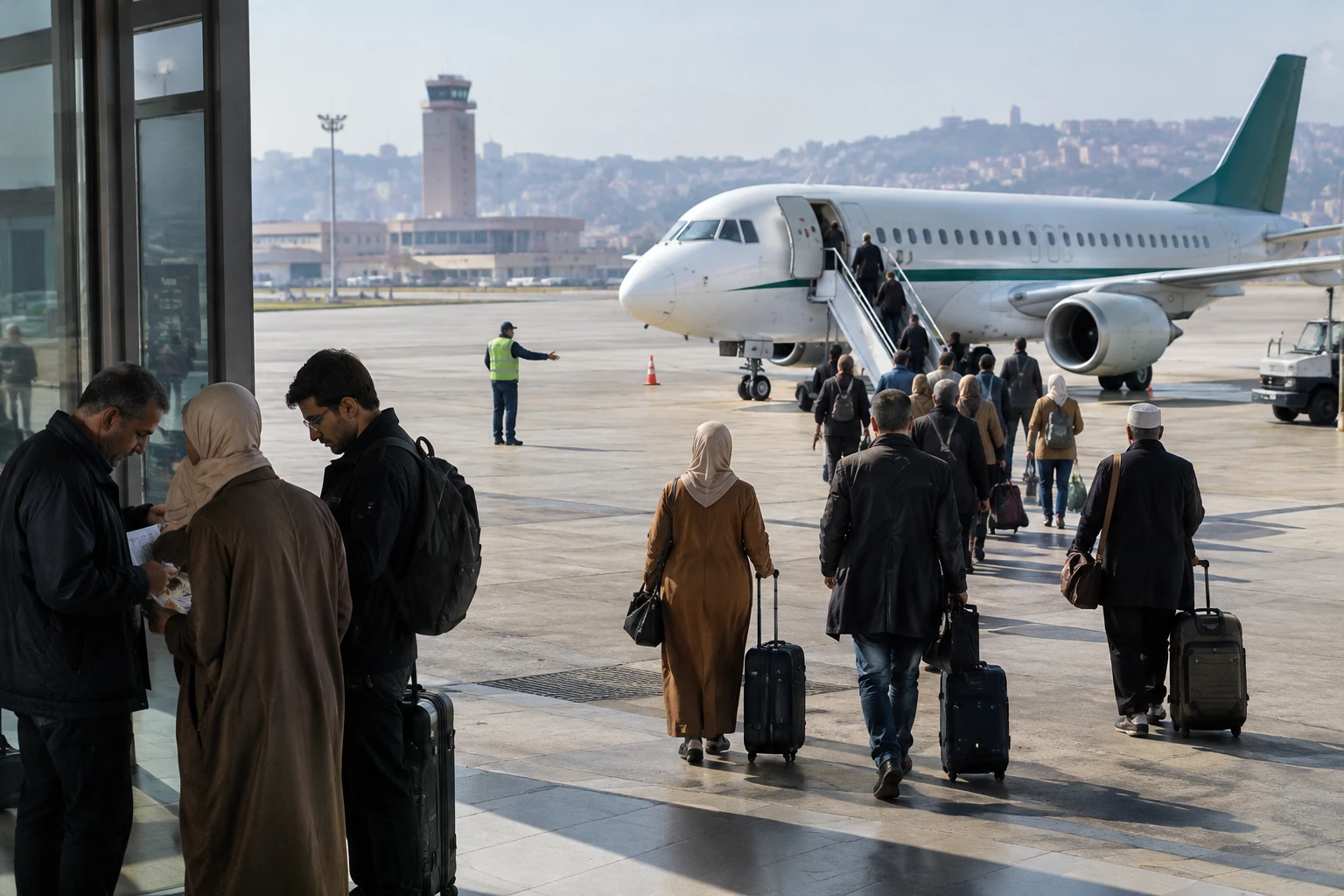
On 22 October 1956, a stopover en route to Tunis ended in Algiers, then under French rule. On board the plane were five officials of the National Liberation Front (FLN), captured after the aircraft was forced to change course. The episode reveals how the war of independence was already spilling beyond Algeria’s borders and testing relations between Paris, Rabat and Tunis.
A war fought beyond Algeria too
In 1956, Morocco and Tunisia had recently gained their independence. The war launched in Algeria in November 1954 was continuing. The FLN, which was leading the fight against French colonial rule, was seeking political support and networks in neighbouring countries. France, by contrast, wanted to prevent the Algerian question from being treated as an international conflict.
The regional context was decisive. Morocco and Tunisia provided space for support for the Algerian cause, while Paris still retained means of influence in the region. The Arab Maghreb Union, which today brings together five North African states, did not yet exist: it would not be created until 1989. In 1956, relations between the three countries were shaped by the urgency of decolonisation and war.
On 22 October, an FLN delegation was due to travel from Rabat to Tunis. It included Ahmed Ben Bella, Mohamed Khider, Hocine Aït Ahmed, Mohamed Boudiaf and Mostefa Lacheraf. Journalists were also on board. The Algerian leaders were due to take part in political meetings devoted to the struggle for independence.
A flight interrupted between Rabat and Algiers
The aircraft, operated by the Moroccan airline Air Atlas, took off from Rabat-Salé bound for Tunis. After a stopover in Palma de Mallorca, it resumed its journey. Historical accounts report that it was then ordered to change course and land in Algiers. The French army intercepted the plane, which landed at Maison-Blanche airport. The five FLN officials were arrested.
Archives and press accounts confirm the central details: the date, the intended destination, the five political passengers and their arrest in Algiers. However, accounts differ on the precise circumstances of the interception and the decision-making chain. It is therefore safer to speak of a plane forced to land than to present every operational detail as definitively established. Press archives published the day after the arrests and footage held by the National Audiovisual Institute document the event.
The significance of the affair went beyond the capture of five leaders. It also touched on Morocco’s sovereignty, since its airline operated the aircraft, and on the security of travel between countries. France justified the operation at the time on security grounds and by reference to the plane’s status. But the interception prompted protests and a diplomatic crisis with Rabat and Tunis.
A tactical success, uncertain political effects
For the French authorities, arresting several prominent FLN figures may have seemed an immediate victory. Yet the detention of these leaders did not stop the war. The movement already had networks and an organisation that did not depend solely on the officials on board the plane. The Soummam Congress, held in August 1956, had helped structure its political and military bodies.
The episode also highlighted the limits of a strategy focused on neutralising leaders. The arrested officials remained in prison until 1962, the year of Algerian independence. Their capture temporarily deprived the FLN of important figures, but did not resolve the conflict. Instead, it fuelled diplomatic tensions and raised the profile of the Algerian cause beyond the country’s borders.
In Morocco, the arrest of officials welcomed by King Mohammed V was seen as an affront to the sovereignty and dignity of the new state. In Tunisia, plans for a political meeting were directly thwarted. For the population, the consequences of such a crisis were not abstract: it affected relations between neighbours, travel and diplomatic ties, in a region where borders inherited from the colonial period remained a major issue.
Decades later, an allegation that Crown Prince Hassan had co-operated with the French authorities circulated. It was disputed by Hocine Aït Ahmed and Ahmed Ben Bella, and no material evidence cited in the works consulted supports treating it as established fact. These speculations should therefore be distinguished from the documented facts about the interception and arrest.
A national memory, a regional precedent
In Algeria, the event forms part of the memory of the war of liberation and the account of support provided by neighbouring countries. Algeria’s official news agency APS marked the 70th anniversary with a conference in Algiers, where speakers described the operation as a dangerous precedent for civil aviation. This commemorative interpretation also serves as a reminder of how much of the history of Algeria’s struggle was written beyond its borders.
Across North Africa, the affair highlights the tension between the ambitions of the newly independent states to co-operate and France’s desire to contain the internationalisation of the conflict. It should not be confused with contemporary hijackings: the legal frameworks, actors and circumstances are different. But the 1956 episode remains a reference point for understanding how a national war can become an issue of regional sovereignty, diplomacy and air law.
The essential facts are corroborated by contemporary press archives, INA footage, French diplomatic archives and the APS account marking the 70th anniversary. Operational details and individual responsibility should, however, be reported with caution where accounts do not agree.



