Algeria
 Egypt
 Libya
 Morocco
 Sudan
 Tunisia
 Benin
 Burkina Faso
 Cabo Verde
 Côte d'Ivoire
 Ghana
 Guinea
 Guinea-Bissau
 Liberia
 Mali
 Mauritania
 Niger
 Nigeria
 Senegal
 Sierra Leone
 The Gambia
 Togo
 Cameroon
 Central African Republic
 Chad
 Equatorial Guinea
 Gabon
 Republic of the Congo
 São Tomé and Príncipe
 Burundi
 Comoros
 Djibouti
 Eritrea
 Ethiopia
 Kenya
 Madagascar
 Malawi
 Mauritius
 Mozambique
 Rwanda
 Seychelles
 Somalia
 South Sudan
 Tanzania
 Uganda
 Angola
 Botswana
 Eswatini
 Lesotho
 Namibia
 South Africa
 Zambia
 Zimbabwe
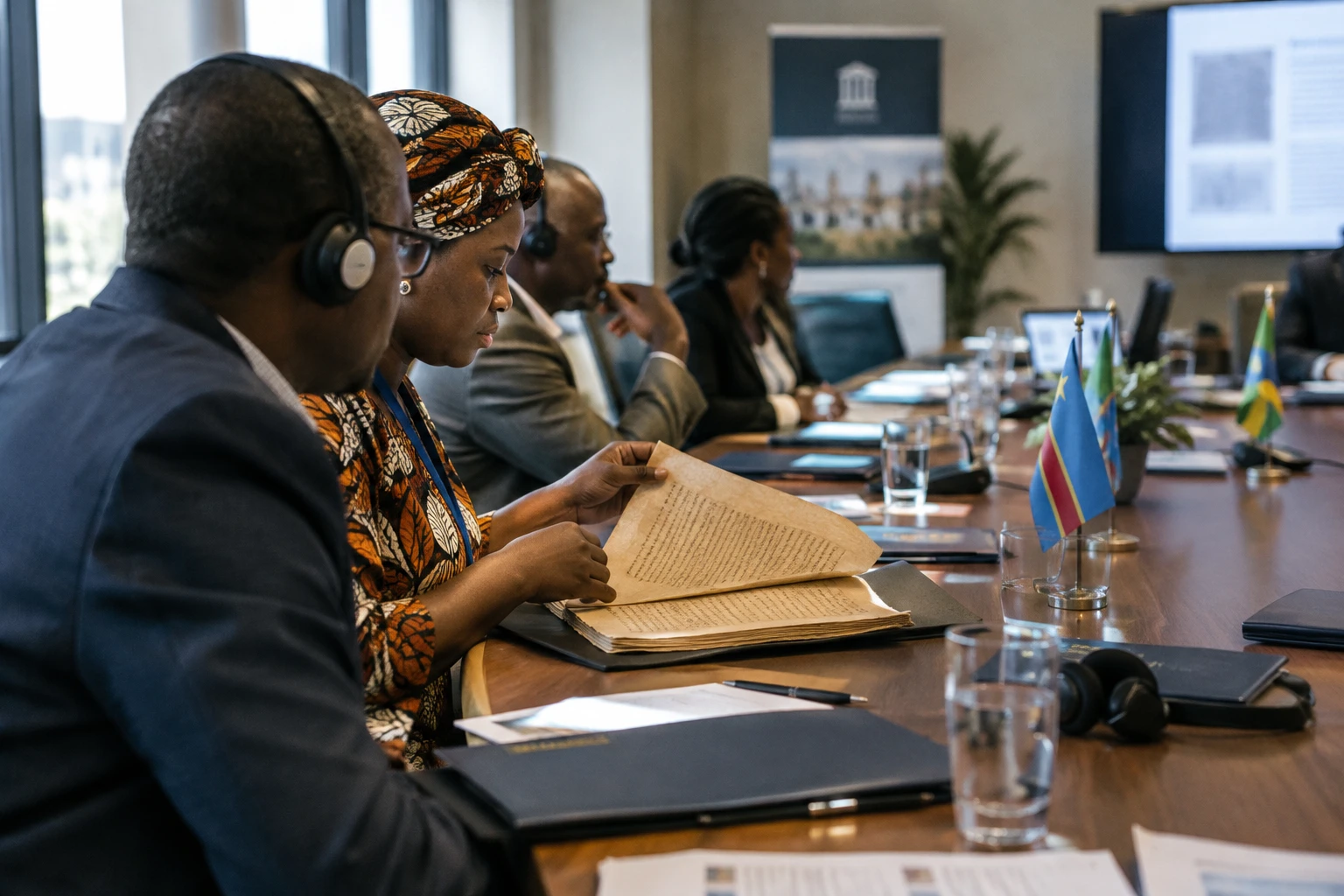
In eastern Democratic Republic of the Congo, manuscripts written in Arabic script tell a story too often relegated to the margins: that of the exchanges, learning and Muslim communities that shaped the region’s intellectual life. These traces invite us to look at Congo’s past beyond the single narrative of Belgian colonialism.
From trade routes to networks of knowledge
From the 19th century onwards, merchants linked to networks on the East African coast travelled through what is now Maniema and reached centres such as Kasongo. These journeys connected the interior of the Congo Basin with East Africa. They carried more than goods: languages, religious practices and texts also travelled along these routes.
Writings in Arabic and in Swahili transcribed in Arabic script bear witness to these exchanges. They were used for correspondence, transactions and religious transmission. Arabic script, sometimes called ajami when used to write an African language, was therefore not simply a tool of worship. It also served social and commercial purposes.
The Congolese and Belgian-Congolese research project Kalamu na wino, dedicated to the heritage of Arabic writing in Congo, documents, among other things, traces preserved in Maniema. A mission conducted in 2024 in Kasongo, Kindu and Kinshasa also gathered accounts of the persistence of these written practices. It brings together researchers from the Université libre de Bruxelles and the University of Kisangani.
Ancient documents held in European collections represent only part of this heritage. Xavier Luffin’s research on Arabic and Swahili archives describes letters, contracts, religious books and other texts originating in what is now Congolese territory. The oldest identified manuscripts date from the late 19th century, but their documented presence alone does not make it possible to establish precisely when they first began to circulate.
A written culture with many uses
The texts found include copies of the Quran, learning materials, legal works and writings linked to practices of protection or healing. Some combine verses with the making of talismans. These objects and texts do not sum up Congolese Islam: they reveal the diversity of knowledge circulating among the learned.
As Xavier Luffin’s study published by the Royal Academy for Overseas Sciences points out, practices considered esoteric exist in several Muslim societies. Depending on place and period, they coexist with different interpretations of religion. In Congo, one and the same scholar could teach the Quran and know texts used to make amulets.
This history corrects a misconception: writing did not reach every region of Congo through European missions or the colonial administration. In the east, the use of written Arabic and Swahili predates the lasting establishment of colonial rule. It attests to local forms of learning and knowledge production, even if the available archives remain fragmentary.
Conquest also shaped what was preserved
Relations between the authorities of the Congo Free State and Arab-Swahili networks changed with the conquest. Between 1892 and 1894, the Congo Free State’s forces conducted military campaigns in the east of the territory. Colonial accounts often presented them as a struggle against the slave trade. That description is not enough to explain the balance of power: the operations were also part of the political and commercial takeover of the region.
This period influenced how Muslim communities were subsequently viewed by the colonial administration. An academic study of Muslims in Maniema describes their lasting marginalisation under Belgian rule and the difficulties this minority faced in gaining political representation. This finding concerns a historical trajectory; it does not by itself capture the diversity of Muslim experiences across the country.
The preservation of manuscripts raises another question. Some documents were handed over to the authorities or deposited in institutions. Others were seized after clashes and then taken away. The archives of the Royal Museum for Central Africa in Tervuren include items linked to the military campaigns of 1892-1894. A document’s history therefore also depends on the circumstances in which it was collected and moved.
A Congolese heritage and a regional cooperation challenge
Today, Kasongo and Kindu remain important places for remembering these movements. Field research, family accounts and the study of archival collections can complement one another. But they require a distinction between what is established by a manuscript, what is reported orally and what remains a hypothesis. Digitisation and cooperation with Congolese institutions could also make it easier to access documents held abroad.
The subject extends beyond today’s borders. The historic routes linking Maniema to the East African coast are a reminder that the region’s societies exchanged goods and ideas for a long time without conforming to boundaries later drawn by colonial administrations. The Democratic Republic of the Congo is today a member of both the East African Community and the Southern African Development Community; these contemporary frameworks should not be confused with the old networks, but they underline the country’s regional importance.
Making these writings visible does not mean replacing one single narrative with another. It means restoring the plurality of Congo’s history to Congolese people: trade, a scholarly tradition, diverse religious practices and a memory shaped by conquest. Future inventories and research conducted with local communities will show how many items remain to be identified, and under what conditions they can be studied and shared.