
 Egypt
 Libya
 Morocco
 Sudan
 Tunisia
 Benin
 Burkina Faso
 Cabo Verde
 Côte d'Ivoire
 Ghana
 Guinea
 Guinea-Bissau
 Liberia
 Mali
 Mauritania
 Niger
 Nigeria
 Senegal
 Sierra Leone
 The Gambia
 Togo
 Cameroon
 Central African Republic
 Chad
 DR Congo
 Equatorial Guinea
 Gabon
 Republic of the Congo
 São Tomé and Príncipe
 Burundi
 Comoros
 Djibouti
 Eritrea
 Ethiopia
 Kenya
 Madagascar
 Malawi
 Mauritius
 Mozambique
 Rwanda
 Seychelles
 Somalia
 South Sudan
 Tanzania
 Uganda
 Angola
 Botswana
 Eswatini
 Lesotho
 Namibia
 South Africa
 Zambia
 Zimbabwe
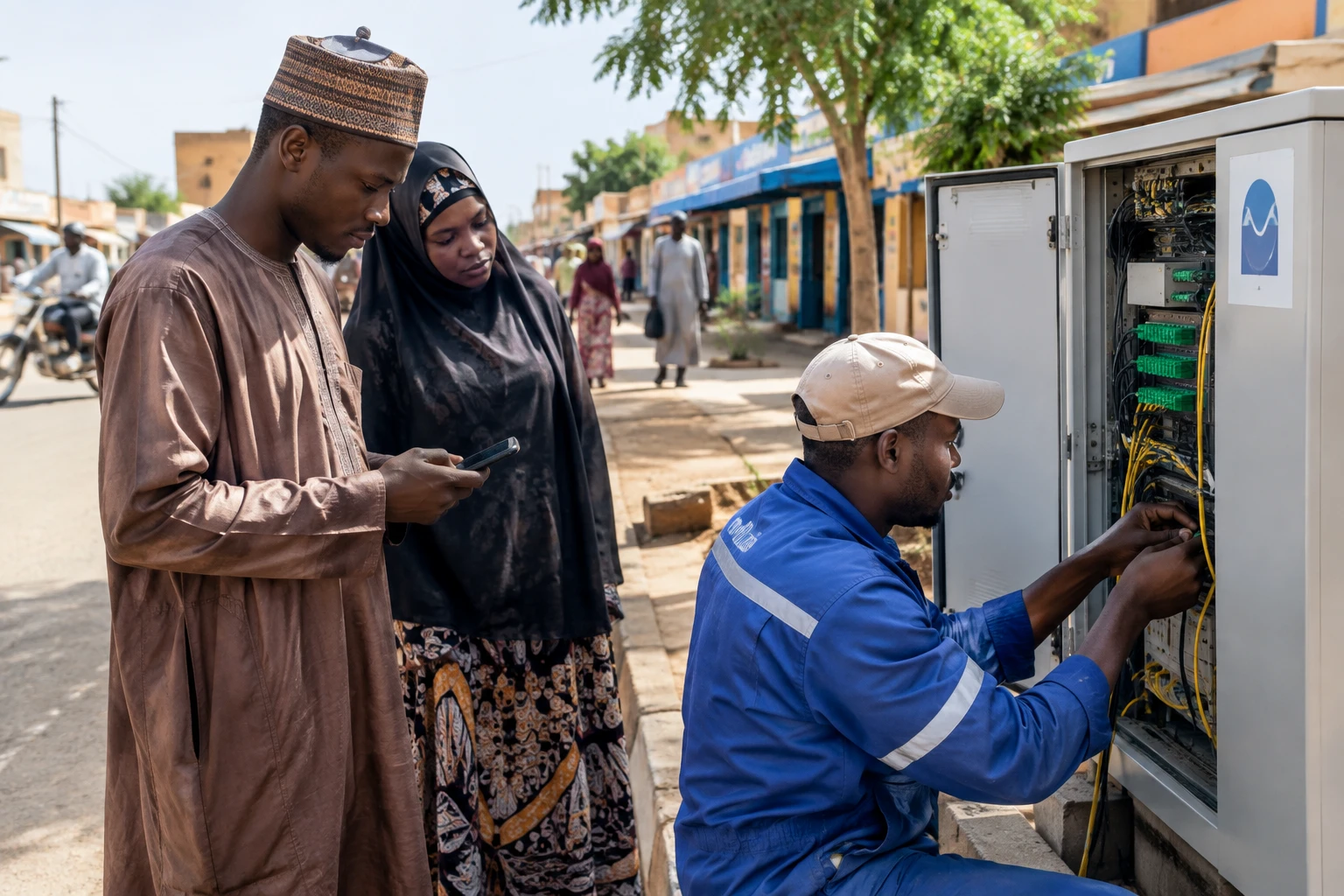
For a landlocked country such as Niger, a border connected by fibre can become a gateway to international networks. But a cable alone cannot guarantee fast, affordable and reliable access: operational connections within the country, equipment and services accessible to residents are also needed.
The announced commissioning at Assamaka therefore opens a new digital route between Niger and Algeria. It marks a concrete milestone in the Trans-Saharan backbone, a regional project with several sections still to be completed.
A link between Assamaka, Arlit and Agadez
On 6 October 2026, the two countries’ ministers responsible for telecommunications, Hamani Kargné and Sid-Ali Zerrouki, presided over the launch ceremony in Assamaka. The cable connects the Algerian network from In Guezzam to Niger’s Arlit and Agadez axis. The authorities have announced an initial capacity of 100 gigabits per second, which could be increased. These details were reported by the Nigerien and Algerian ministries, as well as the Anadolu news agency. The Nigerien Ministry of Communication’s statement and the Algerian news agency APS’s report confirm the date and commissioning. Anadolu also reports the announced capacity.
The figure of 100 Gbit/s refers to the link’s transmission capacity, not the speed that households will automatically receive. The tangible impact will depend on network distribution, operators, prices and the continuity of connections to international infrastructure.
For Niamey, the benefit is to diversify routes to external networks. Algeria has connections to submarine cables. The link could therefore give Niger an additional land route for carrying data. It does not, however, eliminate dependence on equipment and commercial agreements, or disparities in coverage between cities and rural areas.
A link in a six-country project
The Trans-Saharan backbone is designed to connect Algeria, Niger, Nigeria, Chad, Mali and Mauritania. Launched under the New Partnership for Africa’s Development, the project aims to create land links between these countries. The regional goal is to strengthen data exchanges and multiply routes to the internet, rather than make each country dependent on a single corridor.
In November 2025, Niger had already provisionally accepted sections totalling 1,031 kilometres, intended to connect its network to several borders. The Nigerien Press Agency detailed five routes, including links towards Algeria, Chad, Nigeria, Benin and Burkina Faso. The African Development Bank also confirmed the acceptance of more than 1,000 kilometres under the project. The ANP report and the AfDB statement corroborate this milestone.
This provisional acceptance and the launch of the Algerian link are two distinct milestones. Together, they show progress on Niger’s network, but do not mean that all regional branches are complete or that the corridor is already operating uninterrupted from end to end.
Chad illustrates the delays this type of infrastructure can encounter. Its component is due to connect Massaguet to the Nigerien border over about 503 kilometres. Each section requires funding and construction, followed by technical and commercial connections. An announced or planned schedule therefore does not, on its own, guarantee the availability of a continuous service.
Benefits will depend on the domestic network
Government agencies and businesses can benefit from increased capacity to exchange data, host services or improve some digital processes. Telecommunications operators could also gain an additional route for carrying their traffic. For residents, especially outside Niamey, the benefit will be less direct: it will depend on local coverage, subscription prices and the quality of nearby networks.
The connection will not eliminate inequalities between urban and rural areas either. Large cities and formal businesses are generally closer to infrastructure and telecommunications markets. Remote municipalities, small businesses and lower-income users will benefit from the new capacity only if investment continues beyond the border.
Network control also raises questions of resilience and digital sovereignty. Adding routes can reduce the risks associated with a cut on a single line. But the physical security of cables, maintenance, conditions of access to bandwidth and data protection remain crucial. These issues depend as much on cooperation between states as on operators’ choices.
Regional cooperation tested by political relations
The project also has a diplomatic dimension, though the fibre should not be seen as proof of political rapprochement on every issue. Algeria and Niger have experienced tensions, before their ambassadors returned in 2026. Meanwhile, Algiers and Bamako announced the reciprocal return of their ambassadors and the reopening of their airspace on 10 July, after a period of rupture. The Associated Press reported this normalisation and recalled the disagreements that preceded it. Its report on the resumption of Algerian-Malian relations helps place the digital project in a still-fluid regional context.
Mali is one of the six countries involved in the backbone, but the construction of its sections depends on specific political, technical and security conditions. Digital cooperation therefore does not replace diplomatic dialogue or the arrangements needed to carry out work in the areas concerned.
For Niger, the immediate challenge is now to turn the border connection into useful services within the country. At regional level, the next step will be to complete the missing interconnections and make the links compatible. The backbone will become a genuine continental corridor only when its various links can operate together, for the benefit of public authorities, businesses and populations.



