
 Egypt
 Libya
 Morocco
 Sudan
 Tunisia
 Benin
 Burkina Faso
 Cabo Verde
 Côte d'Ivoire
 Ghana
 Guinea
 Guinea-Bissau
 Liberia
 Mali
 Mauritania
 Niger
 Nigeria
 Senegal
 Sierra Leone
 The Gambia
 Togo
 Cameroon
 Central African Republic
 Chad
 DR Congo
 Equatorial Guinea
 Gabon
 Republic of the Congo
 São Tomé and Príncipe
 Burundi
 Comoros
 Djibouti
 Eritrea
 Ethiopia
 Kenya
 Madagascar
 Malawi
 Mauritius
 Mozambique
 Rwanda
 Seychelles
 Somalia
 South Sudan
 Tanzania
 Uganda
 Angola
 Botswana
 Eswatini
 Lesotho
 Namibia
 South Africa
 Zambia
 Zimbabwe
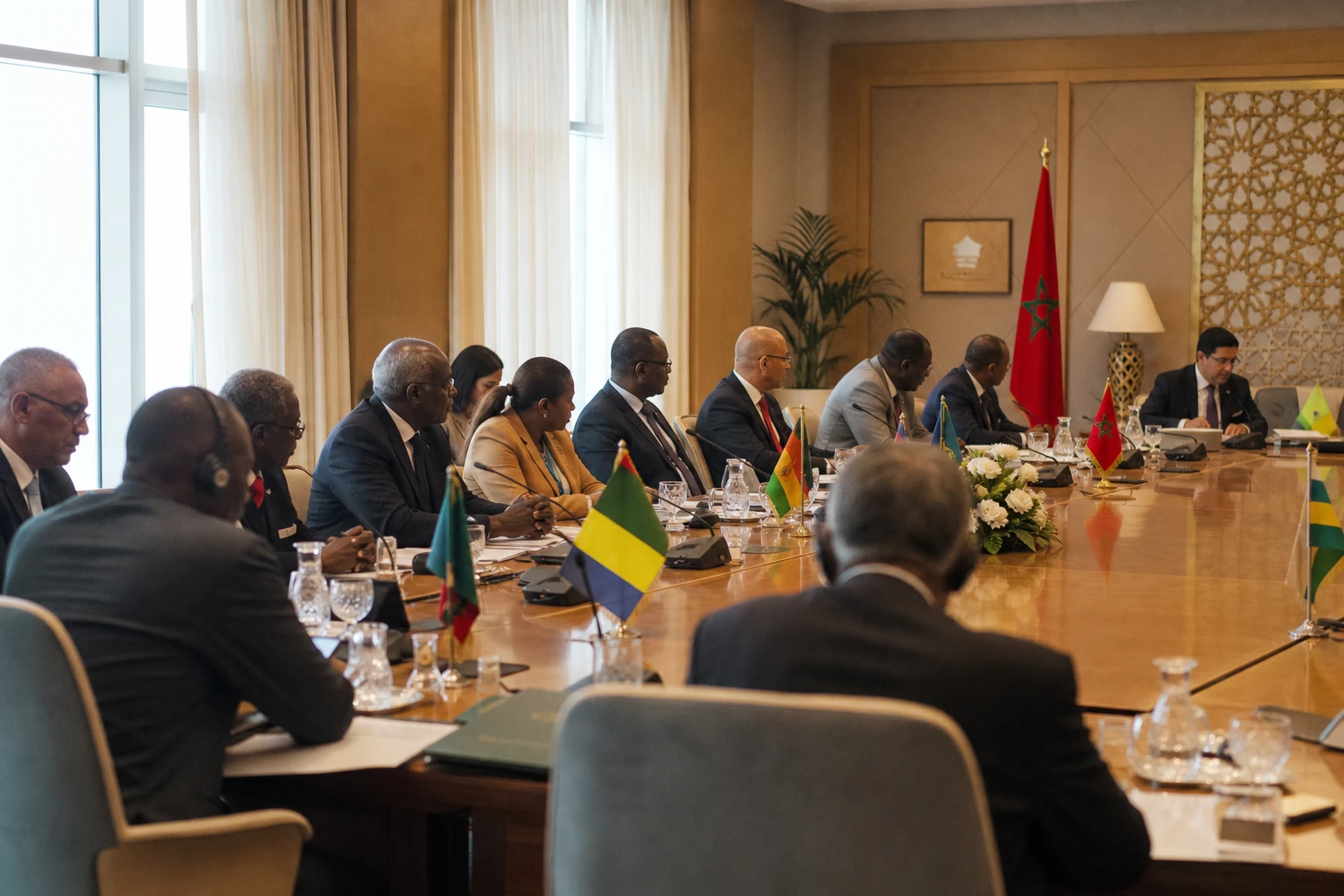
In Rabat, a diplomatic gesture does not tell the whole story
In Moroccan diplomacy, symbols matter. Moving from a liaison office to an embassy is not simply a change of sign. It is a political signal to Washington, Tel Aviv and Moroccan public opinion, where the Palestinian cause remains a sensitive issue.
For Morocco, based in Rabat, the rapprochement with Israel is part of a trajectory that began in December 2020 under the Abraham Accords. Since then, relations have deepened in the security, technology and diplomatic sectors. But the Western Sahara issue has never moved at the same pace.
A bilateral relationship that has grown closer
On 16 September 2026, in New York, Rabat and Tel Aviv announced, alongside Washington, that they would raise their diplomatic representation to embassy level and appoint ambassadors. Official sources and the press reporting the agreement agree on one point: this is an upgrade in status, not yet the completion of a physical opening. The Israeli Ministry of Foreign Affairs website still lists its mission in Rabat as a liaison office. Morocco’s foreign ministry also retains a page dedicated to Israel’s liaison office in Rabat.
This further step extends a process that began in 2020, when Morocco, the United States and Israel agreed to resume diplomatic relations. Even then, the promise was twofold: to open up economic and political opportunities while strengthening strategic cooperation.
On the military front, this cooperation took shape in 2021 with a defence memorandum of understanding. It covered training, capacity-building, technology transfer, cybersecurity and the exchange of expertise. Specialist media later reported purchases of anti-drone systems, followed in 2024 by a contract worth about $1 billion for an observation satellite, awarded to Israel Aerospace Industries. Reuters reported the latter, without detailed public confirmation from either side.
In other words, the security partnership has delivered results quickly. Morocco has gained more advanced surveillance, intelligence and defence capabilities. But it has also added a strategic supplier to its external dependencies, just as Rabat is seeking to develop a more autonomous defence industrial and technological base.
Western Sahara remains the real test
The contrast is clear. On Western Sahara, normalisation with Israel has not delivered the decisive gain Rabat expected. The issue remains within the UN framework, through MINURSO, the mission tasked with monitoring the ceasefire and supporting the political process. The Security Council extended its mandate until 31 October 2026 with Resolution 2797 of 2025.
The UN text and related working documents also reiterate an essential point: a settlement still depends on political negotiations and the parties the UN continues to consult. In 2026, the Secretary-General noted that the situation remained deadlocked and that no concrete improvement had been recorded in relations between Algeria and Morocco.
That is where the paradox emerges. Washington is more supportive of Morocco’s position on autonomy, but Algeria remains an indispensable party to any serious progress on Western Sahara. It hosts Sahrawi refugees, retains direct influence over the Polisario Front and remains a regional actor the United States cannot bypass, particularly on Sahel and energy security issues. The 13 September 2026 meeting between Algerian President Abdelmadjid Tebboune and Massad Boulos, an adviser to the US president, showed this once again. Energy was the stated topic, but Western Sahara was also discussed.
This balance of power explains the gap between Morocco’s bilateral gains and the slow pace of progress at the multilateral level. Israel can strengthen the Kingdom’s capabilities. It cannot, on its own, shift the UN equation. On this issue, the key remains between Rabat, Algiers and the Security Council.
A sensitive equation at home and across the region
In Morocco, the growing partnership with Israel runs up against a political reality the authorities cannot ignore. The Palestinian cause retains strong popular support. Since the war in Gaza, numerous demonstrations have denounced cooperation with Israel and called for it to end. At the same time, the palace is maintaining its course: keeping the diplomatic channel open, asserting a role in regional affairs and presenting itself as an actor for stability.
Morocco also signed an agreement in July 2026 to take part in the International Stabilization Force in Gaza, with a contribution announced of military personnel, police officers, gendarmes and a field hospital. Rabat is thus seeking to maintain two positions at once: remain among those supporting a political solution for Gaza while preserving a useful relationship with Israel and the United States.
This strategy has implications beyond the Maghreb. It says something about the new coalitions taking shape in North Africa and further afield: closer security alliances, flexible diplomacy and difficult trade-offs between public opinion, military interests and calculations on sovereignty issues. In autumn 2026, the real test will remain twofold: the practical implementation of the upgrade to embassy level and the next steps on Western Sahara at the UN, as the next review of MINURSO’s mandate approaches.



