Algeria
 Egypt
 Libya
 Morocco
 Sudan
 Tunisia
 Benin
 Burkina Faso
 Cabo Verde
 Côte d'Ivoire
 Ghana
 Guinea
 Guinea-Bissau
 Liberia
 Mali
 Mauritania
 Niger
 Nigeria
 Senegal
 Sierra Leone
 The Gambia
 Togo
 Cameroon
 Central African Republic
 Chad
 DR Congo
 Equatorial Guinea
 Gabon
 Republic of the Congo
 São Tomé and Príncipe
 Burundi
 Comoros
 Djibouti
 Eritrea
 Ethiopia
 Kenya
 Madagascar
 Malawi
 Mauritius
 Mozambique
 Rwanda
 Seychelles
 Somalia
 South Sudan
 Tanzania
 Angola
 Botswana
 Eswatini
 Lesotho
 Namibia
 South Africa
 Zambia
 Zimbabwe
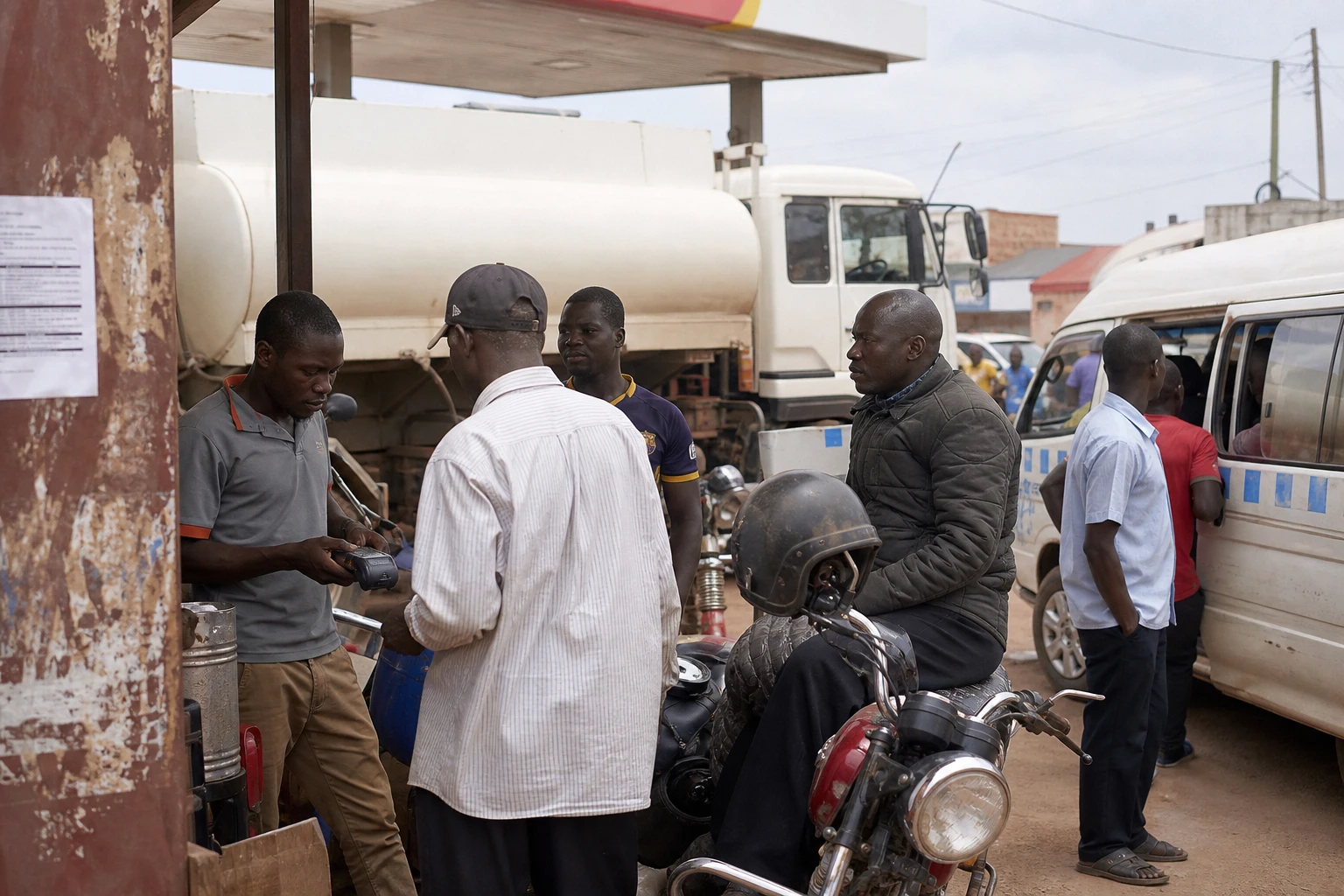
At Mpigi, a project about more than fuel
In Kampala, fuel prices are not determined only at service stations. They also depend on another, less visible link in the chain: the country’s ability to hold stocks, move them and distribute them without disruption. That is the purpose of the new terminal launched at Namwabula, in Mpigi district, west of the Kampala metropolitan area.
The project comes as Uganda seeks to turn future oil production into a tool for industrialisation. The country is preparing both a refinery at Hoima, in the west, and the infrastructure needed to transport, store and dispatch refined products. Mpigi is therefore not simply a logistics site. It is one part of a wider energy system designed to link the Albertine Graben to the capital and, eventually, to regional markets.
The Kampala Storage Terminal, developed by state-owned Uganda National Oil Company, is also intended to reduce dependence on imports arriving through a single corridor and cushion domestic supply against shocks. In a country where transport, agribusiness, formal trade and much of the informal economy depend on diesel and petrol, storage is as much a matter of economic security as of energy policy.
What the project involves and why it matters
On 17 September 2026, the authorities launched work on the Mpigi terminal. The infrastructure is expected to cost about $310 million and provide storage capacity of up to 320 million litres of petroleum products. It will be able to receive petrol, diesel and kerosene.
The announced capacity far exceeds that of the existing state-owned terminal at Jinja, which holds 30 million litres, and complements private depots already established in the centre of the country. Nationally, this changes the balance between imports, storage and distribution. Uganda consumes about 240 million litres of petroleum products a month. At full capacity, Mpigi would therefore represent slightly more than a month of national consumption, excluding aviation.
The site is also intended to form part of a much larger technical chain. The long-planned Hoima refinery is to be connected to Mpigi by a 211-kilometre multi-product pipeline. Mpigi terminal will then serve as a point for receiving and redistributing products. It is also expected to work with a future remote refinery terminal, designed to receive, store and dispatch products from local operations. In industry parlance, it is an essential intermediate link between production and the market.
This infrastructure has strategic value. When stocks are concentrated along a single corridor, a breakdown, transport disruption or regional disturbance can quickly become a national crisis. By increasing reserves and points of passage, Kampala is seeking greater room to manoeuvre in the face of international market volatility and logistical incidents.
A decision built into the country’s economic roadmap
The Mpigi project is aligned with the Fourth National Development Plan, which covers the period 2025/26-2029/30. The document sets a growth target of 10.1% in 2029/30, up from 6.6% in 2024/25, and projects GDP of $158 billion by that point. It also puts hydrocarbons, energy and productive infrastructure at the heart of the transformation strategy.
This trajectory does not concern the state alone. It also affects households, transport operators, distributors and businesses that rely on the cost per litre when setting their prices. Greater storage capacity may ease short-term pressures, but it will not eliminate the Ugandan market’s sensitivity to external fluctuations. As long as the country imports a significant share of its finished products, local prices remain exposed to freight costs, exchange rates and regional supply conditions.
The project also highlights the role of the Kampala metropolitan area. Mpigi is part of the wider urban belt linking the capital with neighbouring districts. Establishing major energy infrastructure close to this area strengthens the logistical importance of the country’s centre. It supports distribution across the country, but also brings significant requirements for planning, industrial safety and environmental management. The choice of site shows that the Ugandan state wants to bring reserves closer to the main centres of consumption, without waiting for the refinery to come fully on stream.
A signal for East Africa and Uganda’s future oil economy
Beyond Uganda, Mpigi reflects a regional trend. Across East Africa, several countries are seeking greater control over their energy supply chains, from production to storage, to reduce their exposure to external disruptions. Uganda is making progress on two fronts at once: developing its oil resources and securing its domestic market. In both cases, the aim is the same: to retain more added value in the country and manage physical flows more effectively.
This approach also has political significance. A project of this scale creates expectations around timelines, financing, connections and governance. In Uganda, where several major public works projects often face delays, the pace of implementation will be closely watched. The Mpigi terminal will have to prove that it is not merely a symbol of the future oil industry, but an operational tool capable of stabilising stocks and absorbing the expansion of oil-related projects.
What happens next will depend on co-ordination between the Hoima refinery, the multi-product pipeline, depots in the Kampala region and import policy. If the system works as a whole, Uganda will have a more integrated, resilient network better suited to its demographic and industrial growth. If progress is fitful, the country will remain exposed to the same vulnerabilities, despite more ambitious infrastructure.
For East Africa, the Mpigi project is therefore more than a national investment. It tests a state’s ability to turn resources that have yet to be produced into a functioning economic network. That journey, from the subsoil to storage and then to the market, will determine whether Uganda’s oil promise becomes a lasting driver of development.