Algeria
 Egypt
 Libya
 Morocco
 Sudan
 Benin
 Burkina Faso
 Cabo Verde
 Côte d'Ivoire
 Ghana
 Guinea
 Guinea-Bissau
 Liberia
 Mali
 Mauritania
 Niger
 Nigeria
 Senegal
 Sierra Leone
 The Gambia
 Togo
 Cameroon
 Central African Republic
 Chad
 DR Congo
 Equatorial Guinea
 Gabon
 Republic of the Congo
 São Tomé and Príncipe
 Burundi
 Comoros
 Djibouti
 Eritrea
 Ethiopia
 Kenya
 Madagascar
 Malawi
 Mauritius
 Mozambique
 Rwanda
 Seychelles
 Somalia
 South Sudan
 Tanzania
 Uganda
 Angola
 Botswana
 Eswatini
 Lesotho
 Namibia
 South Africa
 Zambia
 Zimbabwe
A tragedy rekindles tensions in south-eastern Tunisia
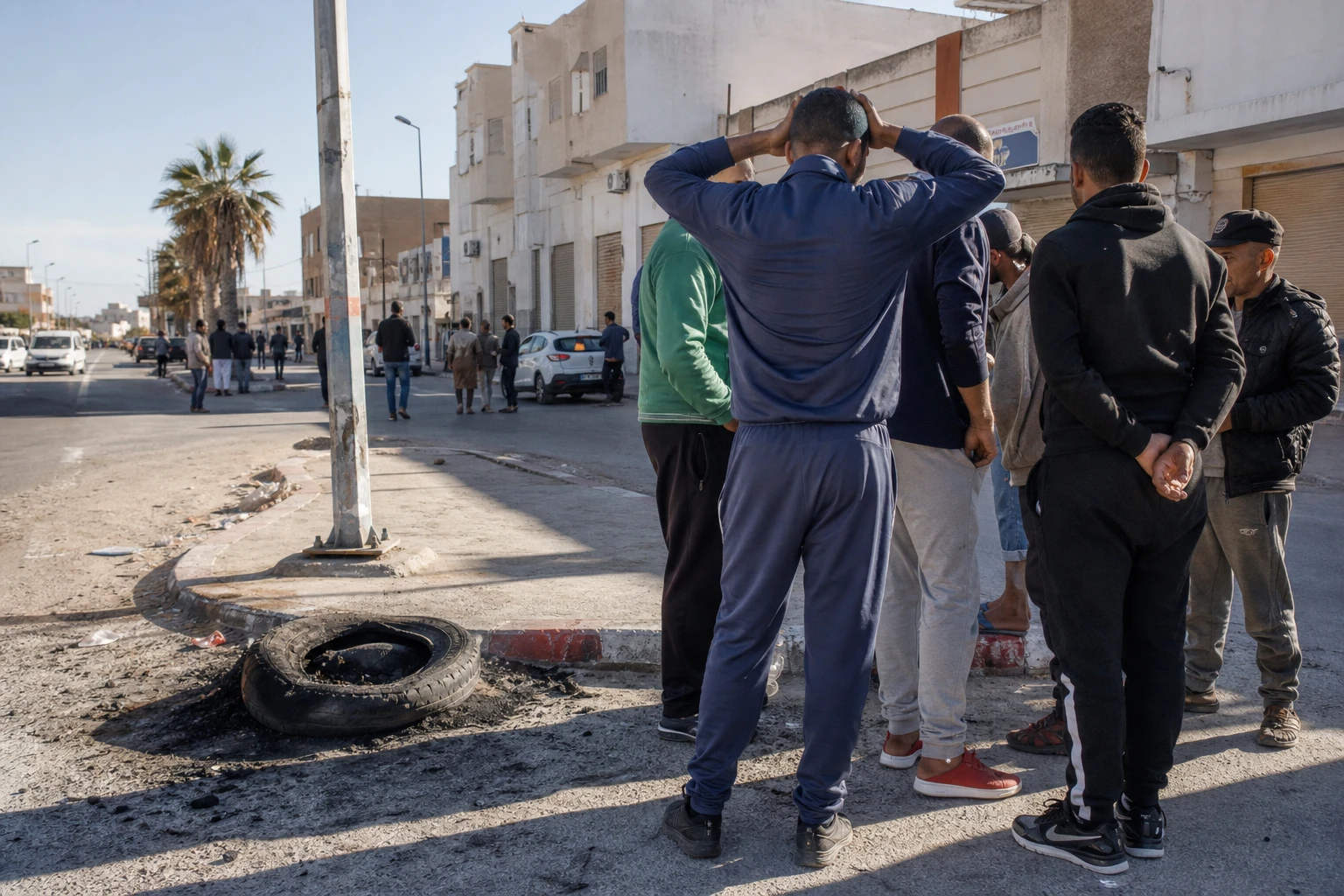
In Ben Guerdane, in south-eastern Tunisia, the sea tells more than a story of departures. It also speaks of the waiting, anger and exhaustion of a border region that has for years lived to the rhythm of crossings, blockades and tragedies. After a boat that had set off from the coasts of Zarzis and Ben Guerdane sank, residents took to the streets overnight, blocked roads and set tyres alight.
The shock is all the greater because Ben Guerdane is no anonymous town on the Tunisian map. This municipality in the governorate of Médenine lies on the edge of the Libyan border, far from Tunis, in an area where the formal economy remains fragile and cross-border activities play a major part in daily life. In such a region, every shipwreck becomes a social event as much as a maritime one.
What is known about the shipwreck
According to Tunisia’s National Guard, the boat was carrying 15 people. Only one passenger survived. The authorities initially announced that several bodies had been recovered, then specified that 12 bodies had been brought ashore off Zarzis, while two people remained missing. The boat sank on Friday evening, about 14 nautical miles off Tunisia’s south-eastern coast.
All the victims were Tunisian, according to information corroborated by media outlets that followed the case. Fourteen people in the group came from Ben Guerdane, and the fifteenth from Zarzis. Overnight, young people in Ben Guerdane protested against what they saw as the slow pace of the search, blocking roads and calling for a faster response.
The shipwreck is part of a broader pattern. The International Organization for Migration said at the beginning of August that deaths and missing persons on the central Mediterranean route had more than doubled in the first four months of 2026 compared with the same period in 2025. Its dashboard records 1,811 deaths or missing persons across all routes to Europe so far in 2026, including 871 on the central route alone.
The central Mediterranean remains the deadliest route
The central Mediterranean links the North African coast with Italy and Malta. It is one of the world’s most dangerous migration routes. The IOM notes that this route accounts for a major share of deaths at sea, and that departures from Tunisia have become increasingly prominent. In 2023, the organisation noted that the increase in the number and proportion of deaths off Tunisia was unprecedented in a decade.
This reality partly explains the political weight of the tragedy. For families in Ben Guerdane, the shipwreck is not just about a departure for Europe. It also points to a local economy under pressure, limited prospects for young people and the continuing importance of informal movement across the Libyan border. The Médenine region, like other parts of southern Tunisia, lies at the intersection of security controls, cross-border trade and persistent demand for mobility.
In this context, residents’ anger is not merely emotional. It reflects a sense of distance from decision-making centres. In Tunis, the public response often focuses on maritime security, investigations and official statements. In Ben Guerdane and Zarzis, it is measured first in hours of waiting, bodies recovered, rumours and anxiety. This difference in timing fuels tension between the southern coast and the capital.
An issue that has become diplomatic between Tunis, Brussels and Rome
The shipwreck comes amid an already fraught diplomatic context. The European Union and Tunisia signed a memorandum of understanding on a strategic and global partnership on 16 July 2023. The text covers five areas, including migration and mobility, and was accompanied by European financial support, including, among other things, nearly €67 million in assistance for migration management and €60 million in budget support announced in September 2023. The European Commission also notes that a €150 million programme was agreed at the end of 2023 as part of the same package of support.
Brussels presented the partnership as a way to strengthen macroeconomic stability, green energy, trade and migration management. But it remains contested. Amnesty International and Human Rights Watch said in July 2026 that European support for border control in Tunisia was contributing to serious abuses against migrants and asylum seekers. The two organisations cite collective expulsions, arbitrary detention and dangerous interceptions at sea in particular.
This criticism carries weight in the wider African debate. It raises a question that has become central in several transit countries across the continent: how far can external partners fund migration control without increasing risks for people on the move? Tunisia is a case in point, because it is located both in the Mediterranean region and within the European asylum policy framework, while also reflecting a North African reality in which borders are economic boundaries too.
What this case says about Tunisia and the continent
In Tunisia, the Zarzis tragedy shows that migration cannot be reduced to interceptions or agreements with Europe. It also affects southern regions, relations with Libya, youth employment, smuggling networks and trust in institutions. As long as these dimensions are treated separately, the public response will remain incomplete.
At the regional level, the issue points to North Africa’s role in movement towards Europe. It is also a reminder that a transit country is not just a checkpoint. It is a place where people live and work, and where social tensions exist. That is why the reaction in Ben Guerdane matters as much as the shipwreck itself: it reveals a population that wants neither to be abandoned nor to see deaths at sea treated as normal.
Over the coming days, attention will remain focused on three points: the final toll from the search off Zarzis, any further investigation into the circumstances of the shipwreck, and how Tunis will respond to mounting pressure over its migration policy. Beyond the Tunisian case, the governance of Mediterranean routes as a whole remains under scrutiny, as deaths and missing persons continue to rise in 2026.