Algeria
 Egypt
 Libya
 Morocco
 Sudan
 Benin
 Burkina Faso
 Cabo Verde
 Côte d'Ivoire
 Ghana
 Guinea
 Guinea-Bissau
 Liberia
 Mali
 Mauritania
 Niger
 Nigeria
 Senegal
 Sierra Leone
 The Gambia
 Togo
 Cameroon
 Central African Republic
 Chad
 DR Congo
 Equatorial Guinea
 Gabon
 Republic of the Congo
 São Tomé and Príncipe
 Burundi
 Comoros
 Djibouti
 Eritrea
 Ethiopia
 Kenya
 Madagascar
 Malawi
 Mauritius
 Mozambique
 Rwanda
 Seychelles
 Somalia
 South Sudan
 Tanzania
 Uganda
 Angola
 Botswana
 Eswatini
 Lesotho
 Namibia
 South Africa
 Zambia
 Zimbabwe
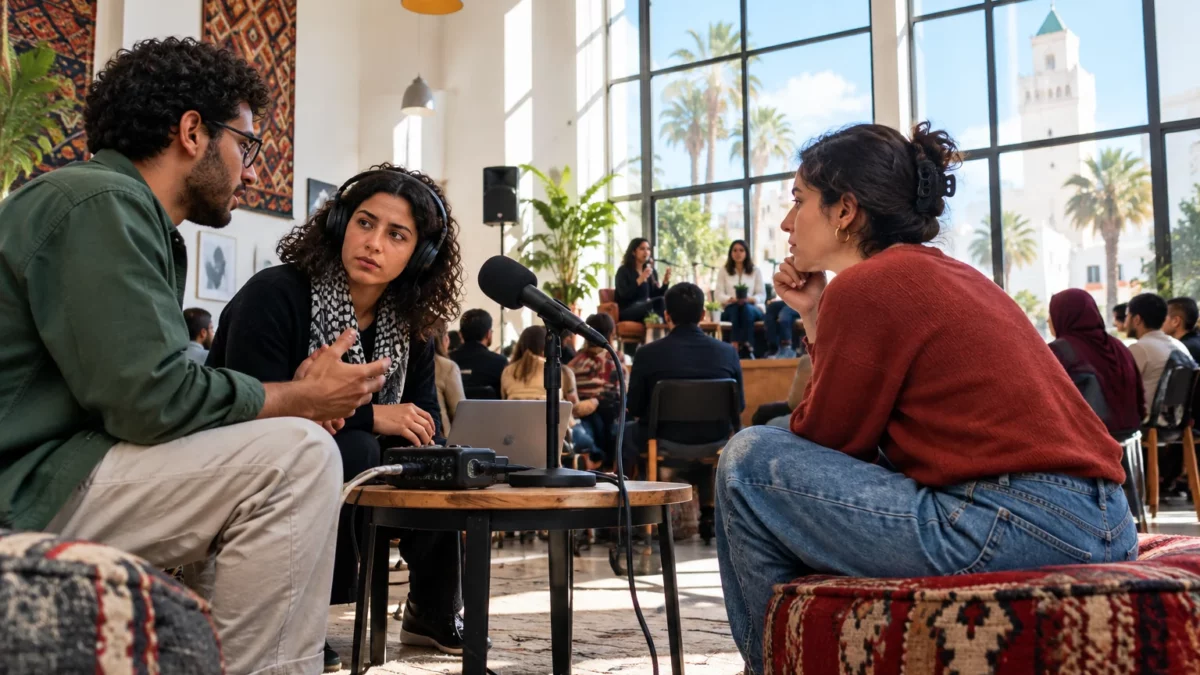
In Tunis, a podcast can become a classroom, a forum for discussion or a young creator’s first professional project. But enthusiasm alone is not enough to keep these voices going: they also need income, skills and space for debate.
An event accompanying a changing landscape
On 6 and 7 November 2026, the Tunisia Podcasts Festival brought listeners and creators together in the Tunisian capital. Panel discussions and masterclasses were held at the Institut français de Tunisie, then at L’Art Rue, a cultural association based in the medina of Tunis. The programme gave enthusiasts the chance to meet professionals and discover the stages involved in producing a podcast.
The event builds on the first edition, held in Tunis from 7 to 9 December 2023. After a three-year absence, the festival has returned in a more compact format. This change alone does not prove that the sector as a whole has grown. It does, however, point to sustained interest in bringing podcasters, listeners and cultural players together.
Tunisia is a member of the Arab Maghreb Union (AMU), which also brings together Algeria, Libya, Morocco and Mauritania. For creators, this regional foothold raises a practical question: how can formats, skills and audiences circulate across borders in a space where languages and listening habits vary?
Topics that go beyond entertainment
Accounts gathered in Tunis point to a range of very different projects. Latifa, a listener considering launching her own programme, wants to tell her story to show young people that there are several paths to professional fulfilment. Her idea responds to an immediate concern: unemployment and career choices weigh on many young Tunisians.
Moez, a 22-year-old law student, began producing podcasts at 14. He is now considering a format that would invite teachers and specialists to explain law and the Constitution. His project would address what he sees as a gap in media debates: expertise exists, but it does not always find a place in discussions aimed at the general public.
Raouia Kheder, a journalist and the festival’s founder, has observed a shift in the subjects being covered. In her view, the range of offerings is no longer limited to entertainment or social media trends. Programmes now address mental health, social issues and economics. She would like to see more in-depth formats on science and philosophy.
These ideas do not mean that every genre is growing at the same pace. Rather, they show that podcasting allows creators to test long-form formats, invite specialists and develop conversations that sometimes have little space elsewhere. Quality will then depend on editorial work: checking facts, providing context and distinguishing analysis from opinion.
An alternative, not a guarantee of freedom
Podcasting is often presented as a freer medium because it can be produced and distributed without the infrastructure of radio or television. This flexibility lowers some barriers to entry. It does not, however, automatically shield creators from pressure, legal action or economic constraints.
The Tunisian context makes this distinction important. Reporters Without Borders describes a media landscape in which pressure on critical media has increased since 2021 and where Decree-Law 54 of 2022, which covers false information among other things, has raised concerns about freedom of expression. The organisation also notes that podcasts and debates by media outlets such as Alqatiba, Rachma and Nawaat are gaining audiences. Podcasting is therefore finding its place in a media environment that is both inventive and under strain.
Being free to publish does not resolve the question of viability either. Creators need resources to record, edit and distribute their work, and sometimes to pay contributors. Advertising, partnerships, donations or subscriptions can help fund projects, but no single model suits them all. Small teams and independent producers generally have fewer resources than established organisations.
Digital distribution also creates disparities. Social networks help episodes find an audience, but creators then depend on the rules and visibility granted by private platforms. Access to a reliable internet connection, equipment and training can also vary between Tunis and other regions. A genuinely open ecosystem therefore requires more than studios: it needs accessible skills and diverse distribution channels.
The challenge of lasting and circulating voices
The festival brings together several links in the chain: creators, listeners, cultural venues and training partners. The gathering can help newcomers learn about sound recording, programme preparation and interviewing. It can also bring Tunisian podcasters closer to neighbouring scenes in the Maghreb, where exchanges between languages and communities offer potential that has yet to be fully developed.
Across Africa, the challenge is similar: to make podcasting a tool for sharing knowledge and debate without reducing the diversity of voices to a simple race for audience numbers. The next developments to watch are the regularity of events, the emergence of more predictable revenue and the place given to creators outside the capital. Only then can individual projects become a lasting landscape.
Tunisia is not starting from scratch: its first edition in 2023 had already brought creators and audiences together. The festival’s return in November 2026 confirms that the event exists, but not yet that the sector is economically sound. Bridging the gap between the desire to tell stories and the means to keep going is now the challenge facing podcasters.