Algeria
 Egypt
 Libya
 Morocco
 Sudan
 Benin
 Burkina Faso
 Cabo Verde
 Côte d'Ivoire
 Ghana
 Guinea
 Guinea-Bissau
 Liberia
 Mali
 Mauritania
 Niger
 Nigeria
 Senegal
 Sierra Leone
 The Gambia
 Togo
 Cameroon
 Central African Republic
 Chad
 DR Congo
 Equatorial Guinea
 Gabon
 Republic of the Congo
 São Tomé and Príncipe
 Burundi
 Comoros
 Djibouti
 Eritrea
 Ethiopia
 Kenya
 Madagascar
 Malawi
 Mauritius
 Mozambique
 Rwanda
 Seychelles
 Somalia
 South Sudan
 Tanzania
 Uganda
 Angola
 Botswana
 Eswatini
 Lesotho
 Namibia
 South Africa
 Zambia
 Zimbabwe
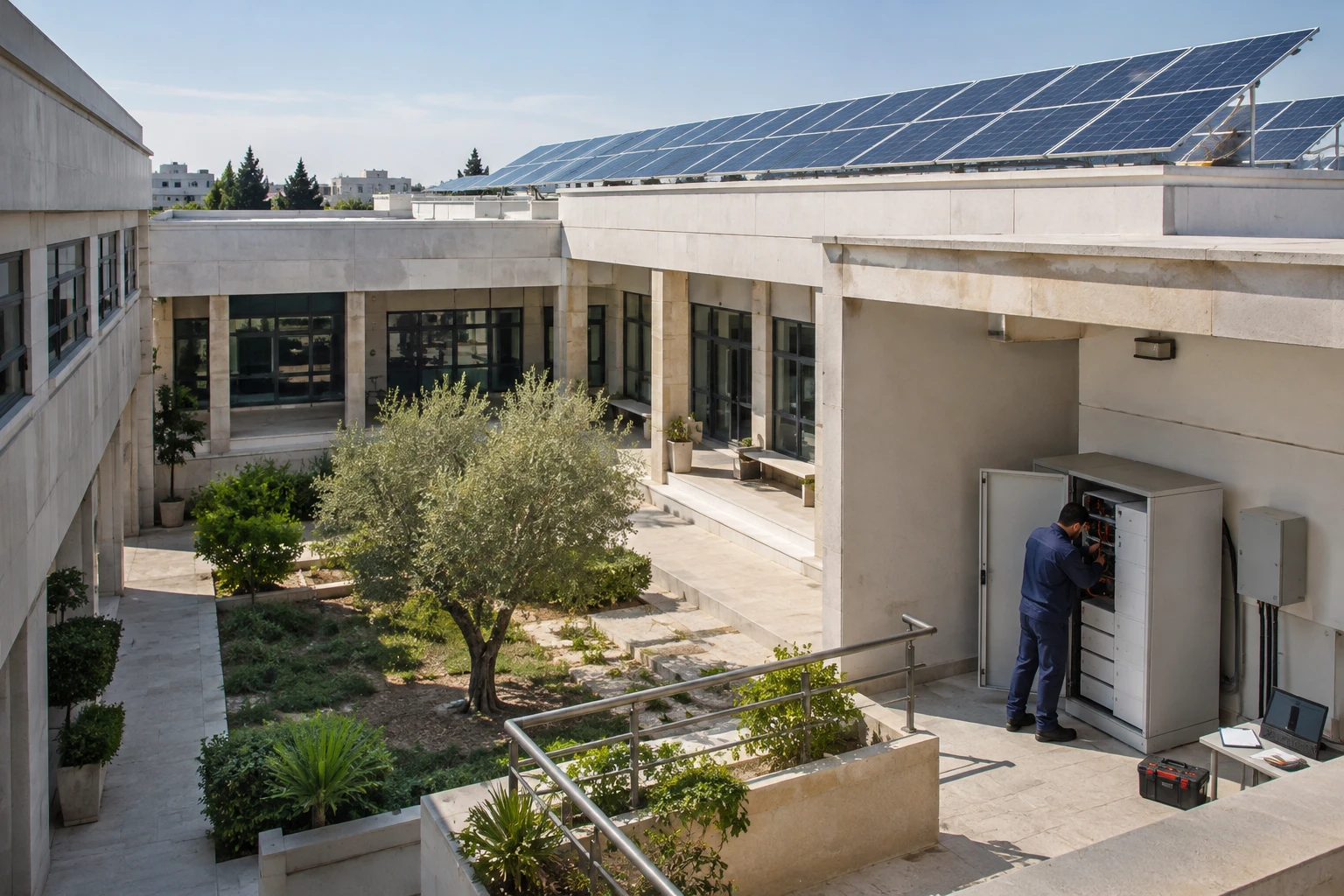
Generating solar power is not always enough to protect a household or business from outages. In Tunisia, battery storage is now possible for installations connected to the grid. But between technical approval, equipment costs and the capacity of the electricity system, the solution remains out of reach for many.
From sunshine to evening: the missing link
Until recently, owners of grid-connected photovoltaic panels could not freely use home batteries to store their output. Unused solar electricity was fed into the Tunisian Electricity and Gas Company (STEG) grid, without guaranteeing an independent supply when the power went out.
The regulatory change announced by STEG in summer 2026 allows residential customers to install storage batteries in their low-voltage grid-connected photovoltaic systems. Tunisia’s TAP news agency and the daily newspaper La Presse reported the change in July and September. It also allows the use of hybrid inverters, which coordinate panels, batteries and the electricity grid. However, this does not mean that every installation can operate without technical checks or additional costs.
For households that already have panels, a battery can shift some of the electricity produced during the day to the evening. Depending on the system’s configuration and installed capacity, it can also provide backup during an interruption. This is a tangible change, but not an immediate answer to pressures affecting the grid as a whole.
A grid still heavily dependent on gas
The challenge goes beyond equipment for private households. According to the energy update published by Tunisia’s ministry responsible for energy, natural gas accounted for 91.8% of national electricity generation at the end of April 2026. Renewable energy accounted for 8.2%, despite an increase in output compared with the previous year.
This dependence directly links electricity security to fuel supplies. The same official report states that Algeria supplied 62% of Tunisia’s natural gas at the end of April, up from 58% a year earlier. Electricity exchanges with neighbouring countries also help balance the grid. Tunisia’s solar transition is therefore taking shape in homes, in national generation choices and in regional energy relations.
Solar panels are nevertheless becoming more widespread. At the end of April 2026, the ministry recorded about 466 megawatts of photovoltaic capacity on residential rooftops and 130 megawatts in the industrial, services and agricultural sectors. Without storage, this output does not always meet demand when it arises. Batteries can help make better use of solar electricity, but they do not replace generation capacity or the investment needed in the grid.
Costs hold back households and businesses
Price remains a major obstacle, particularly for households without enough cash to add a battery to an installation they have already financed. The equipment comes on top of the panels and inverter. Imported batteries are also subject to duties and taxes, increasing the upfront cost. STEG’s approval therefore opens up a technical option without ensuring that it is affordable.
Tunisia’s draft 2027 finance bill provides for an exemption from customs duties, VAT and a professional tax on imported storage batteries, subject to a technical opinion from the relevant services. The measure is included in the draft submitted to parliament: it should not be presented as an exemption that has already come into force. Tunisian renewable energy organisations have also called for lower taxes on solar equipment. The debate is therefore about how to make installations affordable without undermining local manufacturing and assembly businesses.
For small and medium-sized enterprises, the calculation is different. An interruption can halt production, delay a delivery or damage equipment. The Arab Institute of Business Leaders (IACE) estimates that outages in July and August 2026 caused losses of 1,269.6 million dinars in value added. Its survey, reported separately by Tunisian business outlet Managers and Morocco’s MAP news agency via Medi1News, found that 96% of the businesses surveyed had experienced disruption. These estimates describe the sample studied, not a comprehensive measure of all businesses in the country.
The same survey found that 74% of businesses were considering investing in backup equipment, while 52% had postponed productive investment. The figures highlight the dilemma: securing electricity requires new spending, but losses caused by outages reduce the resources available for investment. Businesses able to buy batteries or generators can limit their exposure. More vulnerable firms risk remaining dependent on the grid and suffering more disruption.
A transition to be assessed on several fronts
Tunisia is a member of the Arab Maghreb Union (AMU), a regional cooperation framework that also includes Algeria, Libya, Morocco and Mauritania. In this neighbourhood, energy exchanges and interconnections matter as much as domestic solar generation. Across the continent, the issue feeds into a broader question: how can more renewable energy be integrated without making households and small businesses bear the cost of adaptation alone?
The next milestones will be parliament’s examination of the 2027 finance bill and the practical implementation of STEG’s technical rules. Price trends, SMEs’ access to finance and the actual share of renewables in generation will also need to be monitored. Storage can increase the value of panels already installed. To reduce outages sustainably, it will need to form part of a broader effort on generation, the grid and energy supplies.
Sources consulted: Tunisian news agency TAP on approval for residential batteries, La Presse de Tunisie on STEG’s technical framework, Tunisia’s ministry responsible for energy, April 2026 energy update, TAP on energy measures proposed in the 2027 finance bill, Managers on the IACE survey and Medi1News on the economic losses estimated by the IACE.