
 Algeria
 Egypt
 Libya
 Morocco
 Sudan
 Tunisia
 Benin
 Burkina Faso
 Cabo Verde
 Côte d'Ivoire
 Ghana
 Guinea
 Guinea-Bissau
 Liberia
 Mali
 Mauritania
 Niger
 Nigeria
 Senegal
 Sierra Leone
 The Gambia
 Togo
 Cameroon
 Central African Republic
 Chad
 Equatorial Guinea
 Gabon
 Republic of the Congo
 São Tomé and Príncipe
 Burundi
 Comoros
 Djibouti
 Eritrea
 Ethiopia
 Kenya
 Madagascar
 Malawi
 Mauritius
 Mozambique
 Rwanda
 Seychelles
 Somalia
 South Sudan
 Tanzania
 Uganda
 Angola
 Botswana
 Eswatini
 Lesotho
 Namibia
 South Africa
 Zambia
 Zimbabwe
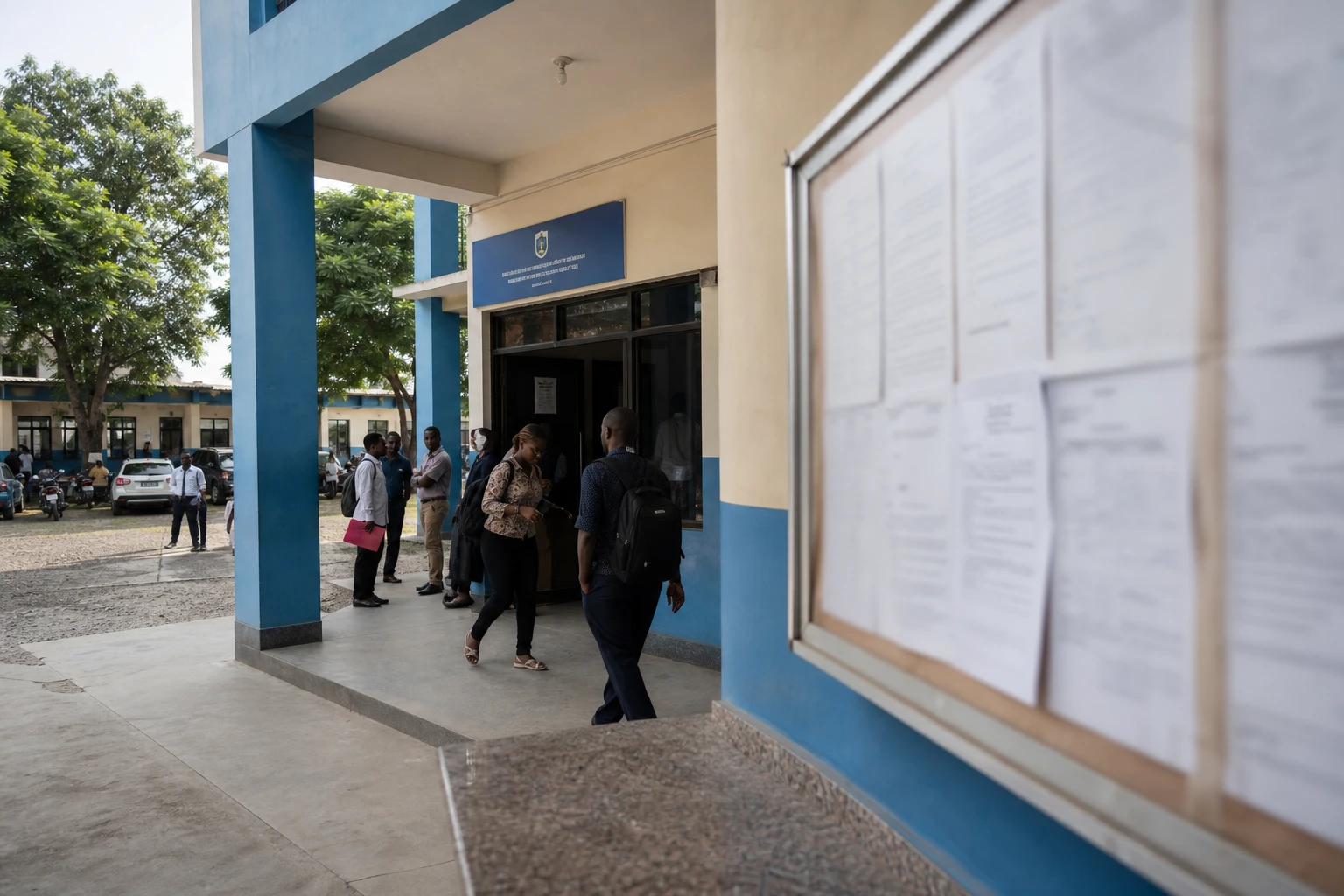
In Goma and Bukavu, universities have once again been caught up in the clash between the Congolese state and a de facto authority.
In eastern Democratic Republic of the Congo, the academic year has not begun with classes, but with a decision that has upended life for thousands of students. Kinshasa has suspended academic activities at 11 public institutions in Goma, North Kivu, and Bukavu, South Kivu, cities under AFC/M23 control. The measure applies to the 2026-2027 academic year and affects enrolment, teaching, assessments and deliberations.
This issue goes beyond university life. It points to something broader: when armed conflict becomes entrenched, it eventually affects degrees, careers and the very standing of public institutions. In eastern DR Congo, schools and universities have become a front line in the struggle for sovereignty.
A conflict that has now spilled into lecture halls
The DRC remains embroiled in a severe security crisis in the east, where the AFC/M23 controls several areas of North Kivu and South Kivu. Diplomatic efforts are continuing under the Doha process, while regional and continental organisations have already called for armed groups to withdraw and state authority to be restored in occupied territories. This is therefore not an isolated issue: it is part of a fragile peace framework, supported in part by the African Union, the East African Community, SADC and the International Conference on the Great Lakes Region.
In this context, Kinshasa has also sought to ensure the 2026-2027 school year begins safely across the country. President Félix Tshisekedi has asked the government to ensure a “peaceful, effective and inclusive” start to the school year, with particular attention to North Kivu and South Kivu. The instruction shows that education has become a political priority, not merely an administrative one.
The decision, announced on 27 August 2026, is based, according to the government, on the Congolese Constitution, the framework law on national education and international principles protecting the right to education during conflict. Kinshasa also cites United Nations Security Council Resolution 2601, which calls for education to be protected in wartime.
The facts: 11 institutions affected, with an exception for finalists
Five public institutions in Goma are affected: the University of Goma, ISC-Goma, ISTM-Goma, ISTA-Goma and ISP-Goma. In Bukavu, six institutions are affected: the Official University of Bukavu, ISC-Bukavu, ISTM-Bukavu, ISP-Bukavu, ISDR-Bukavu and ISAM-Bukavu. However, the government is allowing final-year students from 2025-2026 whose courses could not be completed to sit the necessary assessments at public or private institutions legally recognised by the Congolese state.
Kinshasa says it wants to prevent the value of academic qualifications awarded in the DRC from being undermined. The government also maintains that occupying part of the national territory does not give the AFC/M23 any administrative or academic authority. In other words, the battle is not only over management offices; it is over who has the right to define what constitutes a Congolese university.
The decision came after a period of tension around higher education institutions in Goma and Bukavu. On 7 August 2026, the AFC/M23 announced new appointments to several management committees. On 10 August, the Congolese government rejected the appointments. Then, on 26 August, the movement in turn challenged the suspension of academic activities, accusing Kinshasa of politicising the university sector.
What this means for students, teachers and families
For students, the measure first creates uncertainty. An interrupted academic calendar often means a postponed internship, a delayed thesis defence, a deferred degree and, sometimes, an abandoned plan to study elsewhere. For families, especially in an economy where many rely on informal and irregular income, a few extra months can be enough to derail a trajectory. In Goma and Bukavu alike, the issue is not abstract: it affects transport, housing, tuition fees and the very possibility of pursuing studies safely.
For teachers and administrative staff, the stakes are twofold. On the one hand, they are required to remain within a legal framework recognised by Kinshasa. On the other, they must contend with a local reality in which de facto authorities are seeking to impose their own representatives. The government says it wants to protect the rights of teachers “duly recognised”; the AFC/M23, for its part, presents its reshuffle as a response to vacant posts and a means of ensuring continuity in public services. The institutional conflict is therefore also playing out over jobs, salaries and the legitimacy of careers.
The message sent to urban residents is powerful. In Goma and Bukavu, university life sustains the local economy: shared accommodation, small businesses, urban mobility, photocopying services, food outlets and transport. When lecture halls empty, many modest incomes shrink. The decision therefore affects not only the institutions but the entire social fabric around them. This is all the more sensitive because the Congolese president has also called for a calmer start to the school year, as other provinces are already experiencing the effects of insecurity or epidemics such as Ebola.
Regional implications extend beyond the DRC
This suspension of academic activities points to a wider shift under way in eastern DR Congo: armed groups are seeking not only military leverage but also control over institutions. Universities, finance, the media and local administration: every sphere in which the state sets rules has become a source of power. Several observers have already described this as a form of parallel administration in areas controlled by the AFC/M23.
Across Africa, the issue touches on a broader principle: protecting education in wartime. UNESCO and the United Nations stress that schools, students and teachers must be protected, even when conflicts drag on. In Central Africa and the Great Lakes region, where mediation efforts have overlapped for several years, the Congolese case shows that a territorial crisis inevitably becomes an institutional one.
What happens next will depend as much on developments on the ground as on diplomacy. The next test will not be military alone. It will also be academic, administrative and political: who will reopen the campuses, under whose authority, and with what recognition of degrees? In eastern DR Congo, the answer will say much about the true state of the DRC’s sovereignty.



