
 Algeria
 Egypt
 Libya
 Morocco
 Sudan
 Tunisia
 Benin
 Burkina Faso
 Cabo Verde
 Côte d'Ivoire
 Ghana
 Guinea
 Guinea-Bissau
 Liberia
 Mali
 Mauritania
 Niger
 Nigeria
 Senegal
 Sierra Leone
 The Gambia
 Togo
 Cameroon
 Central African Republic
 Chad
 Equatorial Guinea
 Gabon
 Republic of the Congo
 São Tomé and Príncipe
 Burundi
 Comoros
 Djibouti
 Eritrea
 Ethiopia
 Kenya
 Madagascar
 Malawi
 Mauritius
 Mozambique
 Rwanda
 Seychelles
 Somalia
 South Sudan
 Tanzania
 Uganda
 Angola
 Botswana
 Eswatini
 Lesotho
 Namibia
 South Africa
 Zambia
 Zimbabwe
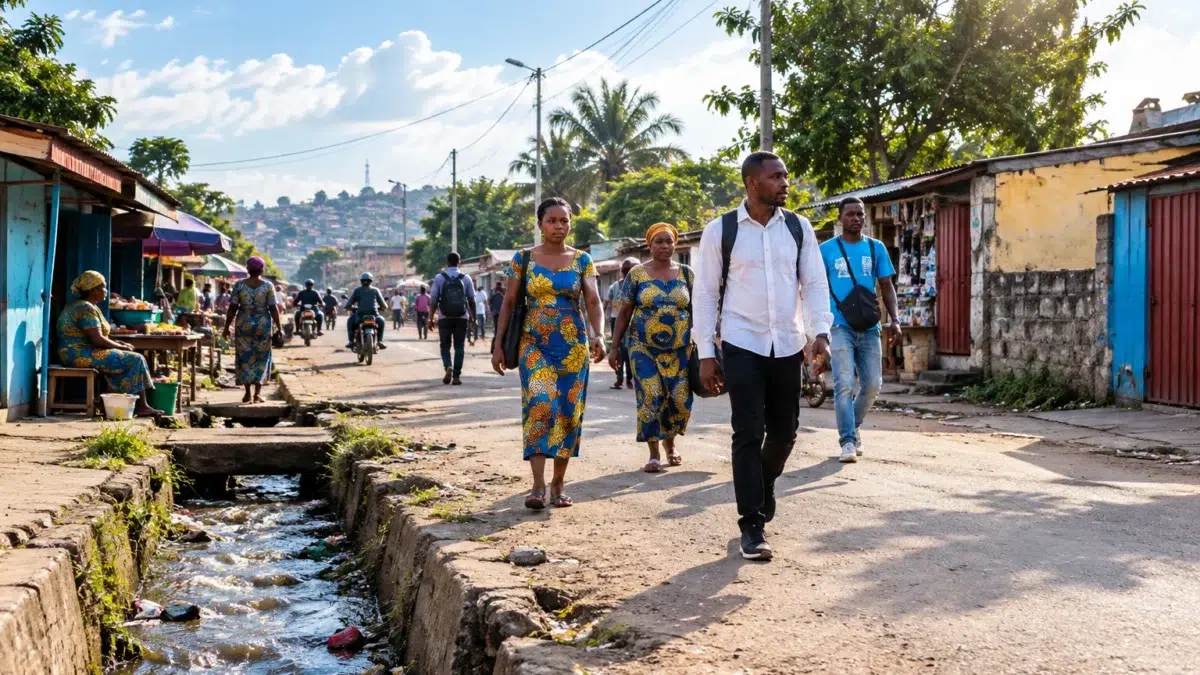
For the Democratic Republic of the Congo, protecting forests and preparing cities for floods are part of the same challenge: turning climate commitments into concrete services and investment. The country’s new roadmap sets targets through 2035, but achieving them depends largely on funding that has yet to be mobilised.
Ambitions span emissions and adaptation
Submitted to the United Nations Framework Convention on Climate Change (UNFCCC), the third nationally determined contribution (NDC 3.0) covers the period 2026-2035. This document, required under the Paris Agreement, sets out each country’s efforts to cut emissions and adapt to climate change. The UNFCCC registry records its submission on 16 November 2026. Information published at COP31 later confirmed its official presentation in Antalya.
DR Congo aims to reduce greenhouse gas emissions by 21% by 2035, compared with a baseline scenario without new measures. The pathway set out in the document envisages a 57% reduction by 2050. These percentages do not mean that current emissions would fall by the same proportions: they are calculated against the baseline scenario adopted by the country.
The strategy covers several sectors. It aims to curb deforestation and preserve forests that absorb carbon, while also addressing energy, urban waste and agriculture. The plan also relies on nature-based solutions. The NDC puts the funding required for 40 mitigation programmes at about $25bn.
Adaptation is a major component. The document identifies 25 programmes, requiring about $30bn. They are intended, among other things, to strengthen early-warning systems, the resilience of schools and health services, access to water, coastal protection and climate-adapted farming practices.
Risks already part of daily life
The plan describes a country that emits little on a global scale but is highly exposed to the effects of climate change. For the period 2031-2060, the projections cited anticipate a rise in average temperatures of 1.2-1.6°C. They also point to potentially longer dry seasons and more intense episodes of extreme rainfall, although the direction of change in annual precipitation remains uncertain.
These changes could worsen floods, landslides and droughts in some regions. The document also notes their possible consequences for harvests, health and population displacement. According to projections cited in the NDC, economic losses could reach about 13% of gross domestic product by 2050. This is a forward-looking estimate, not a record of losses already observed.
The effects are not evenly distributed. In cities, water and waste management put pressure on infrastructure and exposed neighbourhoods. In rural areas, access to water and dependence on rainfall make agricultural livelihoods particularly sensitive to climate variability. Reliable alerts, small-scale irrigation systems and better-designed schools can therefore address very different needs across the provinces.
In Kinshasa, the government will have to co-ordinate ministries, provincial administrations and partners to turn national targets into projects that are monitored. The NDC provides for a measurement and transparency system to assess progress, resources received and results. This capacity to track delivery will matter as much as announcing targets: it will help distinguish funded commitments from actions that remain on paper.
Funding is the main test of credibility
The official document estimates total needs at about $55bn: $25bn to cut emissions and $30bn for adaptation. A Congolese news agency has, however, reported a lower overall figure, underscoring the importance of consulting the breakdown published in the NDC. The Congolese document states that several measures depend on climate finance, technology transfers and capacity-building.
This dependence affects more than government finances. It will determine which projects can go ahead, at what pace and in which provinces. It also raises questions about direct access to funds and the predictability of disbursements, rather than announcements alone. The NDC envisages a role for carbon markets, particularly in the forestry sector, but also stresses the need for a regulatory framework and an equitable sharing of benefits with local communities and Indigenous peoples.
Protecting the forests of the Congo Basin is therefore both a national and a regional concern. It can help regulate the climate and support economic activity, but funding mechanisms must respect land rights and local practices. Carbon valuation alone cannot replace the delivery of public services, territorial management and sustainable economic alternatives.
A roadmap to be tested beyond COP
The submission took place during COP31, held in Antalya from 9 to 20 November 2026. It places DR Congo in a broader African debate: how to finance adaptation, facilitate access to resources and align investment with priorities set on the continent. The United Nations Economic Commission for Africa and the African Development Bank have, in particular, highlighted the need to move from financial pledges to actual disbursements.
For DR Congo, a member of the East African Community and SADC, the challenge extends beyond national borders. Ecosystems, waterways and climate risks are shared across the region, while exchanges of experience can strengthen early warnings and disaster preparedness. The next step will be less about setting another target than publishing details of funds mobilised, projects launched and results verified on the ground.
The roadmap is ambitious in scope, but conditional on the resources available. Its real test will be whether the country can protect ecosystems while improving public safety, access to services and the resilience of economic activity, from Kinshasa to the provinces.



