Algeria
 Egypt
 Libya
 Morocco
 Sudan
 Tunisia
 Benin
 Burkina Faso
 Cabo Verde
 Côte d'Ivoire
 Ghana
 Guinea
 Guinea-Bissau
 Liberia
 Mali
 Mauritania
 Niger
 Nigeria
 Senegal
 Sierra Leone
 The Gambia
 Togo
 Cameroon
 Central African Republic
 Chad
 DR Congo
 Equatorial Guinea
 Gabon
 Republic of the Congo
 São Tomé and Príncipe
 Comoros
 Djibouti
 Eritrea
 Ethiopia
 Kenya
 Madagascar
 Malawi
 Mauritius
 Mozambique
 Rwanda
 Seychelles
 Somalia
 South Sudan
 Tanzania
 Uganda
 Angola
 Botswana
 Eswatini
 Lesotho
 Namibia
 South Africa
 Zambia
 Zimbabwe
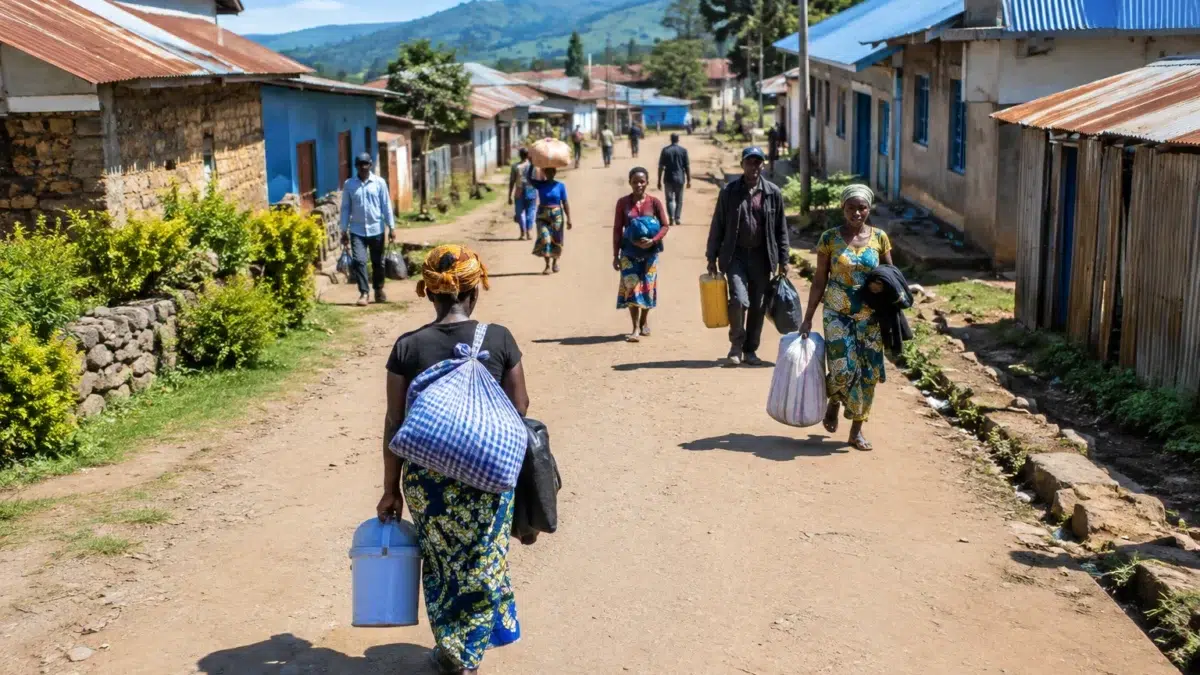
In Minembwe, in the highlands of South Kivu, military operations are taking place amid villages and civilian infrastructure. For people in Fizi and neighbouring territories, the immediate stakes are both security and access to healthcare, schools and roads that could provide a way to flee.
A widening front around Minembwe
South Kivu is at the heart of a crisis that extends beyond local clashes. The province borders Burundi and Rwanda, and shifting armed alliances run through its territories. The FARDC — the Armed Forces of the Democratic Republic of the Congo — are fighting alongside local groups known as Wazalendo. Opposing them are Twirwaneho fighters, who are associated with the Front for the Refoundation of the Nation (FRN), a politico-military coalition led by former president Joseph Kabila.
The FRN was announced in October 2026 as the successor to the Congo River Alliance, which included the M23. This political reshuffle does not mean that realities on the ground changed overnight: fighting, local alliances and disputes over control of territory remain decisive. Radio Okapi reported that Joseph Kabila had taken the helm of the FRN, while the movement announced its creation in a statement.
The region is also caught up in diplomatic efforts that have failed to silence the guns. The Doha process aims to frame negotiations between Kinshasa and the politico-military movement, while a ceasefire verification mechanism has been set up with the support of regional partners. The United Nations has reported verification missions in Minembwe and other parts of eastern Congo. The persistence of the fighting nevertheless highlights the gap between these arrangements and their implementation on the ground.
Fighting reported along several fronts
Clashes intensified from Monday 16 November 2026, according to available information. In the north, in Kalehe territory, fighting was reported along the Kambegeti-Ebisha axis after a FARDC offensive in Kambali. Government forces were seeking to retake localities that had recently come under FRN control, according to reports.
Further south, in Fizi territory, the FARDC launched new operations on Wednesday 18 November around Rugezi, Kipimo and Kabandja, near Minembwe. The Congolese outlet Actualite.cd reported that the army retook Rugezi that day. This account confirms a change of control announced by government forces, but does not in itself establish the outcome of the fighting in neighbouring villages.
Air strikes were also reported in the area. Accounts of their targets and consequences are contradictory. Civil society representatives accused the government coalition of hitting homes and a school, and reported injuries. For its part, FARDC spokesman General Sylvain Ekenge maintained that civilian facilities were being used to store weapons. These claims do not, at this stage, make it possible to independently establish the military use of the buildings or the full toll of the strikes.
Reports about the school in Minembwe illustrate this difficulty. Congolese and Burundian media reported that the ISOKO school complex was hit on 16 November. The army, for its part, said civilian infrastructure in the area was being used for military purposes. Without an independent investigation accessible at the site, the precise circumstances and responsibility remain to be verified. Protecting schools and civilians remains an obligation for all parties to the conflict.
Fighters associated with the FRN have also attacked government positions, notably in Rurambo, in Uvira territory, according to reports. The fighting is therefore not limited to an army push in a single area: it is part of a wider confrontation between Kinshasa’s forces and armed groups in the highlands.
Civilians face displacement and disrupted services
The clashes have triggered new displacement from Kalehe, Kabare, Uvira and Fizi. Local authorities and civil society groups describe a concerning humanitarian situation. The number of people displaced by this week’s fighting has not been established through independently cross-checked data; it is therefore better not to give a figure.
The consequences vary according to location and available resources. In villages close to the fighting, families may leave with few belongings and lose access to fields or markets. In larger centres, needs also include accommodating displaced people and maintaining health and education services. When a school or road becomes inaccessible, the impact lasts beyond the duration of a military operation: classes are interrupted and supplying communities becomes more difficult.
The question of Burundian involvement also calls for caution. Available material refers to the participation of the Burundian army alongside the FARDC and Wazalendo, but the information reviewed does not allow its precise role in operations from 16 to 18 November to be independently cross-checked. This claim should therefore be distinguished from facts confirmed by several accounts, such as the announced retaking of Rugezi.
The ceasefire is also being tested in the highlands
At the regional level, fighting around Minembwe is undermining peace efforts involving Kinshasa and the FRN. It is also a reminder that agreements negotiated at national level do not automatically resolve local rivalries or ensure the safety of people in remote areas. The DRC is a member of the Southern African Development Community (SADC), while peace mechanisms also involve the African Union and international partners.
The next developments to watch are concrete: changes in control of Rugezi and neighbouring localities, whether humanitarian organisations can reach communities, and verification of reports about air strikes and casualties. As long as the parties are fighting over the same territory while civilians flee, the credibility of the ceasefire will be measured less by diplomatic announcements than by an actual reduction in fighting.