Algeria
 Egypt
 Libya
 Morocco
 Sudan
 Tunisia
 Benin
 Burkina Faso
 Cabo Verde
 Côte d'Ivoire
 Ghana
 Guinea
 Guinea-Bissau
 Liberia
 Mali
 Mauritania
 Niger
 Nigeria
 Senegal
 Sierra Leone
 The Gambia
 Togo
 Cameroon
 Central African Republic
 Chad
 DR Congo
 Equatorial Guinea
 Gabon
 Republic of the Congo
 São Tomé and Príncipe
 Burundi
 Comoros
 Djibouti
 Eritrea
 Ethiopia
 Kenya
 Madagascar
 Malawi
 Mauritius
 Mozambique
 Rwanda
 Seychelles
 Somalia
 South Sudan
 Tanzania
 Angola
 Botswana
 Eswatini
 Lesotho
 Namibia
 South Africa
 Zambia
 Zimbabwe

In Hoima, Uganda moves from underground reserves to strategy
Some countries discover a deposit. Others must decide, almost at the same time, how to sell it, transport it and control it without losing the political benefit of the moment. In Uganda, this shift is unfolding in the west of the country, around Hoima, at the heart of the Albertine Graben, an area that has become central to Uganda’s economy and to the balance of East Africa.
Today’s symbolic gesture points in that direction. The authorities have given Uganda’s crude a commercial name: “Pearl Sweet”. The choice evokes Uganda’s image, long presented as the “Pearl of Africa”, and the oil’s low sulphur content. In the official narrative, this is not simply marketing. It is about preparing the country’s entry into the international market.
First oil expected, but still subject to conditions
The timetable remains tight. The country is targeting commercial production by the end of 2026, with a gradual start-up of the major Kingfisher and Tilenga projects. Kingfisher, operated by the China National Offshore Oil Corporation with the participation of TotalEnergies and the national company UNOC, is due to launch an initial phase of around 28,000 barrels a day. Tilenga, operated by TotalEnergies, is also advanced, although work has yet to reach full capacity.
Official estimates converge on peak capacity of about 230,000 barrels a day for the entire operation, although start-up is expected to be gradual. This target would make Uganda one of the continent’s significant future oil producers, without placing it among the giants. For Kampala, the challenge is therefore not just extraction. It is maintaining the industrial, logistical and financial pace that will make production viable over the long term.
President Yoweri Museveni has presented this resource as a lever for lasting transformation. This interpretation has remained consistent in the government’s narrative for several years: oil should fund roads, infrastructure, electricity, the Hoima refinery and a broader value chain. The country is not expecting export revenues alone. It is also seeking a knock-on effect for local industry and skilled employment.
At the same time, sector officials stress that the project’s structure rests on three pillars: the Tilenga and Kingfisher fields, the EACOP pipeline and the Kabaale industrial area, near Hoima. The crude will be transported to the Tanzanian coast via the 1,443-kilometre East African Crude Oil Pipeline, most of which runs through Tanzania. The heated pipeline must keep the oil at a constant temperature to prevent it from solidifying. This is a technical constraint that is simple to state, but difficult to manage over time.
Oil as a national promise, territory as a fault line
The project carries a real economic promise. Uganda is landlocked, which makes its exports more expensive and complicates its energy imports. Having marketable crude, a refinery and a corridor to the Indian Ocean changes the terms of development. It could strengthen public finances, support the construction industry, boost demand for services and affect the trade balance. In East Africa, few countries currently combine these reserves, infrastructure under development and proximity to a regional port.
But the process also opens up a fault line. Criticism is focused first on the environment. The project is contested over its carbon footprint, the planned drilling in or near protected areas, and the risks posed by the pipeline route through sensitive ecosystems. Murchison Falls National Park, one of the country’s most emblematic areas, is among the places regularly cited by NGOs and several environmental advocates. The issue is therefore not abstract. It directly affects wildlife corridors, water, soil and local livelihoods.
Social impacts also remain at the heart of the debate. Critical organisations say that many households have been displaced and that compensation has not always been paid as quickly as promised. TotalEnergies, for its part, says it has compensated most of the households concerned and maintains that land management standards were met. An independent assessment made public in March 2026 found no major systemic failure in the Tilenga project’s land acquisition programme, although this does not put an end to the underlying disputes.
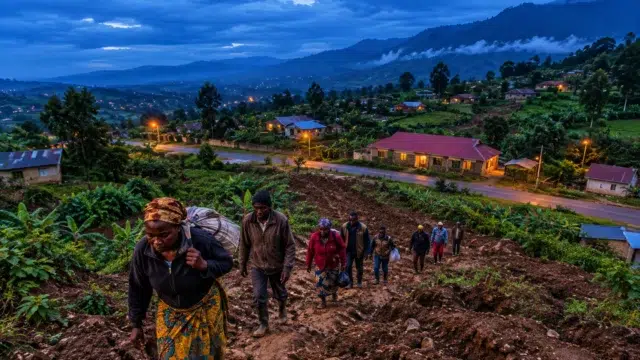
For households in the surrounding areas, the stakes are very tangible. The promised benefits come through jobs, subcontracting opportunities, compensation and new services. The risks, meanwhile, are measured in lost land, payment delays, pressure on land prices and rapid changes in local land use. In the capital, Kampala, oil is often viewed as a macroeconomic instrument. In the districts of Hoima, Kikuube and Buliisa, it is experienced first and foremost as a reshaping of the territory.
What Kampala wants to show the region
The significance extends beyond Uganda. As it moves towards its first oil, Kampala is sending a signal to the East African Community, where logistics corridors, Tanzanian ports and regional markets are becoming strategic assets. The EACOP project thus links the continent’s interior to Tanga on the Indian Ocean, and is a reminder that energy sovereignty also depends on regional cooperation. This is an important point for the EAC: integration there is not just about customs and standards, but also major infrastructure.
This stage also matters for Africa as a whole. Other producing countries have already learnt that a first barrel settles neither questions of governance nor of redistribution. The real test often begins after the ceremony: the ability to negotiate with operators, revenue transparency, the role of national companies, protection of the areas crossed and budgetary discipline. Uganda is entering this phase at a time when the continent is seeking to reconcile the development of its resources, the energy transition and demand for development.
The immediate timetable will therefore be decisive. The gradual start-up of Kingfisher, progress at Tilenga, the final EACOP works and the ramp-up of the Hoima refinery will show whether the country can turn its underground reserves into sustainable revenue. The name “Pearl Sweet” gives Ugandan crude a commercial identity. By itself, it does not guarantee that the economic story promised for Hoima and Kampala will come to pass.