Algeria
 Egypt
 Libya
 Morocco
 Sudan
 Benin
 Burkina Faso
 Cabo Verde
 Côte d'Ivoire
 Ghana
 Guinea
 Guinea-Bissau
 Liberia
 Mali
 Mauritania
 Niger
 Nigeria
 Senegal
 Sierra Leone
 The Gambia
 Togo
 Cameroon
 Central African Republic
 Chad
 DR Congo
 Equatorial Guinea
 Gabon
 Republic of the Congo
 São Tomé and Príncipe
 Burundi
 Comoros
 Djibouti
 Eritrea
 Ethiopia
 Kenya
 Madagascar
 Malawi
 Mauritius
 Mozambique
 Rwanda
 Seychelles
 Somalia
 South Sudan
 Tanzania
 Uganda
 Angola
 Botswana
 Eswatini
 Lesotho
 Namibia
 South Africa
 Zambia
 Zimbabwe
A little-known disease that reveals much about movement across the Mediterranean
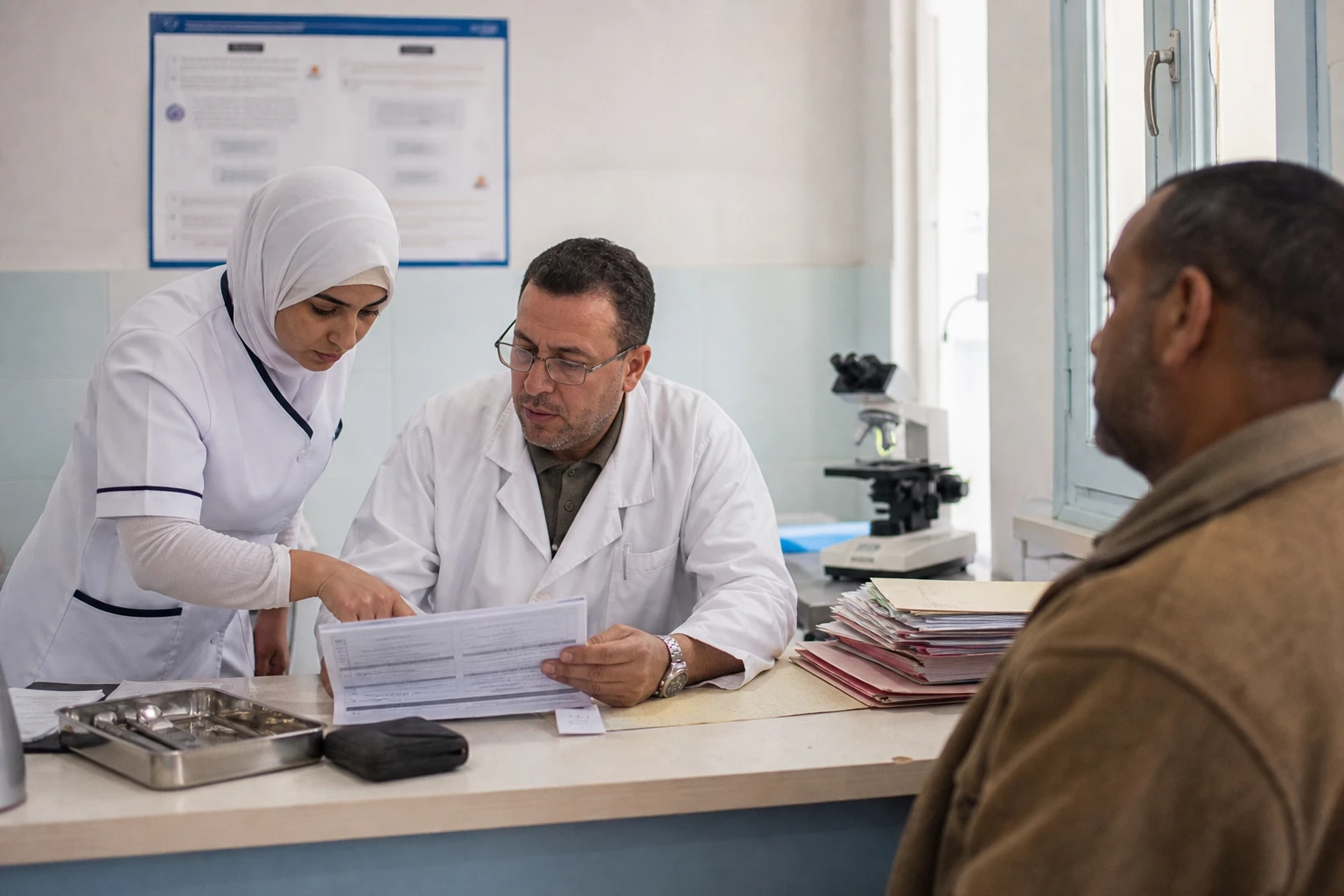
A leisure or family trip can leave more than memories. Sometimes, it also brings back an unexpected diagnosis, several weeks after the return. That is the reminder from cutaneous leishmaniasis, a parasitic infection that causes skin lesions which are often slow to appear and heal, and can leave lasting scars. The episode identified in Toulouse shows above all that a disease endemic in Tunisia can also become a surveillance issue in Europe as travel increases and clinical signals recur.
In Tunisia, the issue is not marginal. The World Health Organization classifies zoonotic cutaneous leishmaniasis caused by Leishmania major as a major public health problem in the country. The eastern Mediterranean region also considers it an important public health disease. Tunisia therefore faces a long-standing endemic disease, familiar to health services, researchers and field teams.
Central Tunisia, with Sidi Bouzid on the front line
The governorate of Sidi Bouzid, in the centre of the country, holds a particular place in this health geography. It is a long-established focus of zoonotic cutaneous leishmaniasis. Public health research has long described active circulation of the parasite there, sustained by rodent reservoirs and sandflies, the small biting insects often mistaken for mosquitoes. Historical WHO data also recall that a major outbreak hit the area as early as the 1980s, with thousands of cases in central Tunisia.
Tunisia’s epidemiological picture is more nuanced than a single focus. Sporadic forms also occur in the north, while the south-east is associated with another variant, called L. killicki or MON-8. This diversity explains why surveillance must remain detailed, local and continuous. In Tunisia, the disease cannot be reduced to a uniform national map. It follows the land, rodents, villages, farming practices and seasons.
Recent research published in Tunisia also confirms that diagnosis depends greatly on the clinical and geographical context. A Tunisian study published in 2025 notes that cases are concentrated particularly between October and January, and that better data collection could strengthen surveillance, especially in rural areas where access to diagnosis remains limited. This matters because the later a case is diagnosed, the longer it circulates in family accounts before entering the medical system.
What the alert from Toulouse shows
Between October 2025 and May 2026, 28 cases of cutaneous leishmaniasis caused by Leishmania major were diagnosed at Toulouse University Hospital. Investigations linked 24 of them to a recent stay in Tunisia, and 19 to exposure in the governorate of Sidi Bouzid. The contrast with usual activity is stark: the Toulouse department saw fewer than three cases a year on average between 2019 and 2024. The cluster is significant enough to suggest a recent intensification of transmission in central Tunisia, although this hypothesis must remain attributed as such until field data have been consolidated.
Clinically, cutaneous leishmaniasis often begins as a small papule or nodule that develops into an ulcer, particularly on exposed areas of the body. The lesion is not always painful. It can, however, last for months and then leave a permanent mark. For a child, a young adult or a woman returning to her village, the burden is not only medical. It is also social, aesthetic and sometimes professional. In rural areas of Tunisia, where outdoor work brings greater exposure to bites, the disease therefore weighs more heavily than a simple dermatology case.
The other lesson is a public health one: cases detected in France do not mean that the disease is spreading locally. Human-to-human transmission remains exceptional. The issue is imported cases, meaning patients infected before arriving in France. In other words, Toulouse observed a sentinel signal, not an outbreak of locally acquired cases. This distinction matters because it avoids confusing individual travel-related risk with the collective risk of transmission in France.
What this says about Tunisian public health and regional challenges
Leishmaniasis is shaped by very concrete factors: the presence of rodent reservoirs, sandfly density, land use, urbanisation, agricultural work, rainfall, heat and environmental changes. The WHO emphasises this complexity. In Tunisia, control measures have already helped reduce annual incidence in recent years, but the agency calls for a longer evaluation to confirm this trend. This kind of development is a reminder that vector-borne disease is rarely controlled by a single measure. It requires continuity, vigilance and fieldwork.
The African dimension of the issue also deserves emphasis. Tunisia is not alone. Morocco and Algeria also have active endemic foci. Across the Maghreb, the circulation of these parasites shows that vector-borne diseases stop neither at administrative borders nor at national narratives. They move with living environments, agricultural seasons and human mobility. For health authorities, this calls for a regional perspective, not just a national one. For travellers, it means simple prevention advice: wear covering clothing, protect against bites, and seek medical attention promptly for a persistent skin sore after a stay in an endemic area.
The continental significance is clear. When a Tunisian focus is flagged at a major European hospital, it speaks as much to mobility as to epidemiological surveillance. It is also a reminder that in North Africa, so-called “neglected” diseases remain real, documented and persistent public health issues. The next step to watch is not dramatic: it is scientific and institutional. It involves consolidating data in Tunisia, monitoring foci in the centre of the country, and ensuring health networks can quickly link a skin diagnosis to a precise geographical exposure.