Algeria
 Egypt
 Libya
 Morocco
 Sudan
 Benin
 Burkina Faso
 Cabo Verde
 Côte d'Ivoire
 Ghana
 Guinea
 Guinea-Bissau
 Liberia
 Mali
 Mauritania
 Niger
 Nigeria
 Senegal
 Sierra Leone
 The Gambia
 Togo
 Cameroon
 Central African Republic
 Chad
 DR Congo
 Equatorial Guinea
 Gabon
 Republic of the Congo
 São Tomé and Príncipe
 Burundi
 Comoros
 Djibouti
 Eritrea
 Ethiopia
 Kenya
 Madagascar
 Malawi
 Mauritius
 Mozambique
 Rwanda
 Seychelles
 Somalia
 South Sudan
 Tanzania
 Uganda
 Angola
 Botswana
 Eswatini
 Lesotho
 Namibia
 South Africa
 Zambia
 Zimbabwe
A date that weighs more heavily than an anniversary
In Tunisia, 25 July is no longer merely a day of national remembrance. It has also become a political marker. On that day in 2021, Kaïs Saïed suspended parliament, dismissed the head of government and concentrated most power in the presidency, invoking a state of constitutional exception. Five years later, the debate is no longer only about the legality of the move. It is about its tangible effects: weakened institutions, pressure on checks and balances, and eroding public trust.
Tunisia, whose capital is Tunis, was long seen as one of the few arenas of genuine political competition in the Arab world after 2011. That trajectory was upended in several stages: the suspension of parliament in 2021, the gradual sidelining of parliament as the centre of gravity, and then the reshaping of the system around a far stronger executive. In the Maghreb, Tunisia remains an important player, even though the Arab Maghreb Union has been paralysed for years and regional balances are being reshaped without it.
What happened on 25 July 2021
The turning point came on the evening of 25 July 2021. According to Reuters, Kaïs Saïed invoked the Constitution to dismiss the prime minister, freeze parliament’s work for 30 days and announce that he would govern with a new head of government. In practice, the suspension lasted far beyond the initial deadline, opening a period of power recentralisation that his opponents describe as a constitutional power grab.
At the time, the head of state was relying on a genuine political deadlock. The Assembly of the Representatives of the People was fragmented, a majority was nowhere to be found, and scenes of tension in parliament were recurring. The Covid-19 health crisis and economic decline provided the backdrop to a shift presented as a response to paralysis, but one that also redefined the institutional balance established by the 2011 revolution.
Since then, the Tunisian government has proceeded through decrees, cabinet reshuffles and revisions to the political framework. The 2024 presidential election confirmed Kaïs Saïed’s institutional foothold: the Independent High Authority for Elections declared him the winner with 90.69% of the vote, on official turnout of 28.79%. His re-election did not end the controversy. Instead, it cemented a landscape in which competition still exists, but within a profoundly unbalanced framework.
An economy under pressure, public services under strain
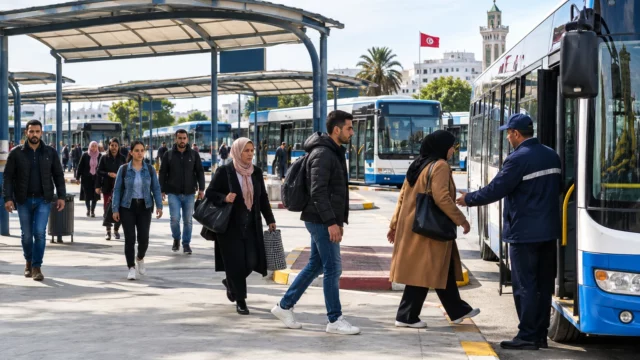
Tunisia’s malaise is not confined to politics. In July 2026, power cuts and water disruptions once again took centre stage. STEG, the state-owned electricity and gas company, announced rolling blackouts in several regions to preserve grid stability. SONEDE, the national water company, also reported disruptions in several governorates. The outages affected Greater Tunis, the North, the Centre and the South.
These announcements are not isolated incidents. They reflect structural weaknesses in infrastructure, exacerbated by the heatwave, rising demand and a lack of investment. STEG and SONEDE remain central to daily life, but also to difficult budgetary trade-offs. In the textile sector, for example, the Tunisian Federation of Textiles and Clothing itself reported a slowdown in activity linked to load-shedding. In other words, the cuts affect more than household comfort. They weigh on production, delivery times and employment.
The government has responded by seeking to take charge. On 22 July 2026, Kaïs Saïed chaired a meeting at the Carthage Palace on prolonged water and power cuts. The presidency brought together the relevant ministries, STEG, SONEDE and the civil protection service. This choice says something about Saïed’s approach: the executive presents itself as the single centre of the public response, even to problems that also stem from investment, maintenance and the governance of state-owned companies.
Opposition, unions and civil society once again on a knife-edge
In this climate, institutional and social safeguards are making their voices heard again. The UGTT, Tunisia’s major trade union federation, has called for an emergency plan to save STEG and SONEDE. The National Bar Association has also denounced the deterioration of the country’s situation. These statements matter because they show that opposition is not coming only from political parties. It is also coming from organisations that have long acted as intermediaries between the state and society in Tunisia.
The political landscape, meanwhile, remains closed and closely monitored. Amnesty International documented a worsening of violations of freedom of expression in 2026, along with prosecutions of journalists and pressure on NGOs. The organisation says Tunisia’s civic space has shrunk. Other observers, including Freedom House, also describe a marked erosion of freedoms since the 2021 shift. These assessments converge on one point: Tunisia has not left the democratic stage, but it has moved away from the pluralist framework that followed 2011.
This decline should, however, be viewed with nuance. Some of the population still sees Kaïs Saïed as a leader capable of imposing order on a system it considered paralysed. Other Tunisians, by contrast, believe the price is too high: a marginalised parliament, a judiciary more exposed to interference, media under pressure and political opponents jailed or disqualified. Polarisation has not faded. It has shifted towards questions of state effectiveness and the quality of public services.
What Tunisia says to the rest of the continent
The Tunisian case resonates beyond its borders because it touches on a central question for many African countries: what happens when a strong executive promises to restore order in the face of contested institutions? In Tunisia, the result has been a concentration of power, followed by a test of its durability: can a country be governed from the top for a long time without rebuilding checks and balances, administrative trust and public-service capacity? The answer matters beyond Tunisia. It also concerns other African democracies facing institutional fatigue and social pressure.
In the short term, the next signal to watch is still that of essential services. Water and power cuts, trade union responses, presidential inspections and STEG and SONEDE’s ability to stabilise the grid will say much about the country’s true state. In the medium term, the question remains the same as it has been since 2021: can Tunisia restore a balance between state authority, democratic oversight and public-sector effectiveness, or is it settling into a lasting system of concentrated power?