Algeria
 Egypt
 Libya
 Morocco
 Tunisia
 Benin
 Burkina Faso
 Cabo Verde
 Côte d'Ivoire
 Ghana
 Guinea
 Guinea-Bissau
 Liberia
 Mali
 Mauritania
 Niger
 Nigeria
 Senegal
 Sierra Leone
 The Gambia
 Togo
 Cameroon
 Central African Republic
 Chad
 DR Congo
 Equatorial Guinea
 Gabon
 Republic of the Congo
 São Tomé and Príncipe
 Burundi
 Comoros
 Djibouti
 Eritrea
 Ethiopia
 Kenya
 Madagascar
 Malawi
 Mauritius
 Mozambique
 Rwanda
 Seychelles
 Somalia
 South Sudan
 Tanzania
 Uganda
 Angola
 Botswana
 Eswatini
 Lesotho
 Namibia
 South Africa
 Zambia
 Zimbabwe
When cultural memory rests on a piece of fabric
An exhibition in Paris of images taken in Khartoum recalls an often-forgotten truth: cinema is not just a darkened room, but also a place for socialising, collective storytelling and urban memory. When these places disappear, it is not only a building that vanishes, but also a way of coming together, debating and seeing the country differently.
In Sudan’s case, this question has particular resonance. Khartoum long enjoyed an active cinema scene, with open-air venues that were part of everyday life, before cinemas gradually declined from the 1970s onwards and then closed amid political restrictions and a lack of investment. The conflict that erupted in April 2023 has further increased the vulnerability of Sudanese cultural heritage, already exposed to looting and destruction.
Khartoum, a cultural landscape weakened by war
Sudan is part of the wider North African region and the IGAD sphere, the intergovernmental organisation that includes the states of the Horn of Africa, among others. In this country, ravaged by war between the Sudanese army and the Rapid Support Forces, the battle is not being fought on the military front alone. It is also being fought over institutions, archives, museums, art schools and screening venues. UNESCO has confirmed extensive damage to the National Museum of Sudan in Khartoum and warned of an immediate threat to the country’s tangible and intangible heritage.
This reality sheds light on the project presented in Paris: giving visible form once again to places and images that the war has made harder to pass on. Khartoum’s filmmakers have long worked in precarious conditions, but with real ambition. The history of Sudanese cinema was shaped by pioneers such as Gadalla Gubara, often described as a founding figure, and Hussein Shariffe, a poet and filmmaker whose films combined creativity, memory and identity.
From Khartoum’s archives to works on fabric
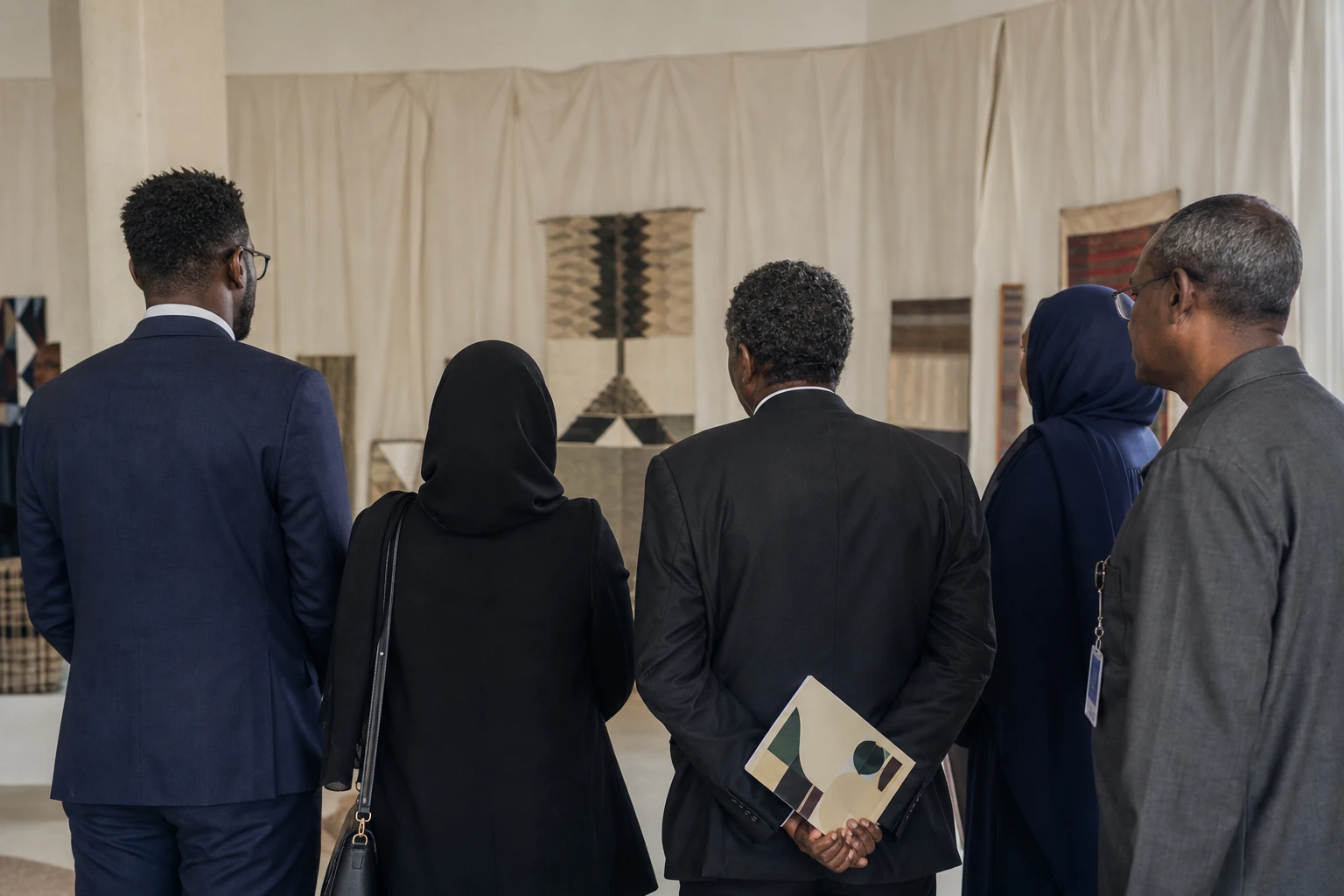
The exhibition brings together photographs taken in Khartoum in the mid-2000s, now printed on fabric. The choice of material is not decorative. It opens up another way of reading the archive: more flexible, more fragile, but also closer to oral transmission and craft. The project reinterprets familiar images by giving them a different material form, one attentive to poetry, the Arabic language and the circulation of stories.
The works are in dialogue with two Sudanese films that have become milestones in the country’s cultural history: The Dislocation of Amber, carried by the poetic voice of Ibn Al Farid, and Tajouj, directed by Gadalla Gubara and hailed as a classic of Sudanese cinema. The former belongs to a conceptual and spiritual cinema; the latter is associated with a love story shaped by tribal affiliations and rich in symbolism. In both, Sudan’s visual memory is written as much through beauty as through the tension between heritage and modernity.
The Paris festival hosting the exhibition runs from 2 to 6 September 2026, at the Goethe-Institut in Paris and La Clef Revival. Its programme features 25 films, most of them being shown in France for the first time, as well as discussions with filmmakers, researchers and critics. The photographic exhibition on fabric is presented as an additional layer of interpretation, focusing on Khartoum’s open-air cinemas, now lost amid the chaos of war.
What this project says about Sudan today
The strength of this work lies in its dual perspective. It looks back to a capital that once had bustling public spaces and cinemas open to families, students and the curious. But it also looks at the present: a country where heritage is no longer damaged by time alone. It is under threat from fighting, forced displacement and institutional collapse. UNESCO has spoken of destruction, looting and the risk of illicit trafficking. This means Sudanese culture is not just losing buildings. At times, it is losing physical evidence, landmarks and archives.
For Sudanese people, the issue goes beyond nostalgia. In the capital and provincial cities alike, war has squeezed public space and reduced places to meet. Artists, meanwhile, are seeking ways to sustain continuity. In this context, fabric becomes a meaningful medium: it preserves the idea of the fragment, displacement and repair. It also serves as a reminder that Sudanese culture cannot be reduced to war or exile. It draws on languages, rhythms, images, crafts and forms of transmission that endure even as infrastructure collapses.
A reach that extends beyond Paris
The exhibition also points to a broader question for the continent: how can artistic memories be preserved when political and military crises displace populations and disrupt cultural institutions? Sudan’s experience resonates beyond Khartoum. It raises questions about African strategies for safeguarding archives, the circulation of works between the continent and the diaspora, and how festivals can provide spaces for continuity when local cultural scenes are shattered.
In this respect, the Paris dates matter as much as the symbolism. By bringing together films, debates and textile works, the organisers present a Sudan that is vibrant, literate, passionate about cinema and inventive, far removed from reductive portrayals. What happens next will depend less on a single gesture than on the ability of artists, archivists and institutions to preserve the physical traces of this history, while the country continues to search for a political way out of the war.