
 Algeria
 Egypt
 Libya
 Morocco
 Sudan
 Tunisia
 Benin
 Burkina Faso
 Cabo Verde
 Côte d'Ivoire
 Ghana
 Guinea
 Guinea-Bissau
 Liberia
 Mali
 Mauritania
 Niger
 Nigeria
 Senegal
 Sierra Leone
 The Gambia
 Togo
 Cameroon
 Central African Republic
 Chad
 DR Congo
 Equatorial Guinea
 Gabon
 Republic of the Congo
 São Tomé and Príncipe
 Burundi
 Comoros
 Djibouti
 Eritrea
 Ethiopia
 Kenya
 Madagascar
 Malawi
 Mauritius
 Mozambique
 Rwanda
 Seychelles
 Somalia
 South Sudan
 Tanzania
 Uganda
 Angola
 Botswana
 Eswatini
 Lesotho
 Namibia
 Zambia
 Zimbabwe
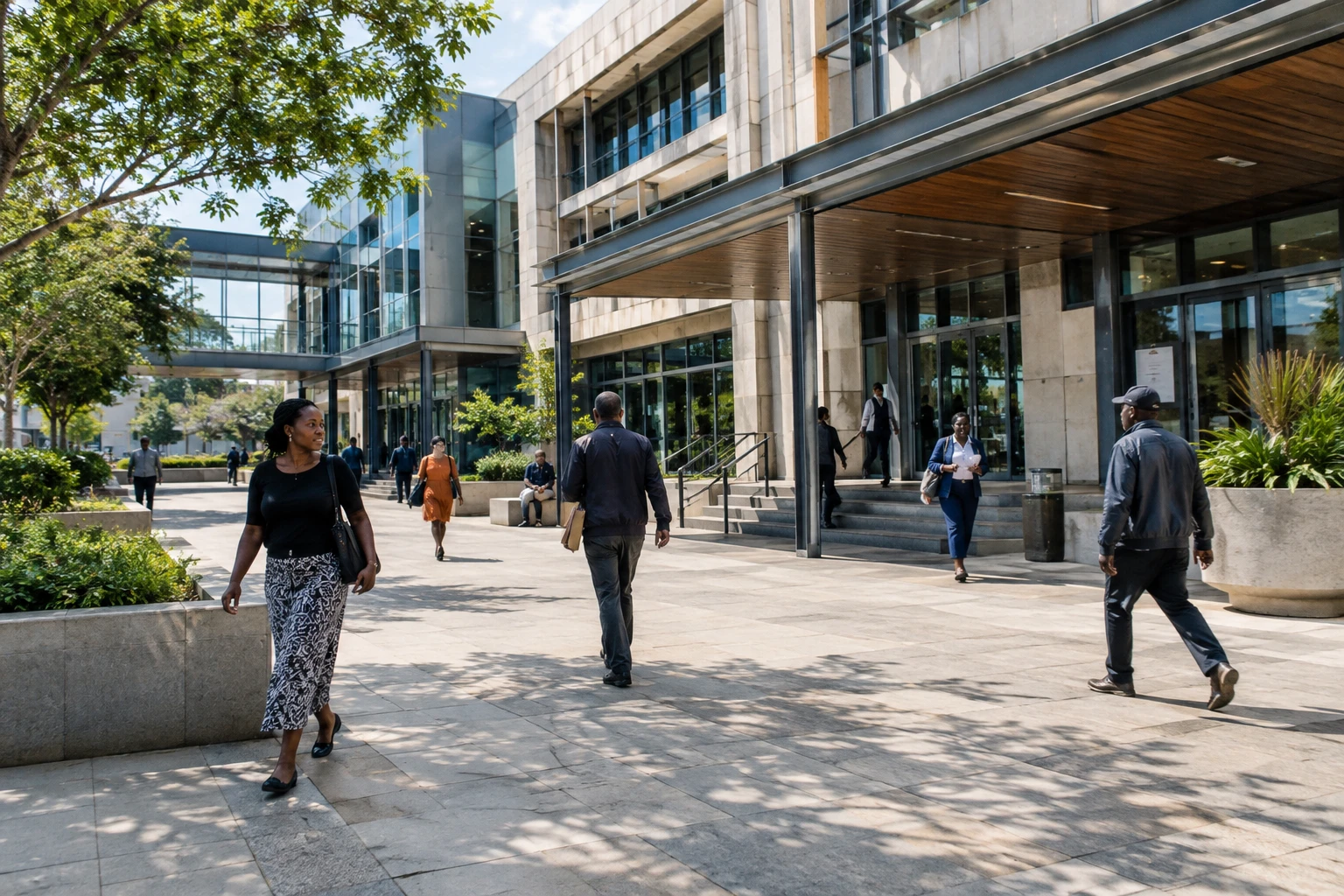
Municipal elections have a daily impact: on access to water, the state of roads, rubbish collection and transport management. In South Africa, early counts from the 4 November 2026 elections suggest voters are punishing the ANC, without giving any one party a decisive lead.
A local vote in a transformed political landscape
Municipal councils decide on essential services and approve budgets that directly affect residents. Their composition can also force parties to negotiate coalitions — agreements to govern together when none has a majority of seats on its own.
The vote comes after a national rupture. In 2024, the African National Congress (ANC), in power since the end of apartheid in 1994, lost its absolute majority in the general election. It subsequently formed a government of national unity with the Democratic Alliance (DA) and other parties. Its loss of support is therefore no longer just a possibility at national level: it is now being measured in the contest for municipal councils.
Regionally, South Africa is a member of the Southern African Development Community (SADC), which brings together states in the region around economic and political cooperation. The continuity of its electoral institutions and the ability of its councils to function are therefore also of interest to its neighbours, even though municipal results do not directly determine the country’s foreign policy.
Results still provisional, but a clear political signal
South Africans voted on Wednesday 4 November. At the time of the count reported on 6 November, more than two-thirds of ballots had been counted. Results remained partial: they were neither a final declaration nor a uniform picture of every region.
In data available after 71% of ballots had been counted, the ANC had around 32% of the vote, according to figures attributed to the Independent Electoral Commission (IEC). The party remained in the lead nationally, but its projected score of around 31.5% from the Council for Scientific and Industrial Research (CSIR), a public research body, would mark an unprecedented decline. This projection is based on incomplete results and may change.
The CSIR put the DA at around 25.5%. The party was in second place in this estimate. The MK Party, founded by former president Jacob Zuma, was credited with about 9%. These broad figures should be read as projections, not final results. South African public broadcaster SABC also reported initial CSIR projections of close to 32% for the ANC, 26% for the DA and 9% for the MK Party.
Comparison with previous elections puts the significance of the signal into perspective. The ANC had already fallen to 40% in the 2024 general election, after losing its absolute majority for the first time. The downward trend is part of a longer sequence, but municipal elections concern different issues: they also reward or punish local councils for the practical management of services.
Major cities, testing grounds for coalitions
The vote is being closely watched in major urban areas, where local balances of power may differ from the national average. In Cape Town, mayor Geordin Hill-Lewis, the DA leader, claimed victory. The CSIR estimated that his party was approaching 56% of the vote there. This provisional estimate would strengthen the DA’s position in a city it already governs.
In Durban, in KwaZulu-Natal province, the MK Party was expected to be a major contender. Yet the CSIR projection reported in the early results gave it only around 32% in the metropolitan area. This figure alone was not enough to conclude who would lead the council: seat totals, final results and any agreements between parties also matter.
In Johannesburg and Pretoria, the country’s economic and political capitals, the fragmentation of the vote made coalitions likely. Johannesburg was governed by a coalition before the election, as were many South African municipalities. Negotiations over positions and budget priorities could therefore matter as much as the parties’ national ranking.
For residents, the issue is not simply who emerges as the leading party. A coalition can broaden representation, but it must also reach agreement on budgets, municipal officials and public service decisions. Conversely, fragile alliances can delay decisions. The effects will not be the same everywhere: urban neighbourhoods, rural areas and small municipalities face different needs and have different administrative capacities.
Turnout between two benchmarks
Turnout was reported at 54.45%. It was higher than the 2021 level of 45.86%, during the Covid-19 pandemic, but remained below the 57.95% recorded in 2016. These figures, reported in information available on the election, point to stronger participation than at the previous municipal vote, but not a return to the level of ten years earlier.
Turnout alone does not explain why some voters went to the polls or stayed at home. It does, however, underscore that councils’ legitimacy also depends on parties’ ability to persuade voters beyond their core support. In a country where local voting directly affects everyday services, abstention and the dispersal of votes are part of the political context.
What the vote signals — and what it does not decide
The ANC’s projected decline sharpens a question that has been open since 2024: can the party retain its central role while sharing power more widely, or will voters continue to redistribute their support among several opposition parties? For the DA, the second-largest force according to projections, the challenge is to turn its results into municipal administrations capable of meeting local expectations. For the MK Party, the vote measures the true extent of its support beyond its strongholds.
The result does not directly predict the next national elections, and an early projection is no substitute for the official count. But it provides a political indicator to watch for parties in the government of national unity as well as their rivals. What happens next will depend on the IEC finalising the results and on agreements reached in councils without a clear majority. It is in these negotiations, and then in the management of services, that the municipal verdict will fully take shape.



