Algeria
 Egypt
 Libya
 Morocco
 Sudan
 Tunisia
 Benin
 Burkina Faso
 Cabo Verde
 Côte d'Ivoire
 Ghana
 Guinea
 Guinea-Bissau
 Liberia
 Mali
 Mauritania
 Niger
 Nigeria
 Senegal
 Sierra Leone
 The Gambia
 Togo
 Cameroon
 Central African Republic
 Chad
 DR Congo
 Equatorial Guinea
 Gabon
 Republic of the Congo
 São Tomé and Príncipe
 Burundi
 Comoros
 Djibouti
 Eritrea
 Ethiopia
 Kenya
 Madagascar
 Malawi
 Mauritius
 Mozambique
 Rwanda
 Seychelles
 Somalia
 South Sudan
 Tanzania
 Uganda
 Angola
 Botswana
 Eswatini
 Lesotho
 Namibia
 Zambia
 Zimbabwe
Official recognition is not enough to protect a woman or move an investigation forward. That was the message delivered on Saturday 21 November 2026 in Johannesburg, where demonstrators again called on the South African government to take concrete action against gender-based violence and femicide.
A year after the declaration, pressure returns to the streets
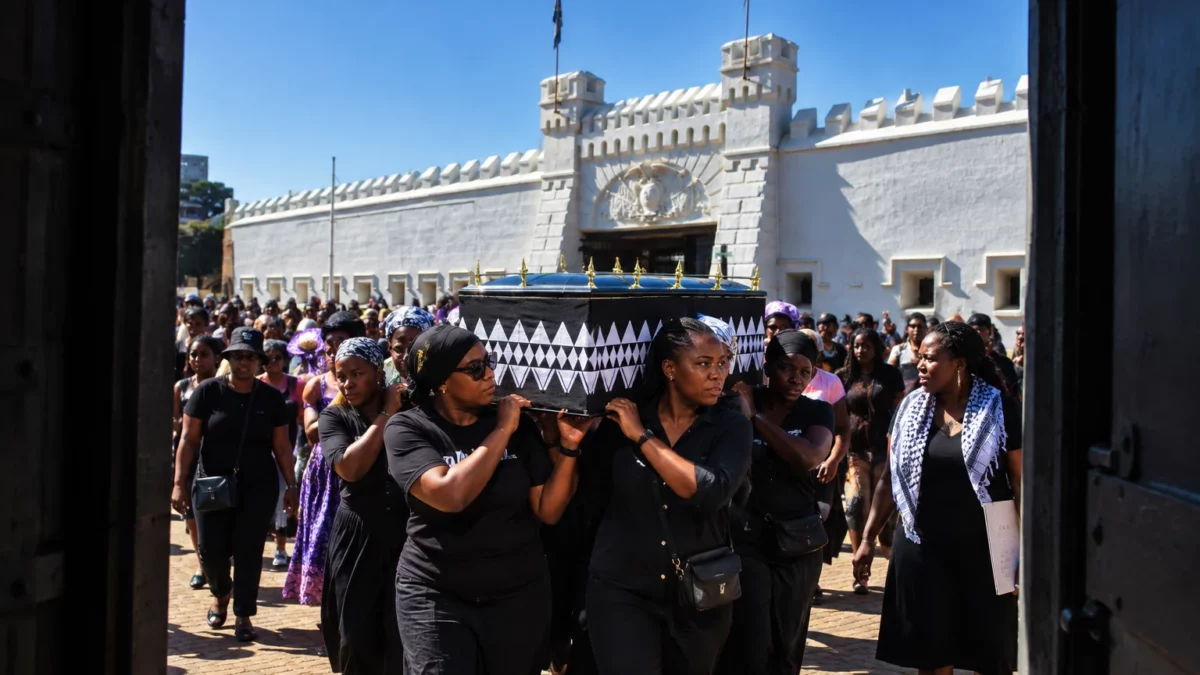
In Johannesburg, a symbolic procession linked the University of the Witwatersrand to Constitution Hill. Participants accompanied a black and purple coffin in tribute to women and children who had been killed. The action was part of a national mobilisation led by Women for Change, with gatherings planned in all nine provinces.
The date was chosen to recall 21 November 2025, when a major mobilisation put gender-based violence at the centre of public debate on the eve of the G20 summit hosted by South Africa. The government then classified the violence as a national disaster. The formal declaration was published in the Government Gazette on 24 November 2025.
For activists, the decision has yet to bring the changes they expected in everyday life. The movement is demanding measurable targets, clearly assigned responsibilities and resources tracked over time. At Constitution Hill, its representatives were due to hand a letter of demands to the authorities. Women for Change describes the mobilisation as a call for accountability a year after the state of emergency was declared.
The scene described by South African media combined tribute with political confrontation. Survivors and relatives of victims spoke. The Minister for Women, Youth and Persons with Disabilities, Sindisiwe Chikunga, defended the government’s actions, but her remarks were met with boos. Demonstrators denounced the gap between official announcements and the results they see.
A national emergency, shared responsibilities
Classification as a national disaster is intended to enable a coordinated response involving the state, provinces and municipalities. It is not, however, a programme in itself, nor a guarantee that funding will automatically reach frontline services. The announced plan must translate into resources available at police stations, courts, health facilities and shelters for survivors.
The debate is now about how to measure action. A parliamentary response reported by the South African press says that the plan approved by Cabinet contains no precise numerical targets. The government, for its part, says it is accelerating implementation and points to a range of funding and measures intended in particular to strengthen investigations, specialised courts and support centres. These announcements alone do not establish which services have already received resources or what results have been achieved.
The available figures also call for caution. The slogan that 15 women are killed every day, repeated at the demonstrations, serves as a reference point for organisers. It does not necessarily correspond to a verified, consistent daily count of femicides. Studies by the South African Medical Research Council instead estimate that about three women a day are killed by an intimate partner. The two figures do not necessarily measure the same category of violence. The lack of data that can be quickly compared makes it harder to monitor public policies.
For families, the emergency often comes after the violence: the quality of the response when a complaint is filed, the preservation of evidence, the progress of the investigation and delays in court. For survivors, access to healthcare, safe accommodation and legal support may depend on where they live. Urban services and rural areas do not always have the same resources. Informal-economy workers, who cannot easily take time off without losing income, also face particular obstacles.
From the national framework to Southern African concerns
South Africa, whose capital is Pretoria, is a major player in the Southern African Development Community (SADC), a regional organisation for political and economic cooperation. Gender-based violence does not stop at borders: prevention, access to justice and support for people moving around the region require accessible services and cooperation between institutions.
The country also hosted the G20 in 2025, giving the demands of local organisations international visibility. But the impact of this moment will be measured above all at national level: the authorities will need to make budgets, responsibilities and progress clear. Declarations of principle do not help families waiting for an investigation or a trial.
The government points to a plan and announced investments; associations are calling for verifiable targets and faster implementation. This difference in perspective will not be resolved by another declaration of emergency. It will be measured in police statistics, court rulings and the ability of services to protect people before, during and after an assault. The 21 November mobilisation thus puts a specific question back at the centre of South African debate: how can national-disaster status be turned into results that women can see?