Algeria
 Egypt
 Libya
 Morocco
 Sudan
 Tunisia
 Benin
 Burkina Faso
 Cabo Verde
 Côte d'Ivoire
 Ghana
 Guinea
 Guinea-Bissau
 Liberia
 Mali
 Mauritania
 Niger
 Nigeria
 Senegal
 Sierra Leone
 The Gambia
 Togo
 Cameroon
 Central African Republic
 Chad
 DR Congo
 Equatorial Guinea
 Gabon
 Republic of the Congo
 São Tomé and Príncipe
 Burundi
 Comoros
 Djibouti
 Eritrea
 Ethiopia
 Kenya
 Madagascar
 Malawi
 Mauritius
 Mozambique
 Rwanda
 Seychelles
 Somalia
 South Sudan
 Tanzania
 Uganda
 Angola
 Botswana
 Eswatini
 Lesotho
 Namibia
 Zambia
 Zimbabwe
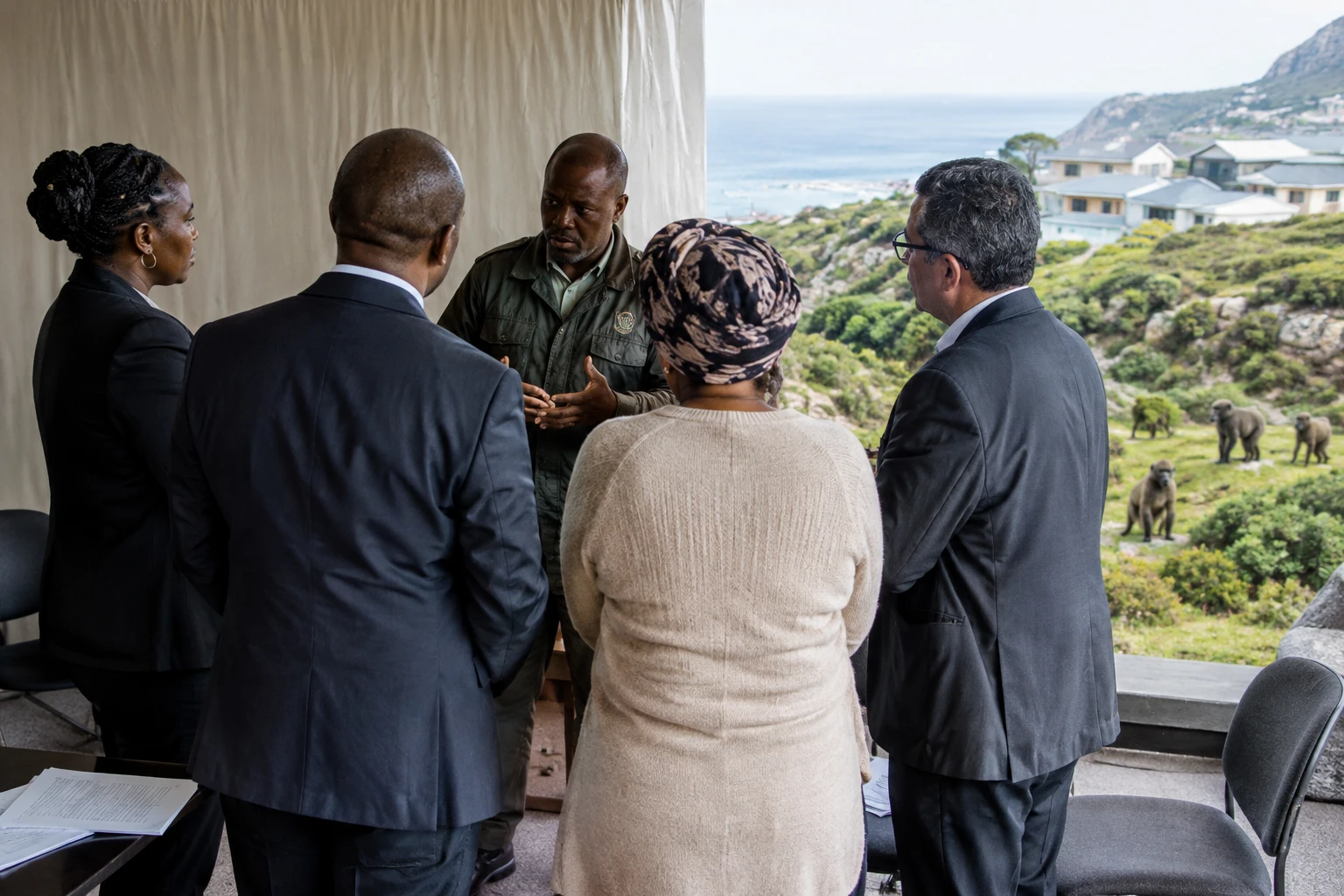
In Simon’s Town, on the Cape Peninsula, the issue goes beyond the contents of rubbish bins or windows left open. It pits two practical priorities against each other: protecting residents from baboon incursions and preserving the freedom of wild animals whose habitat borders the town.
The City of Cape Town has chosen a solution that does not satisfy everyone. In South Africa, the debate is also testing the authorities’ ability to manage wildlife in a place where residential neighbourhoods meet the natural environment.
A town built on the edge of natural habitat
Simon’s Town lies south of Cape Town, in the Western Cape province. The town is backed by the hills of the peninsula and Table Mountain National Park. For chacma baboons, these hills offer habitat close to urban resources. For residents, that proximity can mean visits to their homes.
The case falls under a joint arrangement involving three institutions: the City of Cape Town, the national parks agency SANParks and the provincial body CapeNature. Their joint team, the Cape Peninsula Baboon Management Joint Task Team, coordinates the management of baboon troops on the peninsula. Its strategic plan aims to maintain a free-ranging population while reducing daily contact and conflict with humans.
This coordination takes place in a national context in which conservation falls under several levels of government. It also has a regional dimension: South Africa is part of the Southern African Development Community (SADC), which encourages cooperation between states on biodiversity and natural environments. Here, however, the decision is being made primarily at local level.
Two troops affected by the plan
About 60 chacma baboons live in two groups, or troops, around Simon’s Town. They come down from the hills to look for food and return to higher ground at night. Residents report break-ins and damage. Peter Willis, a resident, said a troop had turned his home upside down after entering through an open window.
The authorities want to move the two troops into semi-wild enclosures near Scarborough, a neighbouring town. According to information released about the project, the areas would be surrounded by electric fences and the animals would be monitored continuously. Gregg Oelofse, a member of the management team, describes this option as a last resort, designed to keep the troops in conditions considered acceptable for their welfare.
Animal advocates oppose the plan. They fear the baboons could injure themselves trying to cross the fences and denounce a form of captivity that could last for the rest of their lives. Shirley Windell, an opponent of the project, says they should not be confined, sterilised and kept in enclosures. The authorities, meanwhile, say they want to avoid escalating control measures in response to repeated incursions.
The disagreement is therefore not only about where the animals will live. It also concerns the acceptable level of risk, what constitutes a sufficiently natural habitat, and the weight given to the concerns of residents affected by the incursions.
Waste management also matters
Across the Cape Peninsula, nearly 500 baboons in about a dozen troops frequent the edges of urban areas, according to figures cited in the case file. The situation in Simon’s Town is therefore a local expression of a wider problem: animals can access food that is easy to find in homes, gardens or rubbish.
Accessible food alone does not explain every incursion. But it makes neighbourhoods more attractive to opportunistic animals. Managing bins, securing homes and shaping the boundaries between the town and natural habitat are therefore among the possible measures. Research conducted in Cape Town has also examined the effects of human interventions and monitoring systems on baboon movements.
Responsibility is shared, but the consequences are not distributed equally. Residents must protect their homes and bear any damage. The authorities must ensure public safety and implement their conservation policy. Baboons, for their part, cannot distinguish a natural food source from an accessible refrigerator.
A closely watched decision
The Simon’s Town project forms part of a wider management plan approved by the City of Cape Town, SANParks and CapeNature. The plan also provides for preventative measures, including fences intended to keep baboons away from residential areas, better waste management and enforcement of local rules. The authorities say they want to maintain a free-ranging population with fewer conflict-ridden interactions, but moving the two troops raises a practical question: how can the animals’ welfare in the enclosures be monitored over the long term?
Monitoring will need to assess their adjustment, health and risk of injury, as well as whether incursions in Simon’s Town actually decline. Transparency about the results and the role given to residents, researchers and associations will affect public confidence in the scheme.
Across southern Africa, the case illustrates an issue likely to arise in other towns near protected areas: how can territory be shared without making residents bear the entire cost of coexistence or reducing conservation to keeping animals at a distance? In Simon’s Town, the answer will depend as much on the day-to-day management of urban resources as on what happens to the two troops.
The management framework is set out by SANParks in its strategic plan for baboons on the Cape Peninsula. The City of Cape Town also outlines the measures in its action plan on fencing, waste and wildlife management.