Algeria
 Egypt
 Libya
 Morocco
 Sudan
 Tunisia
 Benin
 Burkina Faso
 Cabo Verde
 Côte d'Ivoire
 Ghana
 Guinea
 Guinea-Bissau
 Liberia
 Mali
 Mauritania
 Niger
 Nigeria
 Senegal
 Sierra Leone
 The Gambia
 Togo
 Cameroon
 Central African Republic
 Chad
 DR Congo
 Equatorial Guinea
 Gabon
 Republic of the Congo
 São Tomé and Príncipe
 Burundi
 Comoros
 Djibouti
 Eritrea
 Ethiopia
 Kenya
 Madagascar
 Malawi
 Mauritius
 Mozambique
 Rwanda
 Seychelles
 Somalia
 South Sudan
 Tanzania
 Uganda
 Angola
 Botswana
 Eswatini
 Lesotho
 Namibia
 Zambia
 Zimbabwe
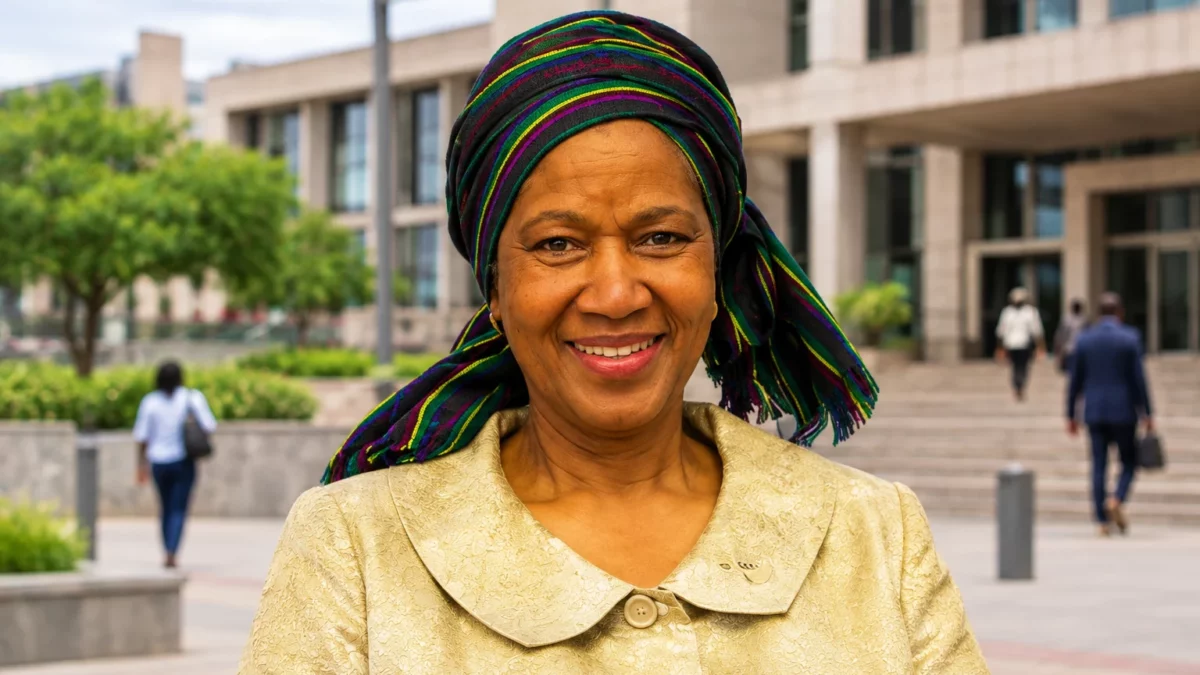
In South Africa, Phumzile Mlambo-Ngcuka held positions long reserved for men. The country’s first female deputy president, she later led UN Women. Her death, announced on Friday 20 November 2026, has brought a broader question back to the fore: how can gains in representation be turned into tangible equality for women?
A career forged in the struggle and in institutions
Born in 1955, Mlambo-Ngcuka campaigned against apartheid before entering the institutions of the new South Africa. A trained teacher, she joined Parliament after the first democratic elections in 1994. She went on to serve as deputy minister of trade and industry, then as minister of mineral resources and energy.
In June 2005, President Thabo Mbeki appointed her deputy president. She became the first woman to hold the position and remained in office until September 2008. This period unfolded amid fierce tensions within the ruling African National Congress (ANC). She succeeded Jacob Zuma, whom Mbeki had removed from the deputy presidency. This political transition is a reminder that appointments at the highest level also reflect the balance of power and rivalries within the dominant party.
Her career is part of the distinctive history of a country that enshrined equality in its Constitution after the end of apartheid. But the presence of women in institutions is not enough to erase social and economic inequalities. Their access to decision-making positions remains tied to political parties, public administrations and available resources.
From Pretoria to the international stage
From 2013 to 2021, Mlambo-Ngcuka led UN Women, the United Nations agency tasked with promoting women’s rights and gender equality. She also held the rank of UN under-secretary-general. In this role, she championed representation and empowerment in international debates, with particular attention to women and girls affected by conflict and displacement.
The South African presidency announced her death on 20 November. Her family said she had died aged 71, following complications related to a medical procedure she had undergone about two weeks earlier. President Cyril Ramaphosa paid tribute to a leader whose work had extended beyond national borders. UN Secretary-General António Guterres also honoured her longstanding commitment to the rights of women and girls.
News of her death was reported by the presidency and the South African public news agency SAnews. Public broadcaster SABC also covered the tributes and funeral arrangements. Acting Deputy President Paul Mashatile announced a special category official funeral. A joint tribute with the family is planned in Johannesburg on Tuesday 24 November, followed by the funeral on Saturday 28 November, in the Eastern Cape province.
A legacy to be measured beyond the tributes
The significance of her career lies in her movement between several spheres of power: the anti-apartheid movements, the South African government and the United Nations. This experience enabled her to bring national issues to a global forum. It also showed that African women leaders are not merely represented in international debates: they can set their priorities.
Her legacy, however, cannot be reduced to the positions she held or statements of support. Equality is shaped by budgets, access to education and employment, protection from violence and the role women have in decision-making. Leadership announcements should therefore be judged by how they translate into everyday life, in major cities as well as in regions less connected to political and economic centres.
This distinction also matters at the regional level. South Africa is a member of the Southern African Development Community (SADC), an organisation bringing countries in the region together for cooperation and integration. The careers of women leaders can inform exchanges between states, but policies and outcomes vary from one country to another. There is no single African experience of equality.
A national figure with continental resonance
Tributes from South Africa and the United Nations have highlighted a career whose milestones are now established: the struggle against apartheid, the country’s first female deputy president, and then the leadership of UN Women. In Southern Africa, her career is part of a political history in which formal rights and representation have advanced, without eliminating all inequalities.
In the coming days, ceremonies in Johannesburg and the Eastern Cape will give public form to the grief. Beyond the funeral, the question will be how South African and regional institutions carry forward the principles she championed. Her career leaves political leaders with a practical question: who gains access to decision-making spaces, and what changes does that presence bring about for women and girls?