Algeria
 Egypt
 Libya
 Morocco
 Sudan
 Tunisia
 Benin
 Burkina Faso
 Cabo Verde
 Côte d'Ivoire
 Ghana
 Guinea
 Guinea-Bissau
 Liberia
 Mali
 Mauritania
 Niger
 Nigeria
 Sierra Leone
 The Gambia
 Togo
 Cameroon
 Central African Republic
 Chad
 DR Congo
 Equatorial Guinea
 Gabon
 Republic of the Congo
 São Tomé and Príncipe
 Burundi
 Comoros
 Djibouti
 Eritrea
 Ethiopia
 Kenya
 Madagascar
 Malawi
 Mauritius
 Mozambique
 Rwanda
 Seychelles
 Somalia
 South Sudan
 Tanzania
 Uganda
 Angola
 Botswana
 Eswatini
 Lesotho
 Namibia
 South Africa
 Zambia
 Zimbabwe
An institutional standoff at the heart of Dakar
In Senegal, the debate over special funds is about more than budget lines. It touches on a broader question: who controls the state’s grey areas, and how far can Parliament go when it seeks to impose greater transparency? In Dakar, this battle also reflects the new architecture of power that emerged from the political reshuffle of 2024 and the balance of forces between the executive and the National Assembly.
In a country where budget governance remains a central issue, the transparency of public spending is closely scrutinised, including by oversight bodies such as the Court of Accounts. The Constitutional Council, for its part, states on its website that its role is to ensure compliance with the Constitution and the balance of powers.
What the Constitutional Council decided
On Tuesday 25 August 2026, the Constitutional Council declared inadmissible a bill seeking to regulate special appropriations, often called “special funds” or “slush funds”. The high court ruled that the procedures for committing, settling, authorising, paying, accounting for and auditing these appropriations fell within a remit delegated to the regulatory power, rather than within the domain of legislation.
The government referred the matter to the Council on 18 August, before the bill was considered in plenary session. According to information published by APS, the executive argued that certain provisions encroached on matters reserved for regulation, particularly in light of Articles 67 and 76 of the Constitution.
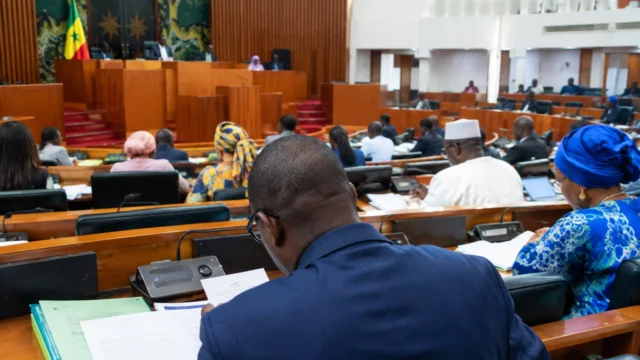
The National Assembly, for its part, had pressed ahead with the initiative led by the Pastef parliamentary majority. The bill sought to regulate appropriations held by the presidency and strengthen oversight of funds that had previously been managed without detailed public accounting.
This is not the Constitutional Council’s first intervention in this institutional dispute. On 9 July 2026, it had already struck down Law No. 18/2026 revising the Constitution, which the National Assembly adopted on 29 June 2026. Once again, the constitutional court has ruled on a dispute over institutional powers.
Why the decision matters politically
The significance of this decision goes beyond legal technicalities. It comes amid a reshaping of power in Dakar, where President Bassirou Diomaye Faye and his former prime minister Ousmane Sonko are no longer speaking with one voice. Ousmane Sonko, now president of the National Assembly, had championed the bill on special appropriations, giving it considerable political weight within the ruling camp.
For the executive, the stakes are twofold. On the one hand, it wants to preserve room for manoeuvre over sensitive spending, often linked to security, diplomacy or certain sovereign functions. On the other, it must avoid an institutional battle creating the impression of a government divided over how to manage public finances. The fact that Prime Minister Ahmadou Al Aminou Lo referred the matter to the Council shows that the government’s line of defence now runs through constitutional law.
The National Assembly sees things differently. Majority MPs present the bill as a step towards greater transparency. Their approach reflects a strong expectation among Senegalese public opinion: to understand better how public money is spent. In this debate, Parliament is seeking to widen its oversight remit, but is running up against the established division of powers between legislation and regulation.
The issue is not purely symbolic. Senegal has embarked on several budget reform initiatives, with the 2026 budget presented as a tool for recovery and transformation under the Senegal 2050 Vision. In this context, any debate over special funds directly affects the credibility of the promise of good governance.
A Senegalese tension with wider West African resonance
Beyond Dakar, the case is of interest across West Africa. In the ECOWAS region, budget transparency and parliamentary oversight regularly return to the agenda, especially in countries seeking to rebuild trust between institutions and citizens. Senegal, often portrayed as an institutionally stable democracy in the region, is seeing its own balance tested at a time when its authorities are promising to overhaul public governance.
This episode also highlights a familiar reality across the continent: transparency often advances in fits and starts, shaped by decisions over the balance between the executive, parliament and constitutional courts. When the law is invoked to define the boundaries of power, it becomes a central instrument of political regulation. In Senegal, the Constitutional Council has once again emerged as the final arbiter.
The next political milestone will show the decision’s practical effect. The policy statement scheduled for 1 September 2026 is expected to set out the government’s roadmap before a National Assembly aligned with Ousmane Sonko. The coming period will show whether the conflict remains confined to parliamentary law or spills over into the day-to-day conduct of public affairs.
In West Africa, where debates over public accountability increasingly shape governments’ legitimacy, Senegal is thus presenting a major institutional test. The decision of 25 August 2026 does not close the matter. Above all, it draws a boundary. And in a country where the demand for transparency has become a powerful political marker, that boundary will shape the decisions to come.